

On this page
Hydrocarbons is Unit 9 of the CBSE 2026-27 Class XI Chemistry curriculum, worth 10 of the 70 theory marks. Class 11 papers are set by schools, so treat these three original cases as case-based practice, not a prediction of your paper. Answers follow the rationalised NCERT Chemistry Part II, Unit 9 (Reprint 2026-27). For the full chapter, start with our Hydrocarbons Class 11 guide.
Case 1: How much ethyne does a carbide generator give?
A fabrication workshop in Ludhiana makes its own ethyne for gas welding. Water drips slowly onto lumps of calcium carbide in a closed generator. One morning the owner loads 640 g of commercial carbide that is 80% calcium carbide by mass (CaC2, molar mass 64 g/mol); the rest does not give any gas. A white sludge collects in the tank. His daughter, in Class 11, wonders why ethyne reacts with sodium metal but ethene does not.
(i) The hybridisation of each carbon atom in ethyne and its H–C–C bond angle are: (a) sp3, 109.5° (b) sp2, 120° (c) sp, 180° (d) sp, 120°.
(ii) Write the equation for the reaction in the generator and name the white sludge.
(iii) Calculate the mass of ethyne (molar mass 26 g/mol) this load can give.
(iv) Why does ethyne react with sodium to release hydrogen while ethene does not? Would but-2-yne react the same way?
Answers.
(i) (c). Each carbon is sp hybridised, so ethyne is linear with a bond angle of 180°.
(ii) CaC2 + 2H2O → Ca(OH)2 + C2H2. The sludge is calcium hydroxide, Ca(OH)2.
(iii) Pure CaC2 = 640 × 0.80 = 512 g, which is 512 / 64 = 8.00 mol. One mole of CaC2 gives one mole of C2H2, so ethyne = 8.00 × 26 = 208 g.
(iv) An sp orbital has 50% s character, so the sp carbon in ethyne is more electronegative than the sp2 carbon in ethene. It pulls the C–H bond pair closer, and the hydrogen leaves as a proton more easily, giving sodium ethynide and H2. But-2-yne has no hydrogen on a triply bonded carbon, so it would not react.
Case 2: How do you make cis and trans hex-3-ene?
A Hyderabad lab needs both geometrical isomers of hex-3-ene, CH3CH2CH=CHCH2CH3. A chemist reduces 4.10 g of hex-3-yne (molar mass 82 g/mol) with a calculated amount of hydrogen over Lindlar's catalyst and gets isomer P. A second batch, reduced with sodium in liquid ammonia, gives isomer Q. Both decolourise the reddish orange colour of bromine in carbon tetrachloride. P has a small dipole moment and Q's is almost zero. Ozonolysis of each, with Zn and water, gives the same single product.
(i) Lindlar's catalyst is: (a) finely divided nickel (b) palladised charcoal partially deactivated with sulphur compounds or quinoline (c) anhydrous aluminium chloride (d) zinc dust in water.
(ii) Which isomer, P or Q, is cis-hex-3-ene?
(iii) Find the mass of hydrogen needed for the first batch, and the mass of the ozonolysis product from 4.20 g of P (hex-3-ene, 84 g/mol; propanal, 58 g/mol).
(iv) Why can ozonolysis not tell P from Q? Name a physical property that tells them apart, and explain it.
Answers.
(i) (b).
(ii) P. Lindlar's catalyst gives cis alkenes; sodium in liquid ammonia gives trans alkenes.
(iii) 4.10 / 82 = 0.0500 mol of alkyne needs 0.0500 mol of H2, or 0.0500 × 2 = 0.100 g. 4.20 / 84 = 0.0500 mol of P gives two moles of propanal per mole, 0.100 mol, so 0.100 × 58 = 5.80 g.
(iv) Ozonolysis breaks the double bond, so the geometry around it is lost: both isomers give only propanal. Dipole moment tells them apart. In the trans isomer the two ethyl groups point in opposite directions and their bond dipoles cancel, so Q is almost non-polar; in the cis isomer they do not cancel. As solids, the trans isomer also melts higher.
Case 3: Where does nitration go on toluene and nitrobenzene?
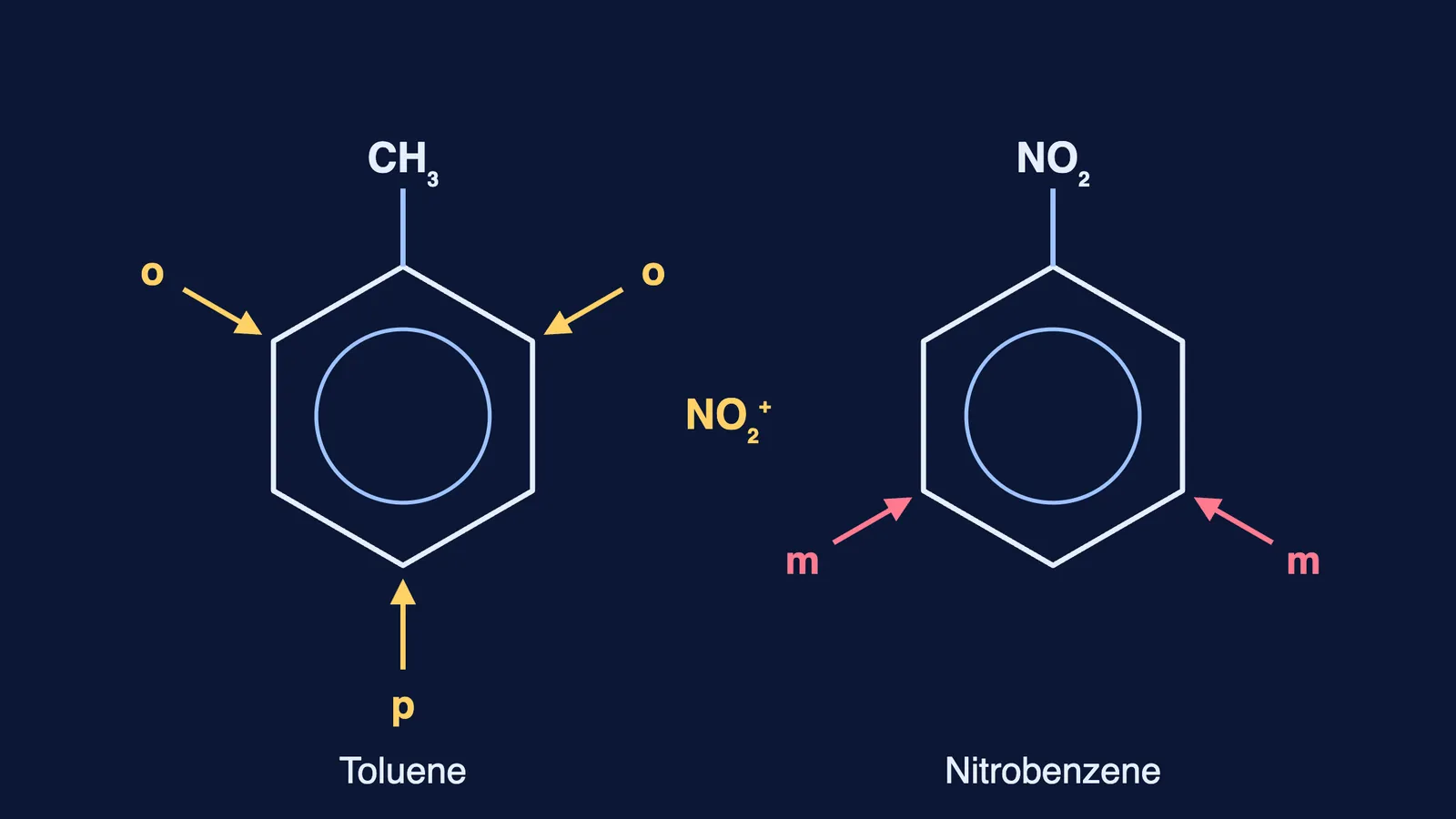
A dye-intermediates unit in Vapi, Gujarat, runs two reactors with nitrating mixture (concentrated nitric and sulphuric acids). Reactor A nitrates toluene, which reacts at a lower temperature than benzene, giving mononitrotoluenes. Reactor B turns nitrobenzene into a dinitrobenzene, but needs a stronger acid mixture and more heat than benzene, and still reacts more slowly. In one shift, Reactor B is fed 24.6 kg of nitrobenzene (molar mass 123 g/mol) and gives 28.56 kg of dinitrobenzene (molar mass 168 g/mol).
(i) The electrophile that attacks the ring in both reactors is: (a) NO2⁻ (b) NO2⁺ (c) HSO4⁻ (d) H3O⁺.
(ii) Name the main products of Reactor A and of Reactor B.
(iii) Calculate the percentage yield of Reactor B.
(iv) Using electron density in the ring, explain why toluene reacts more easily than benzene while nitrobenzene reacts with more difficulty, and why their products differ.
Answers.
(i) (b). Sulphuric acid protonates nitric acid, which loses water to give the nitronium ion, NO2⁺.
(ii) Reactor A: 2-nitrotoluene and 4-nitrotoluene (ortho and para). Reactor B: 1,3-dinitrobenzene (meta).
(iii) 24.6 / 123 = 0.200 kmol of nitrobenzene, so the theoretical yield is 0.200 × 168 = 33.6 kg. Yield = 28.56 / 33.6 × 100 = 85%.
(iv) The methyl group releases electrons into the ring, so it is activating and directs the electrophile to ortho and para positions. The nitro group withdraws electrons by its strong −I effect and by resonance, which lowers the ring's electron density and slows the reaction. The drop is greatest at ortho and para, so meta is left comparatively electron-rich, and NO2⁺ attacks there.
How should you attack case-study questions?
Circle every reagent: Lindlar's catalyst, Na in liquid NH3, Zn–H2O and anhydrous AlCl3 each point to one answer.
In alkyne questions, find a hydrogen on a triply bonded carbon before you say "acidic".
For cis-trans parts, draw both isomers and add the bond dipoles; do not trust a formula written in one line.
On a benzene ring, label the existing group activating or deactivating, then ortho/para or meta, before naming a product.
In numericals, go mass, moles, mole ratio, mass, with units at every step.
If a method keeps slipping, the Fermi Problem Library has worked problems with a step-by-step solver that explains the reasoning rather than printing an answer. For more practice, try our assertion-reason questions on Hydrocarbons, and read how to approach case-based questions.


