On this page
These ten original items cover Unit 15, Hydrocarbons, of the NEET (UG)-2026 syllabus notified by the National Medical Commission, and Unit 9 of NCERT Class 11 Chemistry Part II. Every statement was checked against its Reprint 2026-27 text. For the chapter plan, see our guide to preparing Hydrocarbons for NEET.
How do you answer assertion-reason questions?
Work in three steps:
Is the Assertion true on its own?
Is the Reason true on its own?
Only if both are true: is R the textbook's own cause of A?
Our assertion-reason strategy post has more step-3 examples.
Keys for Q1 to Q6:
(A) Both A and R are true and R is the correct explanation of A.
(B) Both A and R are true but R is NOT the correct explanation of A.
(C) A is true but R is false.
(D) A is false but R is true.
Keys for Q7 to Q10:
(A) Both statements are correct.
(B) Both statements are incorrect.
(C) Statement I is correct, Statement II is incorrect.
(D) Statement I is incorrect, Statement II is correct.
Assertion-reason questions on Hydrocarbons
Answer facts come from NCERT Class 11 Chemistry, Unit 9.
Q1 (easy). Assertion (A): The C–H bonds in an alkane carry almost no bond dipole. Reason (R): Carbon and hydrogen differ very little in electronegativity.
Answer: (A). Both are true, and R is the cause. Bond polarity comes from the electronegativity difference, and NCERT cites this small C–H difference to explain why alkanes are almost non-polar.
Trap: thinking "covalent" alone makes a bond non-polar.
Q2 (easy). Assertion (A): Partial reduction of an alkyne with H2 over Lindlar's catalyst gives a cis alkene. Reason (R): Reduction of an alkyne with sodium in liquid ammonia gives a trans alkene.
Answer: (B). Both are true, but R is about a different reagent, so it cannot explain the cis product.
Trap: picking (A) because both concern alkyne reduction.
Q3 (medium). Assertion (A): Pentane boils at a higher temperature than its isomer 2,2-dimethylpropane. Reason (R): Branching increases the surface area of an alkane molecule.
Answer: (C). A is true: of the three isomeric pentanes, pentane boils highest. R is false: branching makes the molecule more spherical, which reduces the area of contact and weakens van der Waals forces.
Trap: remembering "surface area" without its direction.
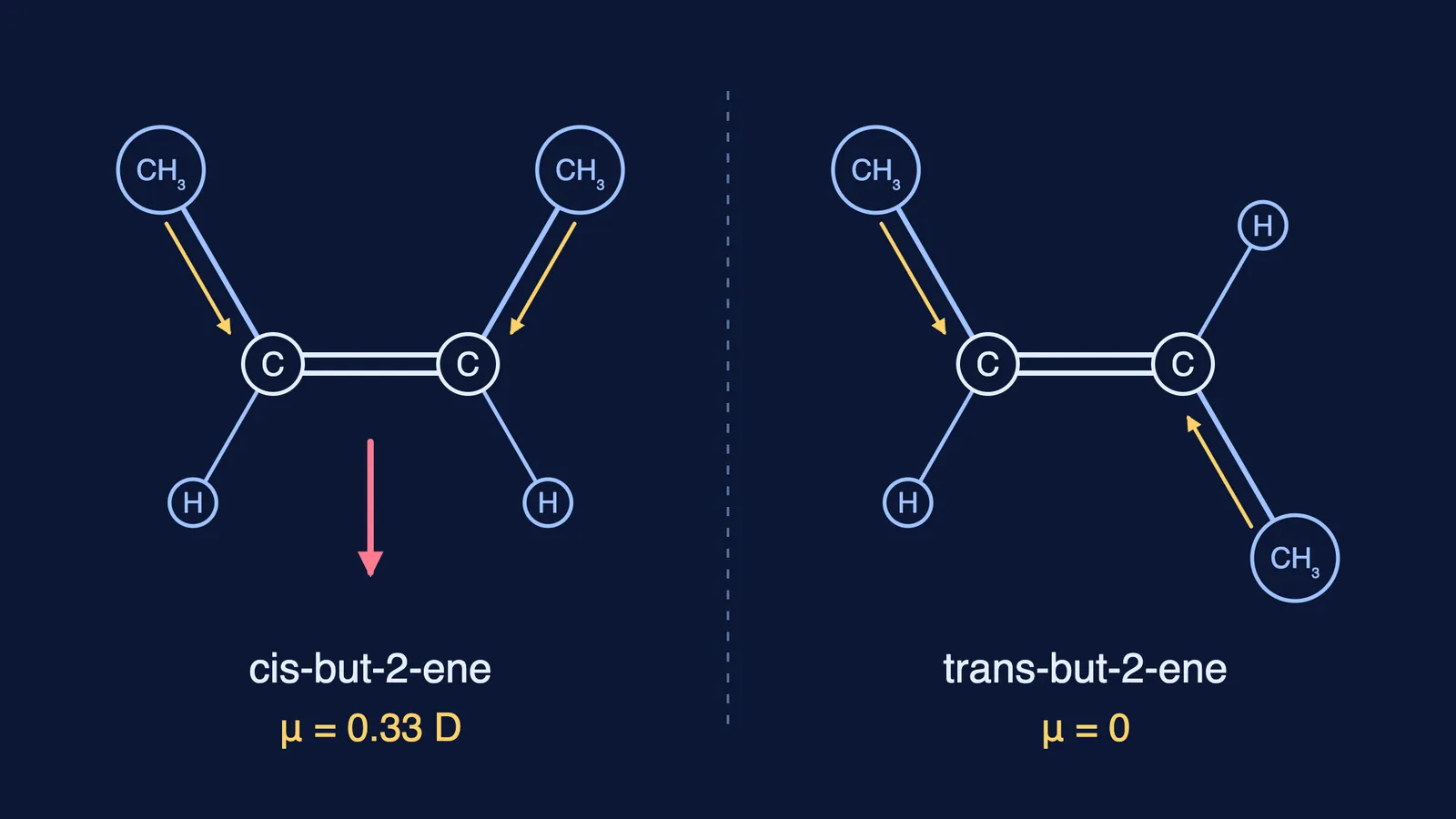
Q4 (medium). Assertion (A): cis-But-2-ene has a higher melting point than trans-but-2-ene. Reason (R): cis-But-2-ene has a dipole moment of 0.33 D, while trans-but-2-ene is almost non-polar.
Answer: (D). A is false: NCERT states that in solids the trans isomer has the higher melting point. R is true: in the trans form the two C–CH3 bond dipoles point in opposite directions and cancel. The diagram at the top shows this.
Trap: assuming the more polar isomer must melt higher.
Q5 (hard). Assertion (A): Propene treated with HCl in the presence of benzoyl peroxide still gives 2-chloropropane as the main product. Reason (R): The H–Cl bond (430.5 kJ mol⁻¹) is stronger than the H–Br bond (363.7 kJ mol⁻¹) and is not cleaved by free radicals.
Answer: (A). Both are true, and R is the reason NCERT gives for HCl showing no peroxide (Kharasch) effect. With no radical route, ordinary Markovnikov addition still occurs.
Trap: assuming HI behaves like HBr. It shows no peroxide effect either, because iodine radicals combine to form I2 instead of adding.
Q6 (hard). Assertion (A): Chlorobenzene undergoes electrophilic substitution with more difficulty than benzene. Reason (R): Chlorine is an ortho and para directing group.
Answer: (B). Both are true, but they have different causes. Chlorine's strong −I effect lowers the ring's overall electron density, which slows the reaction. Resonance leaves more electron density at ortho and para than at meta, which decides where the electrophile goes.
Trap: treating "ortho-para directing" as if it meant "activating".
Statement I and Statement II questions on Hydrocarbons
Judge each statement on its own against NCERT Unit 9; there is no "because" step.
Q7 (easy). Statement I: Ethyne is a linear molecule with an H–C–C bond angle of 180°. Statement II: The C≡C bond in ethyne is longer than the C–C bond in ethane.
Answer: (C). Statement I is correct: each carbon is sp hybridised. Statement II is incorrect: the C≡C bond (120 pm) is shorter than the C–C single bond (154 pm).
Trap: thinking more bonds make a longer bond.
Q8 (medium). Statement I: Heating sodium butanoate with soda lime gives propane. Statement II: Bromomethane heated with sodium in dry ether gives ethane.
Answer: (A). Both are correct. Decarboxylation gives an alkane with one carbon fewer than the acid, so butanoate (4 carbons) gives propane. The Wurtz reaction joins two methyl groups to give ethane.
Trap: mixing the two counts. Soda lime removes a carbon; Wurtz doubles the alkyl group.
Q9 (medium). Statement I: The –NO2 group activates the benzene ring towards electrophilic substitution. Statement II: The –OH group in phenol directs an incoming electrophile to the meta position.
Answer: (B). Both are incorrect. –NO2 withdraws electrons by its strong −I effect, so it deactivates the ring and directs meta. –OH raises the electron density at the ortho and para positions by resonance, so it activates the ring and directs ortho and para.
Trap: swapping the two groups' roles. Ask first where the electron density goes.
Q10 (hard). Statement I: All the hydrogen atoms in but-1-yne are acidic. Statement II: Ethyne is more acidic than ethene because an sp hybridised carbon, with 50% s character, is more electronegative than an sp2 carbon.
Answer: (D). Statement I is incorrect: only the hydrogen on the triply bonded carbon is acidic, and the CH2 and CH3 hydrogens are not. Statement II is correct and is NCERT's own reasoning.
Trap: reading "alkynes are acidic" as "every alkyne hydrogen is acidic".
How should you use this set?
Cover the answers and write your key for all ten, with one line on why.
Wrong on whether a statement is true? Reread the NCERT section. Wrong only between (A) and (B)? Find the textbook's own reason.
Then try our Hydrocarbons NEET practice questions with solutions.
If a trap exposes a concept gap, such as why halogens deactivate the ring yet direct ortho and para, the Fermi Concept Library has a lesson for every concept in chemistry, each with its place in the map.