On this page
This chapter is full of look-alike pairs: iris and pupil, myopia and hypermetropia, dispersion and scattering. Below are the terms from NCERT Class 10 Science Chapter 10 (reprint 2026-27), grouped by topic, with "Don't confuse with" notes. For diagrams and practice, see our Human Eye and the Colourful World chapter guide.
The CBSE 2026-27 Class X Science syllabus lists daily-life applications "(excluding colour of the sun at sunrise and sunset)", so the reddening Sun is left out. It also says information in NCERT boxes "would not be assessed in the year-end examination", so the eye-donation box is skipped.
What does each part of the human eye do?
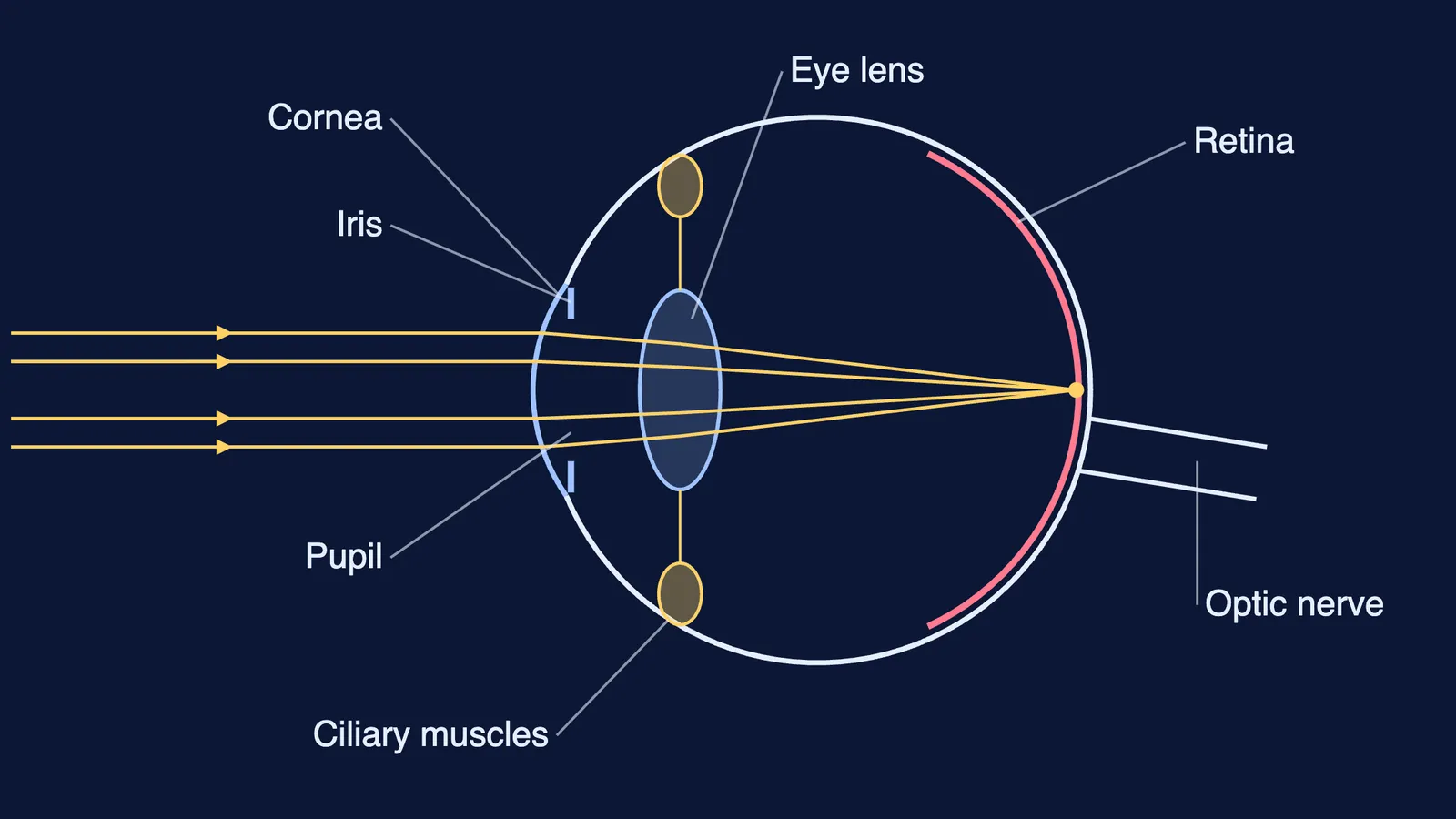
Cornea: the clear, curved window at the front of the eye. Most of the bending of incoming light happens here. Don't confuse with: the eye lens, which only fine-tunes the focus.
Iris: the dark muscular ring behind the cornea that sets the pupil's size. Don't confuse with: the pupil, which is the opening, not the muscle.
Pupil: the opening in the middle of the iris; its size decides how much light gets in.
Eye lens: a jelly-like convex lens that forms a real, inverted image on the retina.
Ciliary muscles: the muscles that make the eye lens more or less curved.
Retina: the light-sensitive screen at the back of the eyeball (the eyeball is about 2.3 cm across, per NCERT). Its cells turn light into electrical signals.
Optic nerve: carries those signals from the retina to the brain.
How does the eye focus at different distances?
Power of accommodation: the eye lens changing its focal length so near and far objects both focus on the retina. Relaxed ciliary muscles make the lens thinner (longer focal length, for distant objects); contracted ones make it thicker (shorter focal length, for near objects). Example: looking up from your notebook to the board.
Near point (least distance of distinct vision): the nearest point where an object still looks sharp and comfortable; about 25 cm for a young adult with normal vision (NCERT).
Far point: the most distant point that still looks sharp; at infinity for a normal eye.
Cataract: the eye lens turns milky and cloudy, often in old age, causing partial or complete vision loss; surgery can restore sight. Don't confuse with: presbyopia, where the lens stays clear but loses flexibility.
Defects of vision and how lenses correct them
Refractive defects: the eye cannot focus light correctly on the retina.
Myopia (near-sightedness): near things look clear, distant things blur, because the image forms in front of the retina. Causes: too much curvature of the eye lens, or a longer eyeball. Fix: a concave lens. Example (NCERT Exercise 6): a far point of 80 cm needs a concave lens of focal length −80 cm, power −1.25 D.
Hypermetropia (far-sightedness): distant things look clear, near things blur, because the image forms behind the retina; the near point moves beyond 25 cm. Causes: focal length too long, or eyeball too small. Fix: a convex lens. Example (Exercise 7): a near point of 1 m needs about +3.0 D.
Presbyopia: with age, the near point moves away because the ciliary muscles weaken and the lens stiffens. Don't confuse with: hypermetropia, which is about the eye's size or focal length, not age.
Bifocal lens: concave upper part for distance, convex lower part for reading, for people with both defects.
Power of a lens: 1 divided by focal length in metres, in dioptres (D); negative for concave, positive for convex. Our Light: reflection and refraction guide covers the lens formula.
What happens when light passes through a prism?
Prism: a glass block with a triangle at each end and three rectangular faces that slope towards each other.
Angle of the prism: the angle between the two side faces the light passes through.
Angle of emergence: the angle between the outgoing ray and the normal at the second face. Don't confuse with: angle of deviation.
Angle of deviation: the angle between the incoming ray's direction and the outgoing ray's, showing how far the prism turned the light.
Dispersion: a prism spreading white light out into its colours, because each colour bends by a different amount; red bends least, violet most.
Spectrum: the band of colours, in the order violet, indigo, blue, green, yellow, orange, red (VIBGYOR).
White light: any light that gives a spectrum like sunlight's. Newton showed a second, upside-down prism recombines the colours into white light.
Rainbow: a natural spectrum seen after rain, opposite the Sun. Each droplet refracts and disperses sunlight, reflects it internally, then refracts it again as it leaves.
Why do stars twinkle and the sky look blue?
Atmospheric refraction: bending of light by air layers whose refractive index changes gradually. Example: objects shimmering above a fire.
Twinkling of stars: a far-off star is nearly a point of light, so moving air makes its position and brightness flicker. Don't confuse with: planets, which are closer and look like small discs, so the flicker from their many points cancels out.
Advance sunrise and delayed sunset: refraction lets you see the Sun about 2 minutes before it crosses the horizon and about 2 minutes after it sets (NCERT). More in our post on atmospheric refraction for Class 10.
Scattering of light: tiny particles sending light off in all directions. Don't confuse with: dispersion, which splits colours by refraction.
Tyndall effect: a beam of light becoming visible because colloidal particles scatter it. Example: sunbeams in a smoky room.
Blue colour of the sky: air molecules, smaller than visible wavelengths, scatter blue more than red; red light's wavelength is about 1.8 times blue's (NCERT). With no atmosphere, the sky would look dark.
Red danger signals: fog and smoke scatter red light the least, so a red signal can be seen from far away.
How to learn these terms
Draw the eye from memory, label seven parts and say each one's job aloud.
Make a two-column card for each "Don't confuse with" pair.
For each defect, write where the image forms, the cause and the fixing lens side by side.
If an idea stays fuzzy, the Fermi Concept Library gives each concept in physics, chemistry, biology, mathematics and computing its own lesson.