On this page
Chapter 2 of the new Class 9 NCERT book *Khel Praveen* traces how Indians trained the body, from rock-shelter paintings to the National Education Policy 2020. Below: each period in brief, a revision method and original practice questions.
What does Chapter 2 of Khel Praveen cover?
*Khel Praveen* (First Edition, April 2026) puts this chapter in Unit 1, "Evolution of Physical Education and Well-being" (NCERT, iehp101.pdf).
In the CBSE 2026-27 curriculum for Physical Education and Well-being, this content sits in Unit 1, "Development of Physical Culture in India", with 4 hours of theory. The theory paper is 20 marks: every unit carries 2 marks (MCQ, objective or short answer), which makes 16 marks across 8 units, plus a 4-mark viva. Those 2 marks belong to the whole unit and are not set aside for this chapter alone. The subject is assessed by your school, not through a board exam.
How did physical culture develop in ancient India?
The book starts before written records. Paintings at the Bhimbetka rock shelters show hunting, weapons and group activity, a sign that movement was part of daily survival (NCERT). For the Sindhu-Sarasvatī civilisation, it points to farming, building, craft and water management, with the Great Bath at Mohenjo-Daro and reservoirs at Dholavira as examples of shared effort and cleanliness.
The Vedic texts each get a short role:
Ṛigveda: warriors, chariots and strength; the timeline adds chariot races and wrestling.
Sāmaveda: chanting that needs steady posture, rhythm and breath control.
Yajurveda: rituals that call for balance and precise movement; also linked to archery and Dhanurveda.
Atharvaveda: health, strength (bala) and protection from disease.
Upaniṣhads (800–200 BCE): the Kaṭhopaniṣhad image of the body as a chariot, with the senses as horses and the mind as reins.
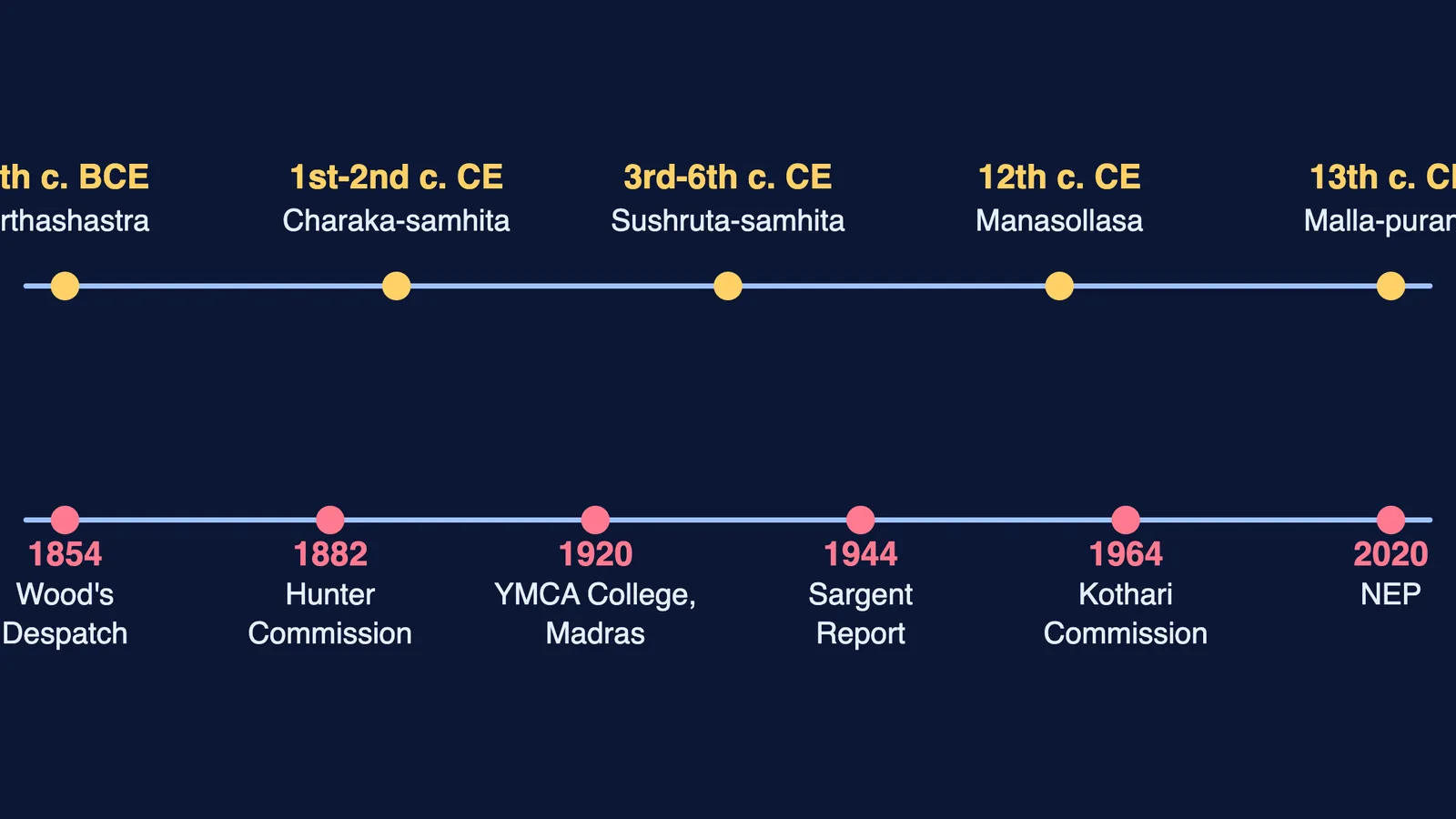
In the epics, the Rāmāyaṇa and the Mahābhārata describe students training in archery, weapons and discipline under a guru in gurukulas; the Mahābhārata adds detail on mace fighting and horse and chariot riding. Kauṭilya's Arthaśhāstra (4th century BCE) treats fitness and routine for rulers, soldiers and officials as a matter for the state.
The key idea is vyāyāma: activity that steadies the body and builds strength, done in moderation. The book cites the Charaka-saṁhitā (c. 1st–2nd century CE) on balancing effort with rest, and the Suśhruta-saṁhitā (c. 3rd–6th century CE) on exercising to about half of one's capacity.
What changed in medieval India?
Wrestling and pole work became organised traditions (NCERT):
The Mānasollāsa (12th century CE) was written by King Someśhvara III; the book calls it the earliest text naming Mallakhamb, where athletes hold acrobatic poses on a wooden pole.
The Malla-purāṇa (13th century CE) lists 16 kinds of wrestling exercise and pairs daily drills with yoga postures.
Town akhāḍās trained young people through daṇḍs (push-ups), baiṭhaks (squats) and lifting weights, with bouts held at fairs and festivals.
In the south, kalaripayaṭṭu grew as a martial art built on flexibility, balance and weapon training. The book adds that these traditions are older, though most written records are medieval.
For the late medieval period, the chapter notes that the Āʾīn-i-Akbarī records wrestling, archery, riding and hunting under Akbar, and that Marathi chronicles of Chhatrapati Shivaji Maharaj and Rajputana histories describe endurance and terrain skills needed for defence.
How did physical education enter Indian schools?
The chapter briefly notes European roots, such as GutsMuths's *Gymnastics for Youth* (1793) (NCERT). In India, the chapter lists these steps:
1854: Wood's Despatch shaped schools around literary subjects, leaving out physical education.
1882: The Hunter Commission asked schools to encourage native games, gymnastics and drills.
1914: The Vaidya brothers founded the Hanuman Vyayam Prasarak Mandal in Amravati.
1920: American educator Harry Crowe Buck opened a YMCA college for physical education in Madras, India's first professional PE institute.
1944: The Sargent Report made physical education compulsory in all schools.
After 1947: NCC (1948), Lakshmibai College of Physical Education, Gwalior (1957), NIS (1961), the Kothari Commission (1964), the 1986 National Policy on Education directing about 8–10 per cent of teaching time for physical and health education, NEP 2020, and NCF-SE 2023.
How should you revise this chapter?
Group the dates into three anchors instead of memorising a list: texts (Arthaśhāstra, Charaka, Suśhruta), medieval traditions (Mānasollāsa, Malla-purāṇa), and policies (1854, 1882, 1944, 1964, 2020). For each, say aloud who, when and what changed.
Practice questions written by us; mark labels are our suggestion, not from CBSE:
Name the text that first mentions Mallakhamb and its century. (1 mark)
What does the term vyāyāma mean, and what limit on it does the chapter mention? (2 marks)
Match: Sargent Report, Hunter Commission, Wood's Despatch with 1854, 1882 and 1944. (1 mark)
Give two ways an akhāḍā trained young people. (2 marks)
Why does the chapter single out the YMCA college opened in Madras in 1920? (2 marks)
For related Class 11 topics, see our guides to changing trends and careers in physical education, Olympism, Olympic values and symbols and yoga in Class 11 physical education.
Not sure where to begin your revision? Fermi's AI tutor works out what you already know and builds a plan for the session.