On this page
First, a note: CBSE's Class X Science syllabus for 2026-27 says in its Note for Teachers, "The topics Periodic Classification of Elements; Heredity and Evolution; and Electric Effects of Electric Current will not be assessed in the year-end examination."
The note adds that it may still count for internal assessment and portfolio credit. The same syllabus still lists Heredity in Unit II, World of Living: Mendel's contribution, laws for inheritance of traits and sex determination. CBSE's official 2026-27 sample paper also has a 4-mark question (Question 15) on Mendel's pea-plant crosses. Ask your teacher how your school will test this chapter.
Below are the terms from NCERT Class 10 Science Chapter 8, Heredity, grouped by topic and in plain words. For the full chapter walk-through, read our Heredity Class 10 chapter guide.
What do variation and heredity mean?
Variation: the small differences between individuals of the same kind, such as two children of the same parents. Don't confuse with: heredity, which is about the similarities being passed on.
Heredity: the passing of traits from parents to offspring, following fixed rules.
Trait (character): a feature that can be seen or measured, such as plant height or seed shape.
Inherited trait: a trait that comes from the parents' DNA. Example: free or attached earlobes; an attached earlobe joins the side of the head directly, a free one does not.
Accumulation of variation: each generation inherits its parents' differences and adds new ones, so diversity builds up. Sexual reproduction adds far more than asexual reproduction.
Selection of variants: the environment favours some variants. Example: bacteria that can stand heat survive a heat wave better.
More in our explainer on how variation arises.
Which terms describe Mendel's experiments?
Gregor Mendel: worked out the main rules of inheritance with garden peas, and was the first to count the plants showing each trait in every generation.
Contrasting characters: two clear opposite forms of one trait. Example: tall or short plants, round or wrinkled seeds, violet or white flowers.
Cross: breeding two plants with different traits.
Progeny: the offspring of a cross. The parent generation is the plants you start with.
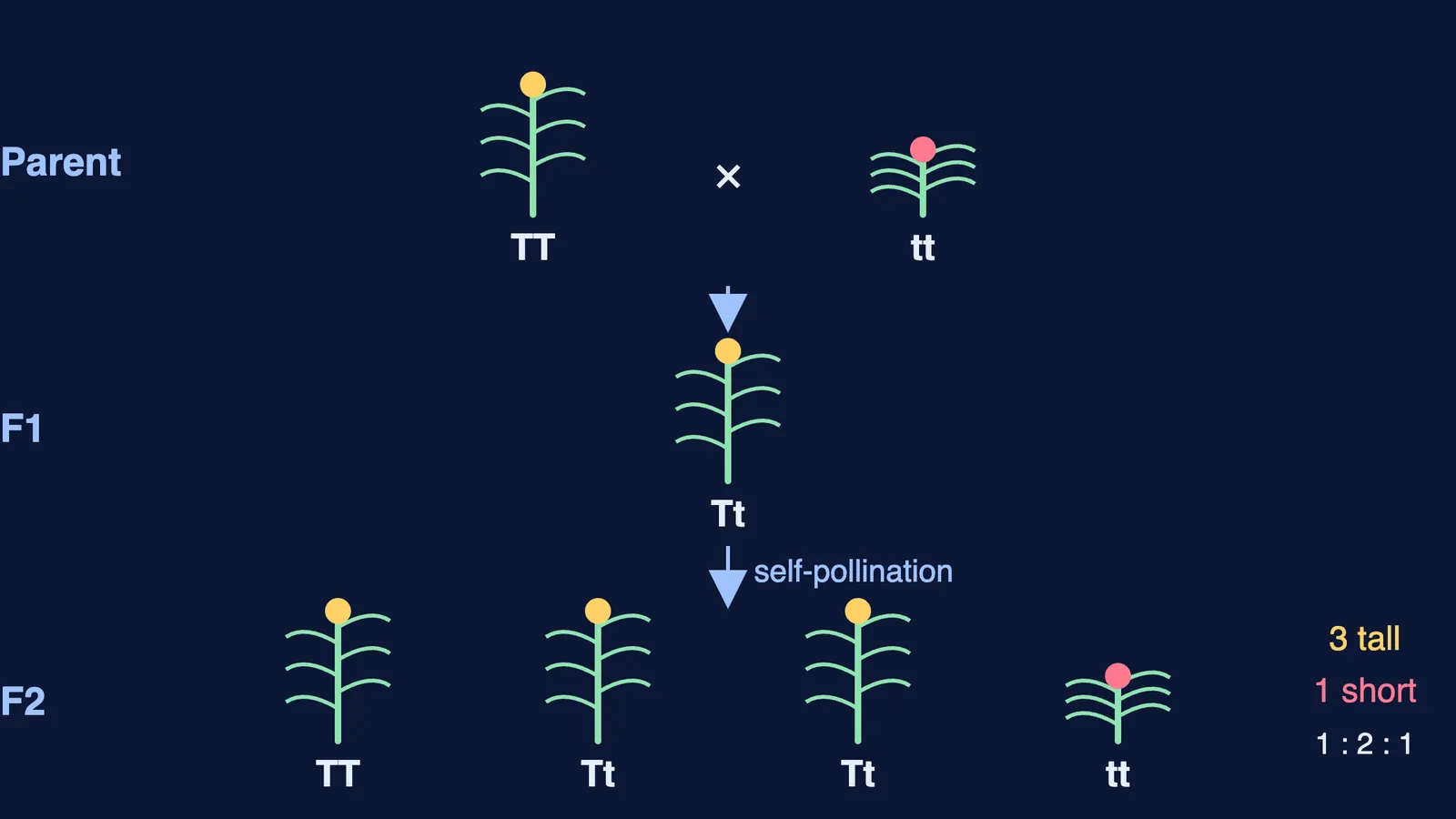
F1 generation: the first generation of progeny from the cross. In the tall × short cross, all F1 plants are tall.
F2 generation: the progeny you get when F1 plants self-pollinate. Don't confuse with: F1, which comes straight from the parent cross.
Self-pollination: pollen from a plant fertilises the same plant, so the progeny has only one parent. Don't confuse with: a cross between two different plants.
Factor: Mendel's word for what controls a trait; today we call it a gene. Sexually reproducing organisms carry two copies.
Dominant, recessive and the ratios
Dominant trait: the trait that shows even when only one copy is present. Example: tallness (T) in peas.
Recessive trait: the trait that shows only when both copies are the same recessive version. Example: shortness (t) shows only in tt plants. Don't confuse with: rare; recessive does not mean uncommon.
TT, Tt and tt: the three trait combinations for height. TT and Tt plants are tall; only tt plants are short.
1:2:1 ratio: the F2 of a tall × short cross has TT, Tt and tt in the ratio 1:2:1, so one quarter of F2 plants are short.
Independent inheritance: two traits pass to the progeny separately. NCERT's Figure 8.5 counts 556 F2 seeds from a seed-shape and seed-colour cross: 315 round yellow, 108 round green, 101 wrinkled yellow and 32 wrinkled green, close to 9:3:3:1 (NCERT Chapter 8). The parents were round green and wrinkled yellow, so round yellow and wrinkled green are new combinations.
How do genes control traits?
DNA: the molecule in a cell that holds the instructions for making proteins.
Gene: a stretch of DNA that carries the instructions for making one protein. Don't confuse with: chromosome, which is a whole piece of DNA carrying many genes.
Protein and enzyme: an enzyme is a protein that runs a process in the cell. If the gene's instructions give an efficient enzyme, the process works well.
Plant hormone: a chemical that can trigger growth. Chain from the chapter: gene, enzyme, amount of hormone, plant height.
Gene set: a full set of genes. Body cells carry two sets, one from each parent.
Germ cell: a reproductive cell that carries only one gene set. Don't confuse with: body cells, which carry two.
Chromosome: one of the separate pieces of DNA a gene set is split into. Each body cell has two copies of each chromosome, one from the mother and one from the father.
Linked traits: traits that would always be inherited together if a gene set were one long thread. Separate chromosomes let them be inherited independently.
Zygote: the cell formed when two germ cells fuse, restoring the normal chromosome number.
More in our post on how genes control traits.
Which terms explain sex determination?
Sex determination: how the sex of a newborn is decided.
Environmental sex determination: sex set by surroundings. Example: in a few reptiles, the temperature of the eggs decides it.
Genetic sex determination: sex decided by inherited genes, as is largely the case in humans. Don't confuse with: snails, which can change sex, so their sex is not genetically determined.
Sex chromosomes: the one pair in humans whose two members do not always match. The other 22 pairs each have a matching copy from the mother and the father.
X and Y chromosomes: women are XX; men are XY, where Y is the short one. Don't confuse with: the idea that the mother decides; every child gets an X from the mother, so the father's X or Y decides.
Not in this chapter: genotype, phenotype and allele, or evolution topics such as speciation and fossils (CBSE lists evolution separately, for formative assessment only).
How to learn these terms
Learn terms in pairs: dominant with recessive, F1 with F2, gene with chromosome.
Draw the tall × short cross from memory, labelling parent, F1 and F2 with TT, Tt and tt.
Say the chain aloud: gene, enzyme, hormone, height.
If a term still feels loose, the Fermi Concept Library gives every concept in biology its own lesson and its place in the map.