

On this page
You are studying heredity for your Class 10 Science exam, and you know that parents pass traits to their offspring. You have probably drawn Punnett squares and memorised that 'T' stands for tall and 't' stands for short. But how does a microscopic piece of DNA actually make a pea plant tall, or give a person brown eyes? The link between a genetic code and a physical feature is not magic; it is a step-by-step chemical chain of command. Understanding this mechanism is one of the most common topics tested in board exams.
How do genes control traits?
In biology, the physical characteristics you can see—like eye colour, leaf shape, blood type or plant height—are called traits. The instructions for all these traits are carried inside the nucleus of every cell in a molecule called DNA.
Cellular DNA is the information source for making proteins in the cell (NCERT). A section of DNA that provides information for one specific protein is called a gene. But a gene is just an instruction manual. Just as a recipe cannot bake a cake by itself, a gene cannot build a stem or colour a petal on its own. Instead, it relies on the specific proteins it codes for to do the actual physical work inside the cell.
What is the chain from gene to height?
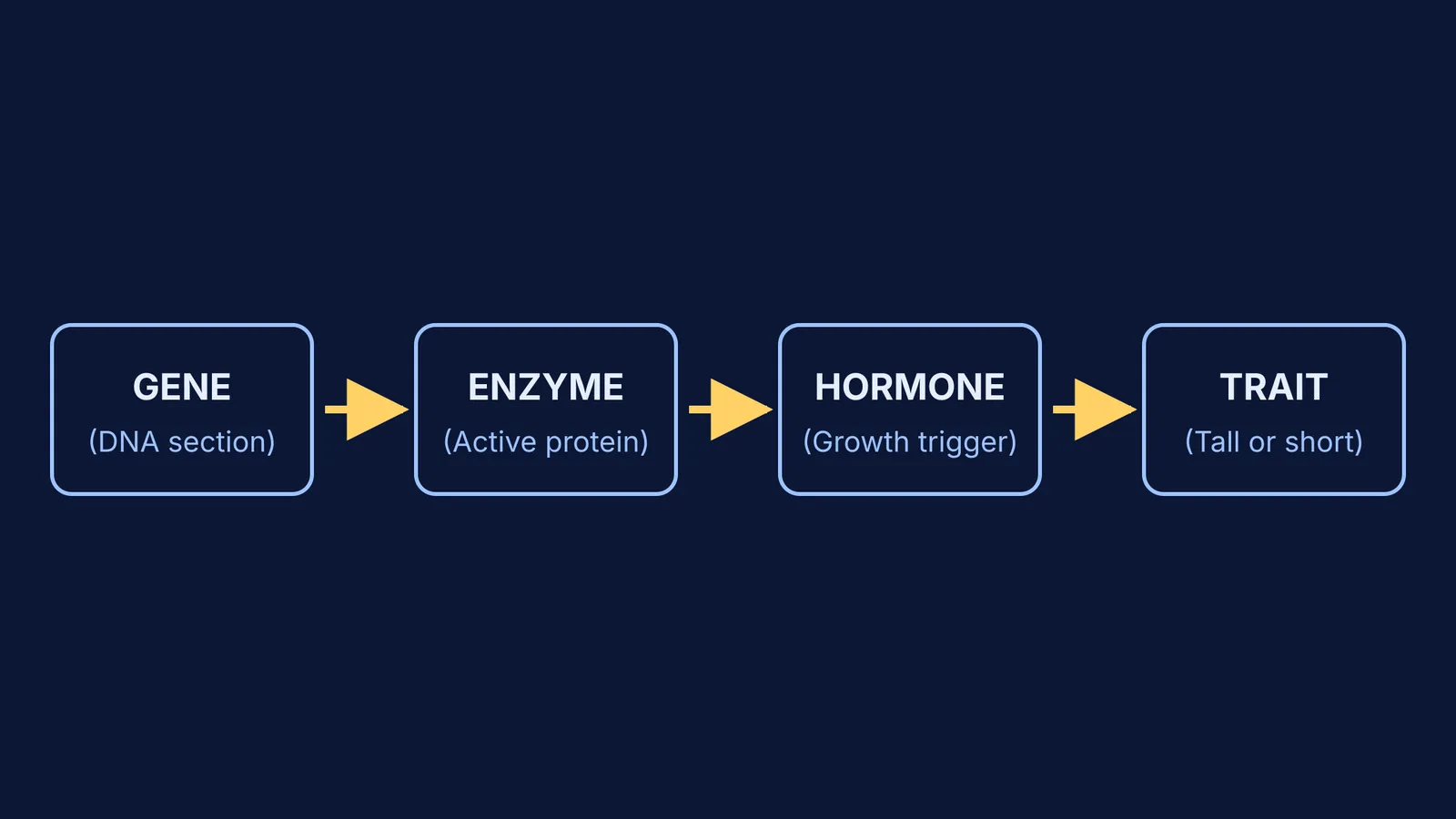
To make this abstract idea concrete, the Class 10 textbook uses plant height to show how this mechanism works in practice. Plant height depends on the amount of a particular plant growth hormone circulating in the organism. The chain from genetic information to a visible trait goes like this:
Gene: A specific section of cellular DNA holds the genetic code.
Protein: The cell reads this gene and builds a protein based on those exact instructions. In this case, the protein acts as an enzyme.
Plant Hormone: The enzyme drives the chemical reaction that manufactures a growth hormone. The amount of hormone produced depends entirely on how efficiently this enzyme works.
Trait: The amount of hormone directly determines the physical result. An abundance of hormone triggers the cells to elongate, resulting in the height of the plant.
What happens when a gene changes?
Sometimes, the sequence of a gene changes through an alteration or mutation. When the DNA instructions change, the shape and function of the protein it produces will change, too.
If the gene for an enzyme has an alteration that makes the enzyme less efficient, the amount of hormone will be less, and the plant will be short (NCERT). This is exactly why some of the pea plants in Gregor Mendel's famous experiments were dwarf plants. They inherited a version of the gene that could not produce a highly efficient enzyme, meaning their cells never received the hormone surge needed to grow tall.
This same principle applies to human genetics. In humans, when this chain of proteins and enzymes breaks down, it can cause severe health conditions like sickle-cell anaemia; you can read how this inheritance works in our post on Mendelian disorders.
How do parents pass these traits on?
Every individual organism has two sets of all genes, meaning they carry two copies of the instructions for every trait—one inherited from each parent. These genes are located on chromosomes.
If a pea plant inherits a 'T' (tall) gene from one parent and a 't' (short) gene from the other, it will still grow to be tall. Why? Because the single 'T' gene is enough to produce an adequate amount of the efficient enzyme. That enzyme manufactures enough hormone to make the plant tall, completely masking the effect of the less efficient 't' gene. This chemical masking is why tallness is called a dominant trait, while shortness remains a recessive trait. To see how these combinations play out when tracking unknown genotypes in an experiment, see our guide to the test cross vs back cross.
Understanding this chain of command makes the study of genetics much easier to follow. Instead of blindly memorising letters and squares, you are following a biological chemical factory at work. If you want to review the foundational rules of inheritance, the Fermi Concept Library maps out every mechanism from Mendel's laws to human genetics. And if you are stuck on how to calculate the mathematical results of a dihybrid cross, the step-by-step solver in the Fermi Problem Library will walk you through the logic behind each combination.


