On this page
Children look like their parents, but never exactly like them. Siblings don't look identical either, unless they are identical twins. The Class 10 chapter "How do Organisms Reproduce?" explains why with two sources of variation. Once you see how they fit together, the exam answer is easier to structure.
What does variation mean in Class 10 biology?
Variation is the set of small differences between individuals of the same species. The NCERT Class 10 Science chapter 7 starts with the idea that reproduction, at its most basic level, means making copies of DNA, the blueprint for the body. If the copy changes, different proteins are made, and different proteins can lead to altered body designs. So any change in copied DNA can show up as a difference in the offspring.
How do errors in DNA copying cause variation?
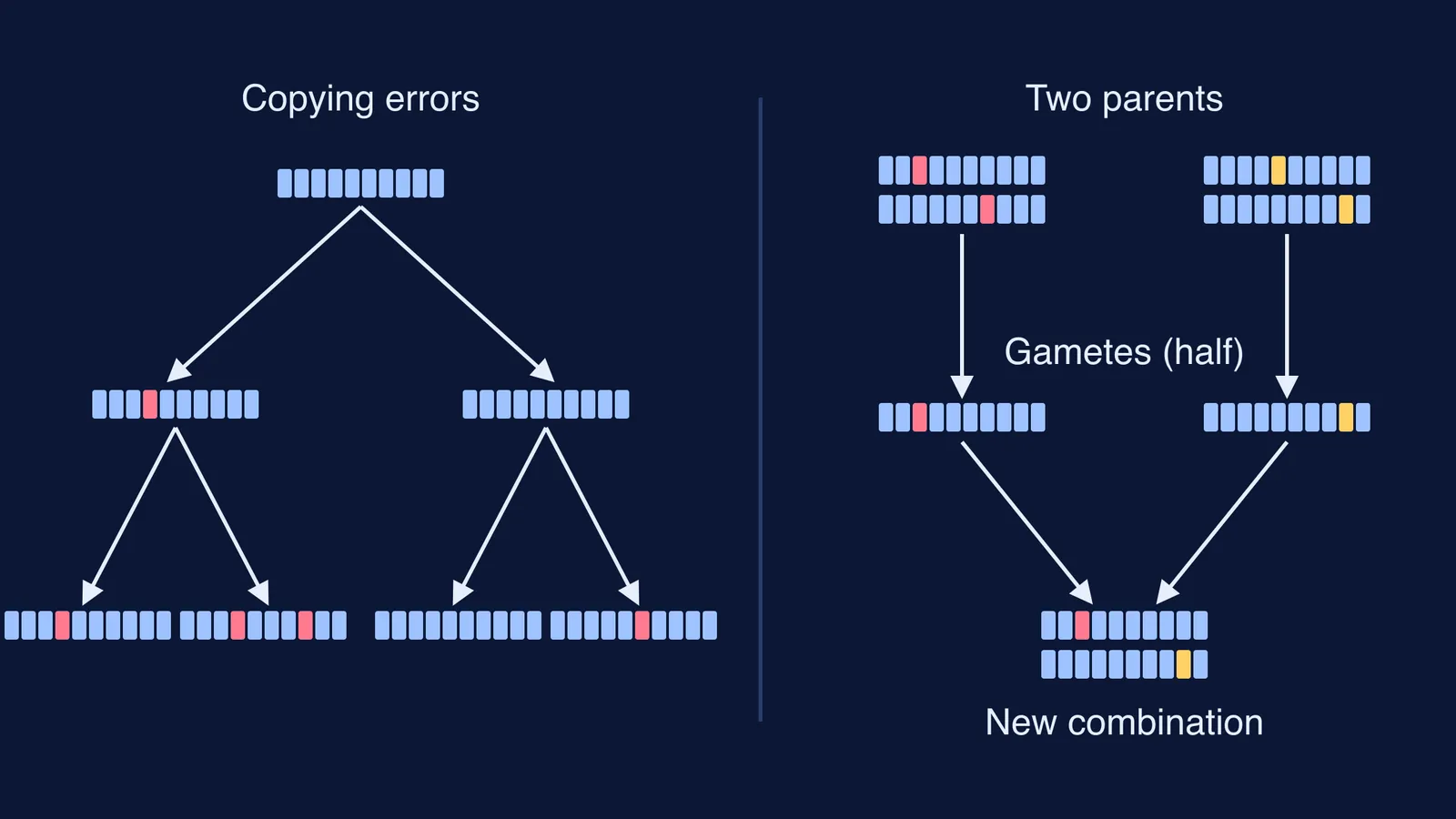
Cells copy their DNA through chemical reactions, and the NCERT chapter puts it plainly: "No bio-chemical reaction is absolutely reliable" (NCERT, chapter 7). So each copy is similar to the original but may not be identical. Some changes are so drastic that the new cell cannot work with the cellular machinery it inherits, and it dies. Most are milder, so the surviving cells are "similar to, but subtly different from each other".
How often does copying go wrong? A 2012 Nature study by Kong and colleagues sequenced the whole genomes of 78 Icelandic parent-child trios. It found that the average rate of new mutations is 1.20 × 10⁻⁸ per DNA letter per generation, which is about one change in every 83 million letters. The same study found that each extra year of the father's age at conception added about two new mutations. NCERT's point follows: copying is accurate enough that variation is "a fairly slow process".
How does sexual reproduction increase variation?
Sexual reproduction speeds up the process. Each individual carries changes built up over earlier generations, so two individuals carry different sets of changes. Combining DNA from two parents creates a new combination every time (NCERT, section 7.3.1).
There is a catch. If two whole sets of DNA were simply added together, each generation would have twice as much DNA as the last. The fix is meiosis: germ cells (gametes) carry half the number of chromosomes and half the DNA of body cells. When two gametes fuse, the normal number is restored.
How many combinations can two parents make?
You don't need this number for the board exam, but it shows the scale. Human body cells normally have 23 pairs of chromosomes, 46 in total (MedlinePlus Genetics).
A gamete gets one chromosome from each pair, so there are 2 choices per pair.
Across 23 pairs that is 2²³ = 8,388,608 possible gametes from one parent.
The other parent has the same number of options, so one couple can produce 8,388,608 × 8,388,608, or about 70 trillion, possible chromosome combinations.
Crossing over during meiosis mixes things further, so the real number is larger still.
That is why siblings differ. For more, see our guide to why meiosis creates variation.
Why is variation important for a species?
NCERT's answer is about changing niches. A population that is well suited to one place could be wiped out if that place changes: temperatures rise, water levels shift, a meteorite hits. The chapter's example: if global warming heats the water that bacteria live in, most die, but the few heat-resistant variants survive and grow. Variation is "useful for the survival of species over time" and, NCERT adds, it is the basis for evolution.
That answers one of the chapter's in-text questions: why is variation beneficial to the species but not necessarily to the individual? One variant may die from a harmful change, but a varied population is more likely to include survivors.
How do you write this answer in the board exam?
For a short-answer "How do variations arise?" question, use this four-line frame:
Define: variations are small differences between individuals of a species.
Source 1: DNA copying is not absolutely accurate, so copies differ slightly; these changes add up over generations.
Source 2: sexual reproduction combines DNA from two parents, giving new combinations; meiosis halves the chromosome number so the total stays constant.
Importance: variation helps some individuals survive if the niche changes (the heat-resistant bacteria example).
Common mistakes to avoid:
Saying asexual reproduction produces no variation at all. It produces a little, through copying errors.
Forgetting why gametes need half the DNA.
Writing that variation helps every individual. It helps the species.
Next, read our Class 10 heredity guide, or revise the modes of reproduction in Class 10. If DNA, genes and chromosomes still blur together, the Fermi Concept Library gives each concept its own lesson and its place in the map. To test yourself, the Fermi Problem Library has worked problems with a step-by-step solver that explains the reasoning rather than printing an answer.