On this page
We wrote these eight Gravitation questions in three formats: single-correct, one-or-more-correct and numerical-value. None is copied from NCERT, a past paper or a coaching book.
What does JEE Advanced ask from Gravitation?
The official JEE (Advanced) 2026 syllabus lists, under Mechanics: law of gravitation, gravitational potential and field, acceleration due to gravity, Kepler's law, geostationary orbits, motion of planets and satellites in circular orbits, and escape velocity. All eight stay inside it, and most join two ideas. It covers circular orbits only; Q6 and Q7, with non-circular paths, need just energy and angular momentum conservation.
How should you use this set?
Cover the solutions. Allow three minutes per easy question, five per hard one.
Judge each option of a one-or-more-correct question on its own. Our explainer on JEE Advanced question types covers the formats.
Name the tool first: force balance, energy or angular momentum.
New to the chapter? Start with our guide on how to prepare Gravitation for JEE Advanced. Stuck partway through a solution? The Fermi Problem Library has worked problems with a step-by-step solver that explains the reasoning rather than printing an answer.
Easy: binary stars and a hollowed sphere
Q1 (easy, single correct). Stars of masses M and 2M, a distance d apart, circle their common centre of mass. What is the period?
(A) 2π√(d³/3GM) (B) 2π√(d³/2GM) (C) 2π√(4d³/27GM) (D) 2π√(d³/GM)
Answer: (A). The star of mass M circles at 2d/3 from the centre of mass, but the force on it is still G(2M)M/d². So G(2M)/d² = ω²(2d/3), giving ω² = 3GM/d³ and T = 2π√(d³/3GM).
Trap: (C) puts 2d/3 into the force law too, but the force depends on the separation d.
Q2 (easy, numerical). A uniform solid sphere of radius R has surface gravity 8 m/s². A spherical cavity of radius 0.5R is cut out, its centre 0.35R from the sphere's centre. What is the magnitude of the gravitational field, in m/s², at any point inside the cavity?
Answer: 2.8. Treat the cavity as a small sphere of negative density added to the full sphere. Inside a uniform sphere the field is −(g/R) times the position vector, so the sum is (g/R) times the centre-to-centre vector: 8 × 0.35 = 2.8 m/s², uniform throughout the cavity.
Trap: 4, which uses the cavity radius instead of the offset.
Medium: shells, a ring and a slowly sinking satellite
Q3 (medium, one or more correct). Two thin concentric shells have mass M at radius R and mass 2M at radius 2R. Which statements are correct?
(A) The field at 1.5R is 4GM/9R². (B) The potential at 0.5R is −2GM/R. (C) The potential at 1.5R is −2GM/3R. (D) The field at 3R is GM/3R².
Answer: (A), (B), (D). At 1.5R only the inner shell pulls: GM/(1.5R)² = 4GM/9R². Inside a shell the potential is constant, so at 0.5R: −GM/R − 2GM/2R = −2GM/R. At 3R both act as 3M at the centre: GM/3R².
Trap: (C) drops the outer shell, which exerts no force at 1.5R but still adds −GM/R to the potential.
Q4 (medium, single correct). A thin fixed ring has mass M and radius R. A small particle is released from rest on its axis, √3R from the centre. What is its speed when it passes through the centre?
(A) √(GM/R) (B) √(2GM/R) (C) √(2(1 − 1/√3)GM/R) (D) √(GM/2R)
Answer: (A). Every bit of ring is √(R² + x²) away, so V = −GM/2R at the start and −GM/R at the centre. Then v²/2 = GM/2R and v = √(GM/R).
Trap: (C) takes the start distance as √3R, not the 2R to the ring itself.
Q5 (medium, one or more correct). A satellite of mass m slowly spirals inward under weak air drag, from a circular orbit of radius 4R to one of radius 3R (R and g are Earth's radius and surface gravity). Which statements are correct?
(A) Its kinetic energy rises by mgR/24. (B) The drag does work −mgR/24. (C) Its potential energy falls by mgR/24. (D) Its angular momentum about Earth's centre rises.
Answer: (A), (B). With GM = gR², KE = mgR²/2r rises by mgR/24, PE = −mgR²/r falls by mgR/12, and total energy falls by mgR/24: the drag's work. L = m√(GMr) falls.
Trap: (C). PE falls by twice the KE gain, mgR/12. Our post on why a satellite's kinetic, potential and total energies are in the ratio 1 : −2 : −1 explains the split.
Hard: launch angles, kicks and three stars
Q6 (hard, numerical). A projectile leaves Earth's surface at speed √(gR), 30° from the vertical. Ignoring air and rotation, find its greatest height as a multiple of R, to two decimals.
Answer: 0.87. At the top, velocity is perpendicular to the radius. Angular momentum: R√(gR) sin 30° = rv. Energy: gR/2 − gR = v²/2 − gR²/r. With u = r/R, 4u² − 8u + 1 = 0, so u = 1 + √3/2 and h ≈ 0.87R.
Trap: 1.00, the vertical-launch height; sideways velocity never becomes height.
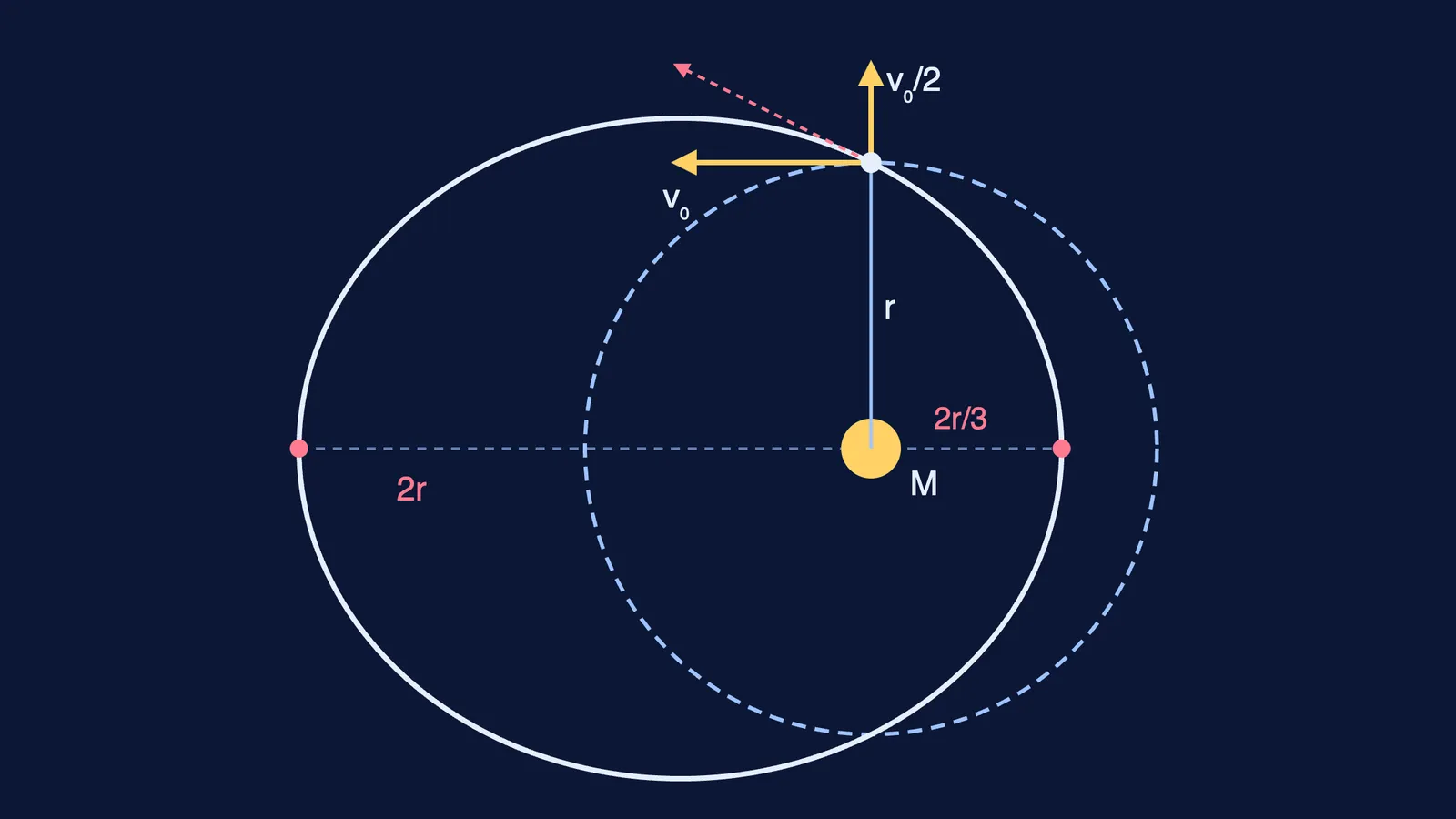
Q7 (hard, single correct). A satellite circles a planet at radius r with speed v₀. A short burst adds outward radial velocity v₀/2, leaving the tangential speed unchanged. What is its greatest distance from the planet's centre afterwards?
(A) 8r/7 (B) 3r/2 (C) 2r (D) 8r/3
Answer: (C). At the extreme points, angular momentum gives rv₀ = r′v. Energy, with GM = v₀²r: (5/8)v₀² − v₀² = v²/2 − v₀²r/r′. With u = r′/r: 3u² − 8u + 4 = 0, so u = 2 or 2/3. The greatest distance is 2r.
Trap: (D) turns all the kinetic energy into potential energy, but the satellite still moves sideways there.
Q8 (hard, single correct). Three stars of mass m at the corners of an equilateral triangle of side a circle its centre under mutual gravity. How much energy must be supplied to make the side 2a, still circling?
(A) 3Gm²/4a (B) 3Gm²/2a (C) Gm²/4a (D) 9Gm²/4a
Answer: (A). Each star feels √3Gm²/a² towards the centre, a/√3 away, so v² = Gm/a. Total energy: −3Gm²/a + (3/2)Gm²/a = −3Gm²/2a. At side 2a it is −3Gm²/4a, so 3Gm²/4a is needed.
Trap: (D) adds the kinetic energy lost to the potential energy gained, but that loss pays for half the rise.
Redo Q3, Q6 and Q7 in three days, without the solutions.