On this page
Gravitation is Chapter 7 of the NCERT Class 11 Physics Part I textbook (2026-27 reprint) and Unit VI of the CBSE Class XI Physics syllabus for 2026-27. Here are 26 of its key terms by topic, with SI units. For derivations, see our Gravitation Class 11 physics chapter guide.
Geostationary and polar satellites are in neither the current chapter (sections 7.1 to 7.10) nor the 2026-27 syllabus, and weightlessness gets only a Points to Ponder note, so none has an entry.
What are Kepler's laws and the terms that go with them?
Kepler's laws are in section 7.2 of the NCERT chapter.
Geocentric model: Ptolemy's old picture, with everything circling a fixed Earth; the heliocentric model puts the Sun at the centre.
Ellipse and foci: an ellipse is a closed curve whose distances from two fixed points, the foci, always add to the same total. A circle is the case where the foci meet.
Semi-major axis (a): half the longest diameter of the ellipse, in metres; for a circle, the radius.
Perihelion: the orbit's closest point to the Sun, where the planet moves fastest. Don't confuse with: aphelion, the farthest and slowest point.
Law of orbits: each planet moves on an ellipse with the Sun at one focus.
Law of areas: in any two equal stretches of time, the line from the Sun to a planet covers the same area (m²). It holds because gravity is a central force, along the Sun-planet line, so angular momentum (kg m² s⁻¹) stays constant.
Law of periods: T²/a³ (SI unit s² m⁻³) is the same for every planet around the Sun. Example: NCERT's Table 7.1 gives about 3 × 10⁻³⁴ y² m⁻³ for all eight.
Universal law of gravitation: key terms
These follow sections 7.3 and 7.4 of the NCERT chapter.
Universal law of gravitation: two point masses attract with F = Gm₁m₂/r², in newtons, along the line joining them. Double r and F drops to a quarter.
Gravitational constant (G): the fixed number in that law, about 6.67 × 10⁻¹¹ N m² kg⁻². Don't confuse with: g, an acceleration that changes from place to place.
Principle of superposition: the net pull on a mass is the vector sum, in newtons, of the pulls from every other mass, each acting independently. Example: three equal masses at a triangle's corners give zero net force at its centroid.
Shell theorem: a uniform hollow shell pulls an outside mass as if all its mass were at its centre, and pulls a mass inside it with zero net force.
Cavendish experiment: Henry Cavendish's 1798 measurement of G with a torsion balance; the wire's restoring torque (N m), proportional to its twist (rad), balances the gravitational torque.
How does acceleration due to gravity change with height and depth?
Sections 7.5 and 7.6 of the NCERT chapter treat Earth as a uniform sphere.
Acceleration due to gravity (g): the acceleration Earth gives any body near its surface, g = GM_E/R_E², about 9.8 m s⁻².
Mass of the Earth (M_E): found from g, R_E and G, which is why Cavendish is said to have "weighed the Earth"; NCERT's Example 7.6 gets about 5.97 × 10²⁴ kg.
g at a height (h, in m): g(h) = GM_E/(R_E + h)², in m s⁻², which is about g(1 − 2h/R_E) when h is much smaller than R_E.
g at a depth (d, in m): g(d) = g(1 − d/R_E), in m s⁻², because only the inner sphere of radius (R_E − d) pulls. g is largest at the surface. Don't confuse with: g at a height, which falls twice as fast near the surface.
Gravitational potential energy and escape speed: key terms
These follow sections 7.7 and 7.8 of the NCERT chapter.
Conservative force: a force whose work (J) between two points does not depend on the path, like gravity.
Gravitational potential energy (U): energy, in joules, due to a body's position in Earth's field: U = −GM_E m/r, with U = 0 at infinity. Don't confuse with: mgh, which gives only the change near the surface, when h is much smaller than R_E.
Gravitational potential (V): potential energy per unit mass at a point, V = −GM/r, in J kg⁻¹. Don't confuse with: potential energy, which depends on the mass placed there.
Escape speed: the least launch speed from the surface that lets a body reach infinity, √(2gR_E), in m s⁻¹. It is about 11.2 km s⁻¹ (1.12 × 10⁴ m s⁻¹) for Earth and 2.3 km s⁻¹ for the Moon, which is why the Moon has no atmosphere.
What do orbital speed and satellite energy mean?
Sections 7.9 and 7.10 of the NCERT chapter take a satellite in a circular orbit of radius (R_E + h).
Earth satellite: any body revolving around Earth, such as the Moon (about 27.3 days, or 2.36 × 10⁶ s, per orbit).
Orbital speed (v): v = √(GM_E/(R_E + h)), in m s⁻¹, where gravity exactly supplies the centripetal force; it falls as h rises. Don't confuse with: escape speed, √2 times the orbital speed at the same distance.
Time period of a satellite (T): the time for one orbit, in seconds; T² is proportional to (R_E + h)³, Kepler's third law for satellites. Close to the surface it is about 85 minutes (5.1 × 10³ s).
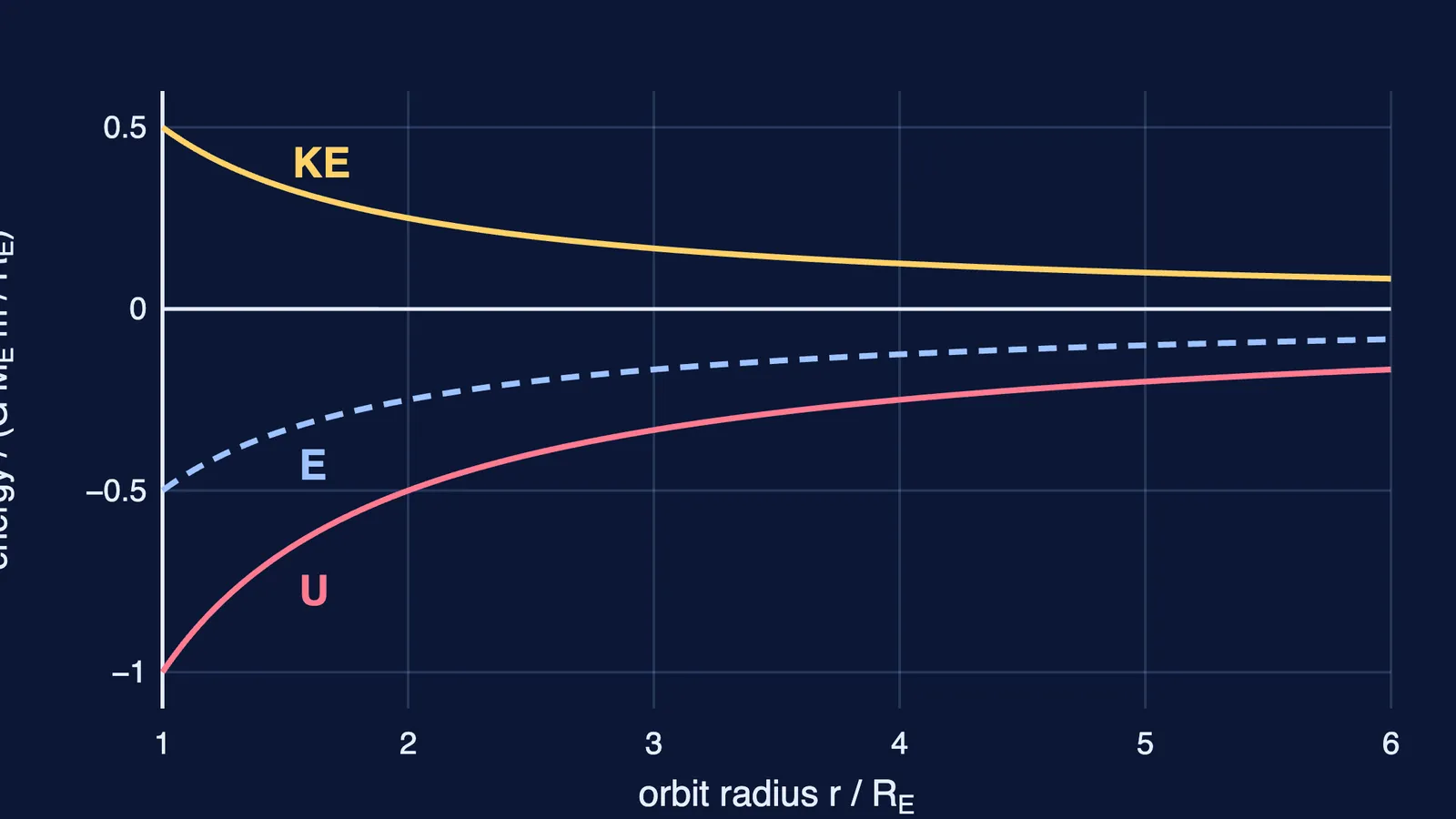
Kinetic energy of a satellite: GM_E m/2(R_E + h), in joules, positive and half the size of its potential energy.
Total energy of a satellite: E = −GM_E m/2(R_E + h), in joules, always negative.
Bound orbit: negative total energy keeps the satellite at a finite distance; zero or positive total energy lets a body escape.
For worked numbers, see Gravitation for NEET: how to prepare, with worked examples.
How to learn these terms
Learn the pairs together: G and g, potential and potential energy, orbital and escape speed.
Sketch g against distance from Earth's centre: a straight rise inside, a peak at the surface, a 1/r² fall outside.
For satellites, remember KE : U : E = 1 : −2 : −1.
If a word stays fuzzy, open it in the Fermi Concept Library, where each concept has its own lesson and its place in the map.