On this page
Grassroots Democracy — Part 1: Governance is Chapter 10 of Exploring Society: India and Beyond, NCERT's Social Science textbook for Grade 6 (book code fees1, First Edition June 2024) (NCERT chapter PDF). It is the second chapter of Theme D, Governance and Democracy, after Chapter 9, and sets up Chapters 11 and 12 on local government (NCERT contents).
CBSE publishes no separate 2026-27 curriculum for Classes 6 to 8; they follow the NCERT book, and the chapter is assessed by the school.
What does governance mean in Class 6?
The chapter starts simply: people living together need rules, or society cannot work. In the book's terms, governance is the whole process of taking decisions, organising life through rules and making sure the rules are followed (NCERT Ch. 10). The government is the group of people, or the system, that makes those rules and enforces them. The book calls some of the more important rules laws.
Rules are not fixed forever: citizens have a say in changing them.
What are the three organs of government?
The chapter introduces them through an example about cybercrime, criminals who steal money by digital means (NCERT Ch. 10):
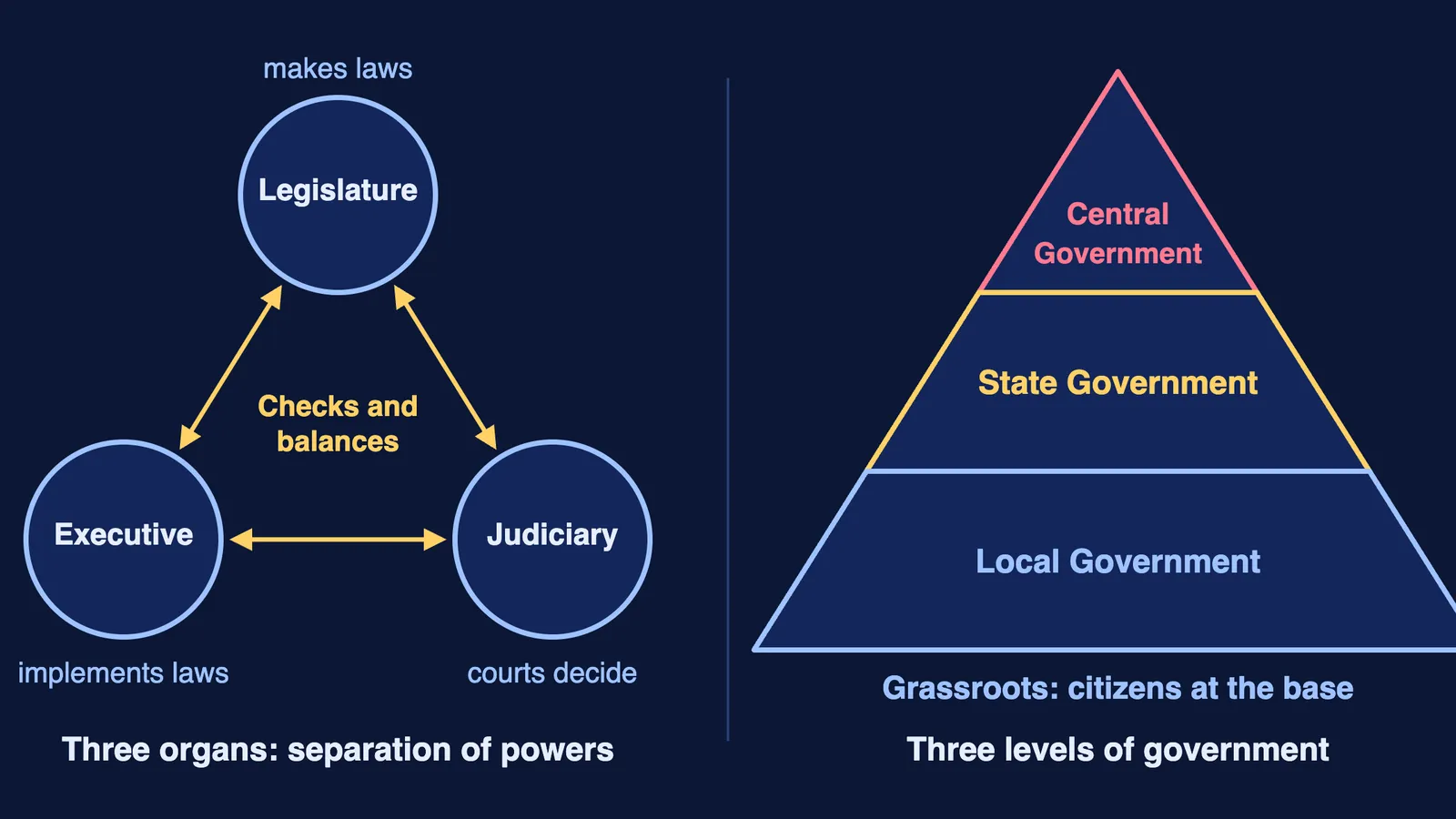
Legislature: an assembly of the people's representatives that makes new laws, and updates or removes old ones.
Executive: puts the laws into action. It includes the head of state, the ministers and agencies that enforce law and order, such as the police.
Judiciary: the courts. They decide whether a law was broken and what should follow, and sometimes examine whether an executive decision is right or a law is fair to all.
Keeping the three apart is called the separation of powers. It creates checks and balances: each organ can watch the others and correct one that goes beyond its role.
What are the three levels of government in India?
India's government works at three levels: local (town or village), State, and Central or Union (NCERT Ch. 10). Each deals with different matters. In the book's flood example, local authorities handle a small flood, the State a wider one, and the Centre may help in a massive one.
Fig. 10.5 gives the Central executive defence, foreign affairs, atomic energy, communications, currency, inter-state commerce, education and national policies. The State list includes police and law and order, public health, education, agriculture, irrigation and local government. Education appears in both. At the national level, laws are made by two houses, the Lok Sabha and the Rajya Sabha; most States have one assembly, the Vidhan Sabha. The President of India and a State's Governor are nominal heads; the Prime Minister and the Chief Minister are the executive heads.
Worked example: following one new rule through the organs
A made-up case, not real traffic law: imagine a fictional State where many children ride on two-wheelers without helmets.
Legislature: the State assembly debates the problem and passes a law that every child on a two-wheeler must wear a helmet.
Executive: the police, the agency for law and order, check riders and act against those who break it. Police and law and order sit on the State list in Fig. 10.5.
Judiciary: when a rider disputes the charge, a court decides whether the law was broken and what should follow. Courts can also examine whether the law itself is fair.
Checks and balances: the police neither write the rule nor judge disputes.
How is direct democracy different from representative democracy?
The word democracy joins the Greek dēmos (people) and kratos (rule or power): rule of the people (NCERT Ch. 10). In a direct democracy, everyone votes on the decision themselves. In a representative democracy, people elect members (MLAs in the State, MPs at the national level) who discuss and decide for them. The book calls India a representative democracy and the world's largest, counting some 970 million voters in 2024. It adds that, in principle, Indian citizens above 18 have the right to vote in these elections.
Our own example: a cricket club voting by show of hands on its jersey colour is direct democracy; electing a captain to speak for the club is representative.
Grassroots democracy means ordinary citizens, the base of the three-level pyramid, take part and have a say in decisions that affect them. Chapters 11 and 12 cover rural and urban local government; our Panchayati Raj Class 6 guide explains Chapter 11. The Class 9 chapter on governance and public policy picks up the same ideas.
Practice questions (mark labels are our suggestion)
Define governance and government in one sentence each. (2 marks)
A State bans plastic bags, an inspector fines a shop, and the shopkeeper goes to court. Match each step to an organ. (3 marks)
A town's flood spreads across several districts. Which levels of government step in, and in what order? (3 marks)
Is a school council election an example of direct or representative democracy? Explain. (2 marks)
Stuck on which organ does what? Fermi's AI tutor works out what you already know and builds a plan for the session.