On this page
Globalisation is the last chapter, chapter 7, of NCERT's Contemporary World Politics. The CBSE Political Science curriculum for 2026-27 gives it 4 marks out of the 40 for Part A and keeps all five topics: the concept, causes and consequences, India and globalisation, resistance, and India and resistance. This guide follows the current NCERT chapter (reprint 2026-27). For the 1991 reforms in detail, read our LPG reforms 1991 guide for Class 12.
What is globalisation in Class 12 Political Science?
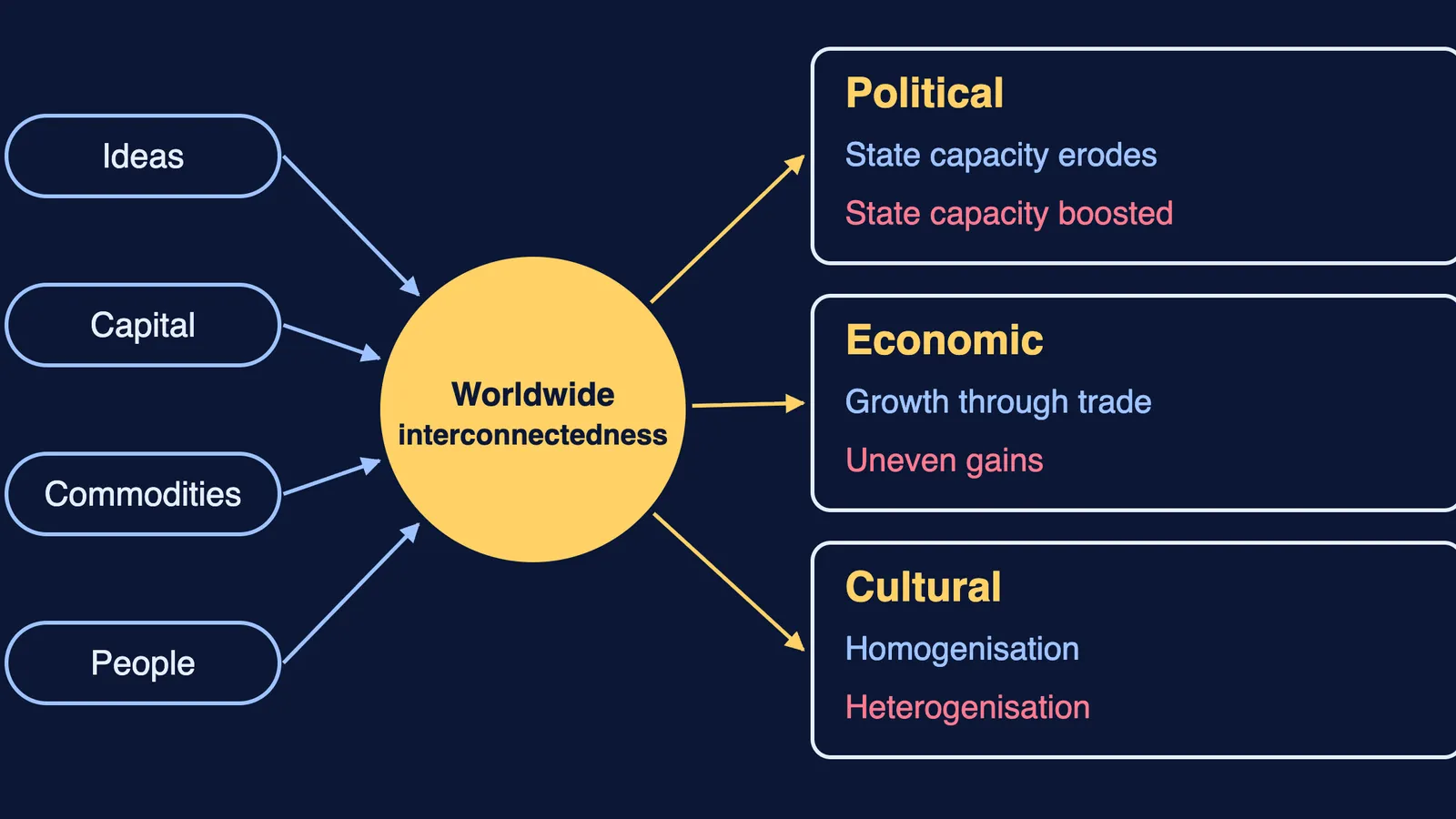
In the NCERT chapter, globalisation means flows of ideas, capital, commodities and people across the world, and the "worldwide interconnectedness" those flows create.
Three points to remember:
It is multidimensional: political, economic and cultural, not only one of these.
Its impact is uneven across societies, and within them, so judge it in context.
It is not new or one-way. The flows run through history, and influence does not only travel from rich countries to poor ones.
Picture a student in Pune: her phone runs software written abroad (ideas), her father's employer has a foreign investor (capital), her shoes were made in another country (commodities), and her cousin works in the Gulf (people). Four flows, one interconnected life.
What are the causes of globalisation?
No single factor causes it, but technology is critical: the telegraph, the telephone and the microchip changed how the world communicates. What is new today is the scale and speed of the flows.
People must also recognise that events in one place affect another; NCERT's examples are bird flu and a tsunami, which ignore borders. Capital and commodities usually move faster and further than people.
What are the political, economic and cultural consequences?
Political. Globalisation can erode state capacity. The welfare state gives way to a minimalist state that keeps law and order and security but steps back from welfare, while the market sets priorities and multinational companies (MNCs) narrow what governments can decide alone. Yet the state remains the basis of political community, and technology helps it gather information on citizens, so its capacity can be boosted.
Economic. Barriers to imports and to the movement of capital have fallen, and ideas spread through the internet. People move far less freely, because developed countries guard their borders with visa policies. Advocates say deregulation brings growth, that trade lets each economy do what it does best, and that globalisation cannot be stopped. Critics concerned with social justice say gains go to a few and call for "social safety nets"; some economists call it recolonisation. The institutions involved, such as the IMF and the WTO, are covered in our International Organizations Class 12 guide.
Cultural. The fear is cultural homogenisation: critics argue that a "global culture" is really Western, especially American, culture spreading as the soft power of US hegemony, sometimes called McDonaldisation. But the same process also produces cultural heterogenisation, where cultures become more distinct. NCERT's example is a khadi kurta worn over jeans, a mix that travelled back to America.
How did India experience and resist globalisation?
Under colonial rule India exported raw materials and bought finished goods, so after independence it chose protectionism. NCERT says this left health, housing and primary education neglected and growth sluggish. In 1991, facing a financial crisis and wanting faster growth, India began reforms to deregulate trade and foreign investment. NCERT's test of success is not growth alone but whether its benefits are shared.
Resistance comes from both sides. The left says globalisation makes the rich richer and the poor poorer. The right fears a weaker state, wants some self-reliance and worries about traditional culture. Many anti-globalisation movements network globally and oppose a specific programme rather than globalisation itself.
For one-mark questions:
1999: protests at the WTO Ministerial Meeting in Seattle over unfair trading practices.
World Social Forum (WSF): a broad platform where activists for human rights, the environment, workers, young people and women oppose neo-liberal globalisation; first meeting Porto Alegre, Brazil, 2001; fourth in Mumbai, 2004; the latest meeting NCERT lists was in Nepal in February 2024.
In India: left-wing protests and the Indian Social Forum, trade union and farmer protests against MNCs, opposition to foreign patents on plants such as neem, and right-wing objections to foreign TV channels, Valentine's Day and western dress.
How is this chapter asked in the board exam?
The 2026-27 sample paper asks from this chapter a one-mark question on the WSF's aim, an assertion-reason item on Western cultural influence, and a 2-mark question on the advocates' arguments. Two-mark answers stay within 50-60 words, and cartoon or passage questions can come from either book. Try these:
(1 mark) Name the phenomenon in which cultures become more distinct through globalisation.
(2 marks) Give two arguments made by critics of economic globalisation.
(4 marks) "Globalisation always weakens the state." Assess this view with two arguments on each side.
(4 marks) Using one Indian example, explain how outside cultural influence can enlarge choices.
Revising several chapters at once? Fermi's AI tutor can work out what you already know and build a plan for the session, so you start with a clear next step.