On this page
The last chapter of NCERT's India: People and Economy, Geographical Perspective on Selected Issues and Problems, covers pollution, urban waste, rural–urban migration, slums and land degradation.
How many marks is this chapter worth in 2026-27?
The CBSE Geography curriculum for 2026-27 gives Chapter 9 a weightage of 5 marks, out of 35 for the India: People and Economy book. It keeps five topics: pollution and its types, urban-waste disposal, rural–urban migration (case study), problems of slums, and land degradation (case study). The map list says "Nil" for this chapter.
In the 2026-27 sample paper, Question 26 is a 5-mark long answer with a choice: turning urban waste into resources, or why noise pollution is hazardous in big cities. Long answers run 120 to 150 words. The marking scheme lists five points, I to V, for each option.
What are the four types of pollution in Class 12 geography?
NCERT classifies pollution by the medium that carries pollutants: air, water, land and noise (NCERT Chapter 9).
Water: industry is the biggest human source, led by leather, pulp and paper, textiles and chemicals. Farm chemicals and pilgrimages add more.
Air: burning fossil fuels, mining and industry release oxides of sulphur and nitrogen, carbon monoxide, lead and asbestos, causing respiratory diseases, urban smog and acid rain.
Noise: measured in decibels. Traffic is the biggest nuisance. It is location specific and weakens with distance.
Land: garbage, excreta, untreated industrial waste and pesticide and fertiliser residues.
The textbook cites the World Health Organization as showing that about one-fourth of communicable diseases in India are water-borne. It names polluted stretches of the Ganga (downstream of Kanpur and Varanasi) and the Yamuna (Delhi to the Chambal confluence), and lists the aims of the Namami Gange Programme.
Why is urban waste disposal a problem in India?
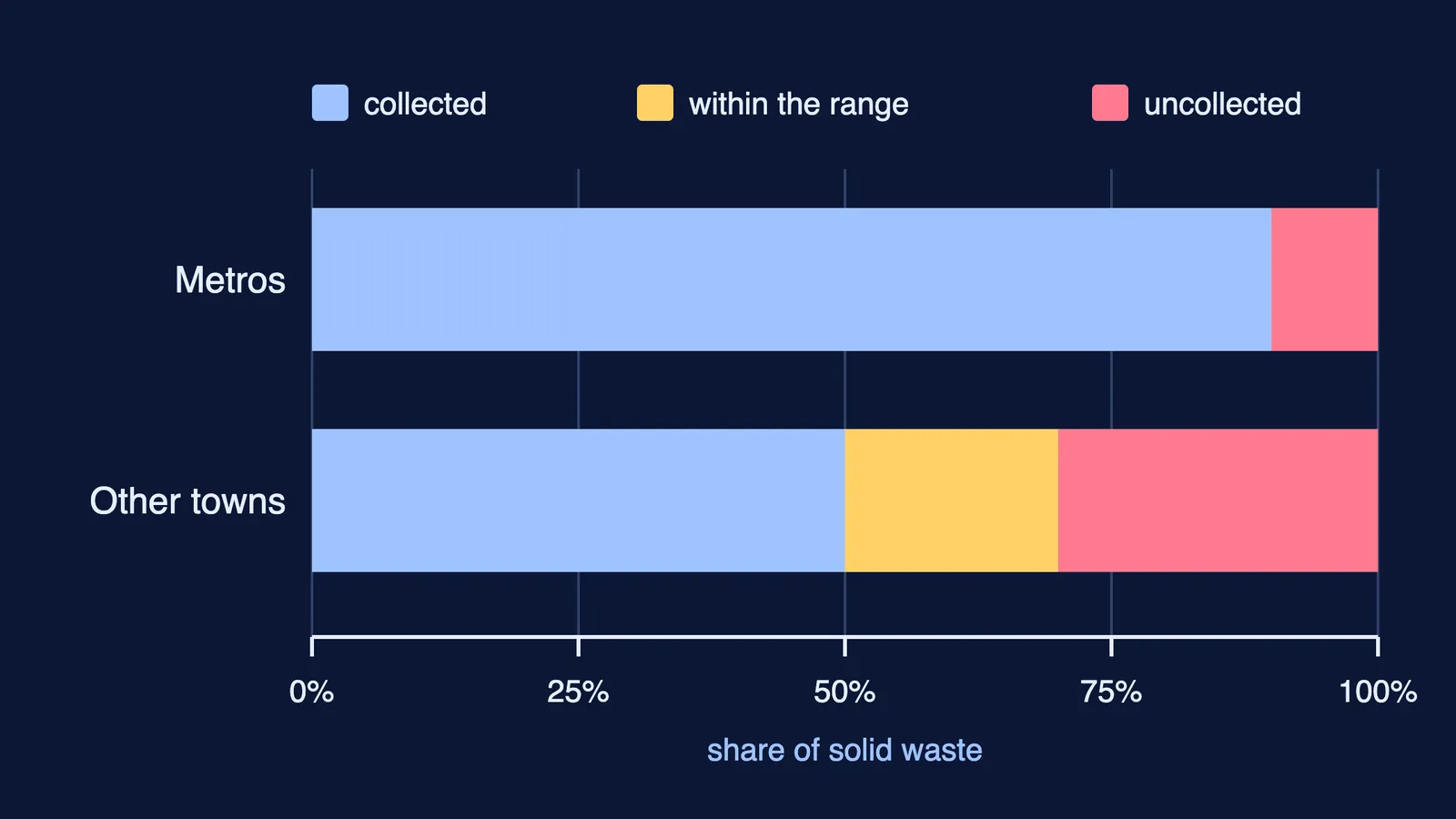
NCERT says metropolitan cities like Mumbai, Kolkata, Chennai and Bengaluru collect and dispose of about 90 per cent of their solid waste, but most other cities and towns leave about 30 to 50 per cent uncollected (NCERT Chapter 9). Uncollected waste draws flies and rodents that spread typhoid, malaria and cholera, and untreated waste ferments, releasing methane. NCERT's answer: treat waste as a resource for energy and compost.
The Daurala case study (near Meerut) applies "polluter pays". Untreated industrial wastewater had put heavy metals into the village groundwater. The village's plight drew public attention in 2003. A Meerut NGO, Daurala's industries, officials and villagers then worked together on a 900 m drinking-water pipeline, a desilted pond, rainwater harvesting and 1,000 trees. For how water quality is measured, see our explainer on BOD and dissolved oxygen.
How are rural–urban migration and slums linked?
Demand for labour in cities, few rural jobs and uneven development push people to cities, and the poor often bypass small towns for mega cities (NCERT Chapter 9). In the case study, Ramesh earned Rs 20 a day in a Ludhiana woollen factory in 1988, learnt welding in Surat, and now sends Rs 20,000 a year home, but lives apart from his family. Low wages keep families in the village, so the migration stream is mostly male.
Migrants who cannot afford city rents end up in slums: dilapidated housing, poor ventilation, little drinking water, light or sanitation, and low-paid, risky unorganised work. NCERT links the Swachh Bharat Mission to improving slum life.
How does NCERT explain land degradation?
Land degradation is a temporary or permanent fall in land's productive capacity, caused by soil erosion, waterlogging, salinisation and alkalinisation (NCERT Chapter 9). The National Remote Sensing Centre's wasteland classes sort by cause:
Natural: ravines, desert or coastal sands, barren rock, steep slopes, glacial areas.
Natural and human: waterlogged, marshy, saline or alkaline land.
Human: degraded forests, pastures and shifting cultivation areas, and mining and industrial wastelands.
In Jhabua district (Madhya Pradesh), the Ministry of Rural Development's programmes alone treated 20 per cent of the district's area over five years. In Petlawad block, Bhil households each planted a tree on common land, sowed fodder grass and switched to stall feeding. Our Land Resources and Agriculture guide explains common property resources.
How do you write a 5-mark answer on this chapter?
Worked plan for "Explain how community participation reversed land degradation in Jhabua":
Define land degradation in one line.
Locate Jhabua: Madhya Pradesh, mainly Bhil population.
Name the tool: watershed management, linking land, water and vegetation.
Give evidence: 20 per cent of the area treated; trees, fodder grass, stall feeding.
Close on the lesson: the encroacher became a group member, so everyone shared the benefit.
Practice questions we wrote:
(3 marks) Why is noise pollution called location specific?
(3 marks) Why is uncollected waste a health risk in smaller towns?
(5 marks) "Migration and slums are two sides of one problem." Examine.
(5 marks) Classify wastelands by the processes that create them.
If you don't know where to start, Fermi's AI tutor can work out what you already know and build a plan for the session, so you sit down to a clear next step.