On this page
These eight original questions mix single-correct, one-or-more-correct and numerical-value formats, and each solution ends with the trap that catches most students.
What does JEE Advanced test in gases and liquids?
The official JEE (Advanced) 2026 syllabus names this unit "States of Matter: Gases and Liquids". It covers gas laws, van der Waals deviation, kinetic theory with average, rms and most probable speeds, partial pressures, diffusion, intermolecular forces, and vapour pressure, surface tension and viscosity. For theory and a plan, read how to prepare gases and liquids for JEE Advanced; for the formats, see JEE Advanced question types.
Data: R = 0.08314 L bar mol⁻¹ K⁻¹ = 8.314 J mol⁻¹ K⁻¹ (NIST molar gas constant), N_A = 6.022 × 10²³ mol⁻¹ (NIST Avogadro constant); H 1, C 12, O 16 g mol⁻¹.
How should you use this set?
Cover the solutions and allow about 30 minutes.
Write the governing relation before any numbers.
Log each miss by cause and redo it two days later.
Easy: partial pressures and vapour pressure
Q1 (easy, single correct). Bulb A (2.0 L) holds N₂ at 3.0 bar and bulb B (3.0 L) holds O₂ at 1.0 bar, both at 300 K. The tap is opened at constant temperature. What is the final partial pressure of O₂?
(A) 0.40 bar (B) 0.60 bar (C) 0.90 bar (D) 1.0 bar
Answer: (B). At constant T, moles scale with pV. O₂ brings 3.0 bar L into 5.0 L, so p(O₂) = 0.60 bar (total 1.8 bar).
Trap: (D) forgets that O₂ now fills 5.0 L.
Q2 (easy, single correct). A pure liquid is in equilibrium with its vapour under a piston. Which change raises the equilibrium vapour pressure?
(A) Pushing the piston in at constant temperature (B) Adding more liquid (C) Raising the temperature (D) Increasing the liquid's surface area
Answer: (C). A pure liquid's vapour pressure depends only on temperature. Compression just condenses some vapour; a larger area speeds evaporation and condensation equally.
Trap: (A) applies Boyle's law to a vapour in contact with its liquid.
Medium: speeds, effusion and a closed flask
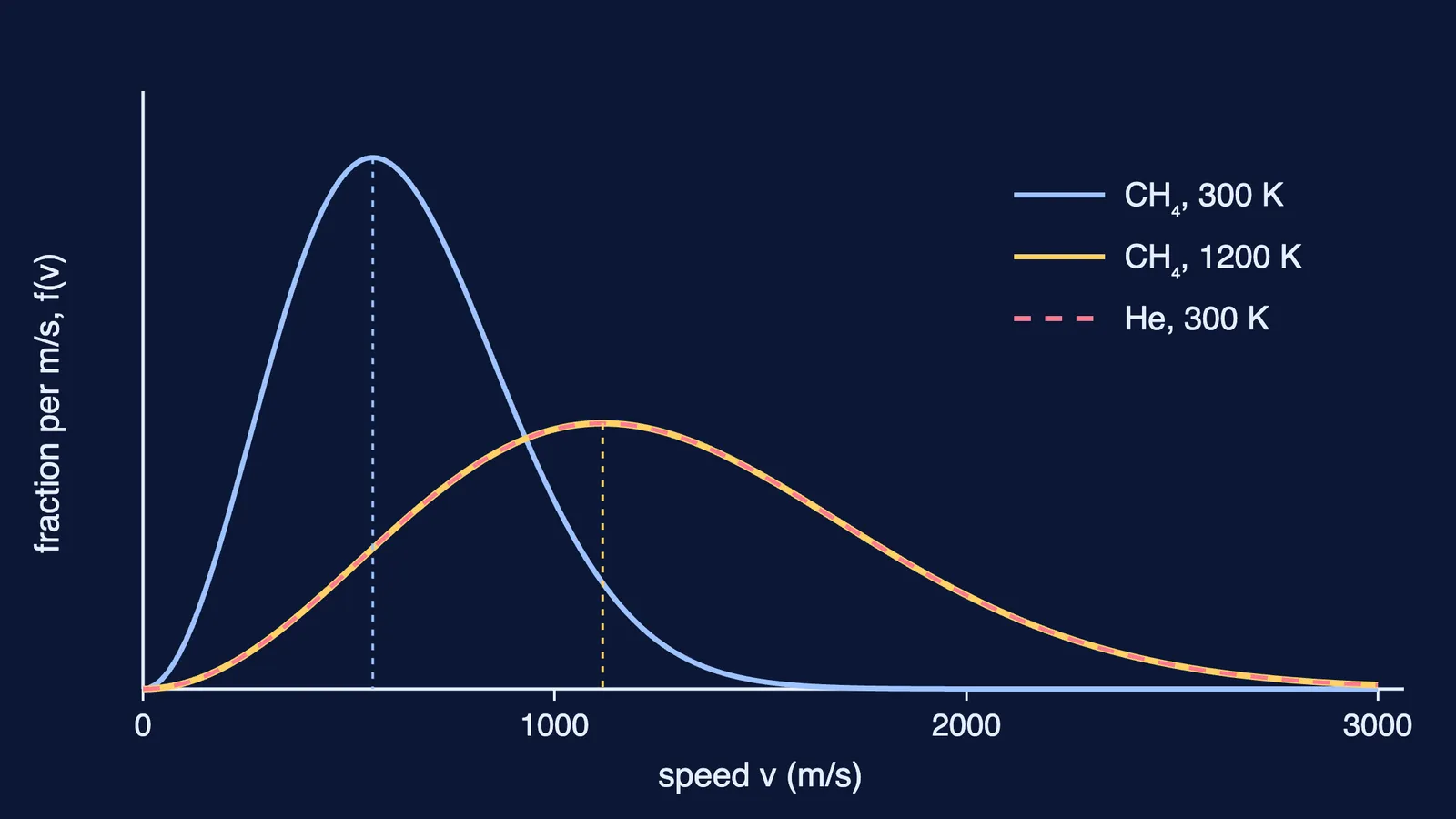
Q3 (medium, one or more correct). Compare He (4 g mol⁻¹) at 300 K with CH₄ (16 g mol⁻¹) at 1200 K. Which are correct?
(A) Their most probable speeds are equal. (B) Their average kinetic energies per molecule are equal. (C) Their Maxwell speed-distribution curves are identical. (D) The rms speed of CH₄ is twice that of He.
Answer: (A), (C). Every speed depends on T/M, which is 75 K mol g⁻¹ for both, so the curves coincide (v_mp = 1117 m s⁻¹, v_rms = 1368 m s⁻¹ each) and (D) fails. Kinetic energy per molecule depends on T alone, so CH₄ has four times as much.
Trap: (B); at equal speed the heavier molecule carries more energy.
Q4 (medium, numerical). Under identical conditions, equal volumes of O₂ and an alkane CₙH₂ₙ₊₂ effuse through one pinhole. O₂ takes 40 s and the alkane takes 60 s. Find n.
Answer: 5. t ∝ √M, so M = 32 × (60/40)² = 72 g mol⁻¹, and 14n + 2 = 72 gives n = 5.
Trap: dropping the square gives M = 48 and a non-integer n.
Q5 (medium, numerical). 0.360 g of water is put into an evacuated rigid 10.0 L flask held at 300 K. Take the vapour pressure of water at 300 K as 3.5 kPa. What mass of liquid water, in mg, remains at equilibrium?
Answer: about 107 mg. All-vapour would give nRT/V = 4.99 kPa, above 3.5 kPa, so liquid remains. Vapour mass = pVM/RT = 0.253 g, leaving 0.107 g liquid.
Trap: answering 0 without comparing with the vapour pressure.
Hard: real gases and connected flasks
Q6 (hard, one or more correct). Gas P has van der Waals constants a = 4.2 L² bar mol⁻² and b = 0.037 L mol⁻¹; gas Q has a = 2.3 L² bar mol⁻² and b = 0.043 L mol⁻¹. Which statements are correct?
(A) At 300 K, P can be liquefied by compression alone but Q cannot. (B) The critical pressure of Q is higher than that of P. (C) The molar volume of P at its critical point is 0.111 L mol⁻¹. (D) At the critical point, Z of P exceeds Z of Q.
Answer: (A), (C). Tc = 8a/27Rb, Pc = a/27b², Vc = 3b. P: Tc = 405 K, Pc = 114 bar. Q: Tc = 191 K, Pc = 46 bar. At 300 K, P is below its Tc and Q above it: (A) holds, (B) fails. Vc = 0.111 L mol⁻¹: (C) holds. Zc = 3/8 for every van der Waals gas: (D) fails.
Trap: (D); a and b cancel out of Zc.
Q7 (hard, numerical). At 400 K a gas has compression factor Z = 1.090 at 100 bar. Neglect the a-term, so Z ≈ 1 + bP/RT. Taking b as four times the volume of a mole of spherical molecules, find the molecular radius in pm.
Answer: about 144 pm. b = (Z − 1)RT/P = 0.090 × 0.08314 × 400/100 = 2.99 × 10⁻⁵ m³ mol⁻¹. One molecule's volume is b/4N_A = 1.24 × 10⁻²⁹ m³; r = (3V/4π)^(1/3) = 1.44 × 10⁻¹⁰ m.
Trap: dropping the factor of 4 (b is excluded volume) gives 228 pm.
Q8 (hard, one or more correct). Flask A (1.0 L) and flask B (2.0 L), joined by a thin tube, hold an ideal gas at 300 K and 1.00 bar. Flask A stays at 300 K; flask B is heated to 600 K. Which are correct at steady state?
(A) The pressure becomes 1.50 bar. (B) Flask A now holds half of the gas. (C) The average kinetic energy per molecule in B is √2 times that in A. (D) The number density in B is half that in A.
Answer: (A), (B), (D). Pressure is equal and total moles fixed: P(1/300 + 2/600) = 3/300, so P = 1.50 bar. At equal P, n ∝ V/T, so A : B = 1 : 1, and number density (∝ P/T) halves in B. Energy per molecule doubles; √2 is the rms speed ratio.
Trap: (C), mixing up energy and rms speed.
The Fermi Problem Library has worked problems with a step-by-step solver that explains the reasoning rather than printing an answer. Next, read how to prepare chemical thermodynamics for JEE Advanced.