On this page
The official JEE (Advanced) 2026 syllabus names this unit "States of Matter: Gases and Liquids" and says the 2026 syllabus is the same as 2025. The 2027 syllabus had not been published as of 19 November 2026, so use the 2026 list.
JEE (Advanced) 2027 is on 23 May 2027, organised by IIT Delhi (JEE (Advanced) website). Among the eligibility criteria, you must be in the top 2,50,000 of the JEE (Main) 2027 B.E./B.Tech paper.
What does the JEE Advanced syllabus say about gases and liquids?
The 2026 syllabus lists:
Gas laws and ideal gas equation, absolute scale of temperature
Deviation from ideality, van der Waals equation
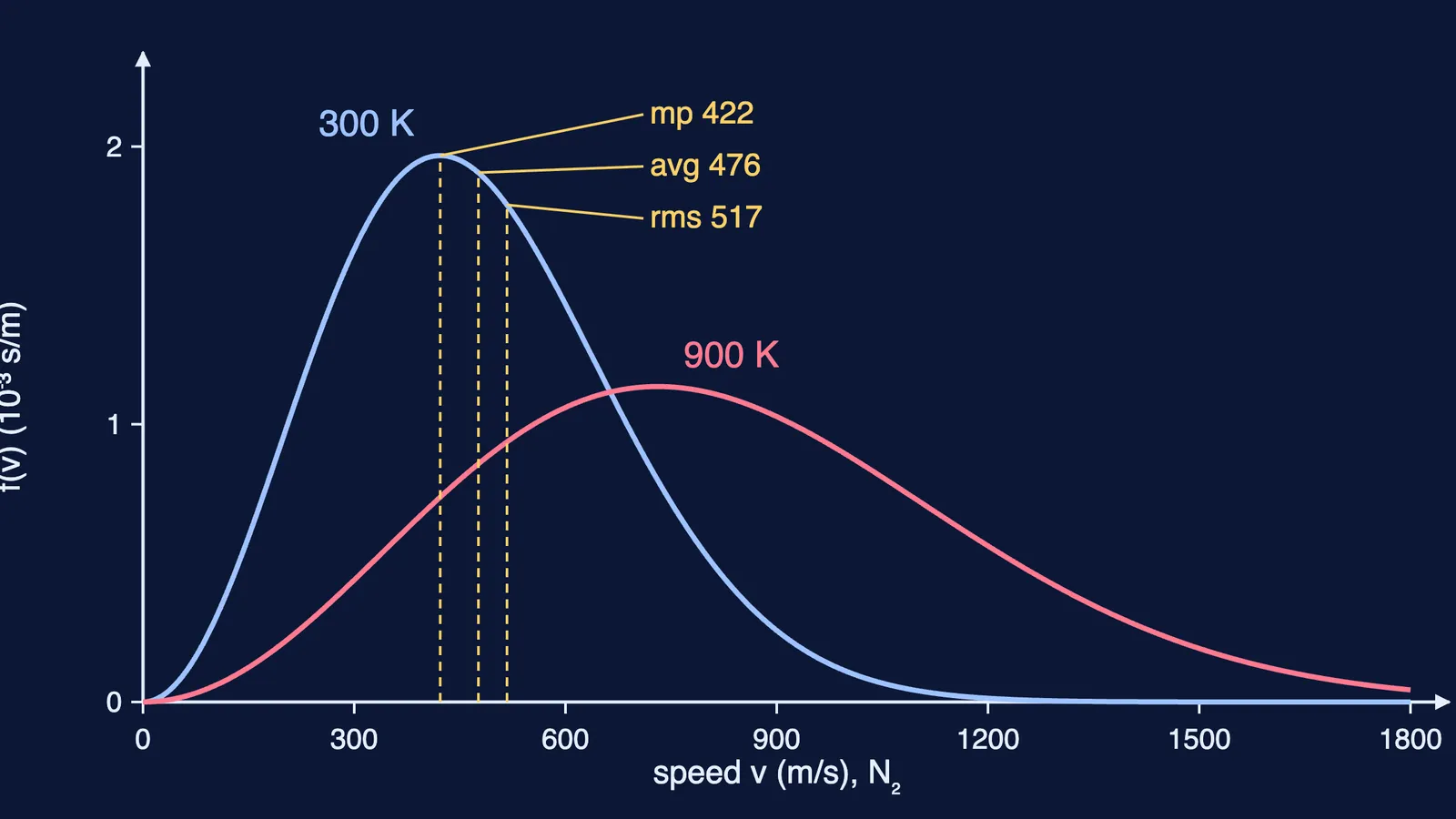
Kinetic theory of gases, average, root mean square and most probable velocities and their relation with temperature
Law of partial pressures; diffusion of gases
Intermolecular interactions: types, distance dependence, and their effect on properties
Liquids: vapour pressure, surface tension, viscosity
JEE (Advanced) 2026 had two compulsory papers of three hours each (2026 Information Brochure). Formats change yearly; see our guide to JEE Advanced question types.
Which parts go beyond JEE Main?
The JEE (Main) 2027 syllabus has no States of Matter unit in Chemistry. Its Physics units cover the perfect-gas equation, RMS speed, mean free path, surface tension and viscosity; its Chemistry units name hydrogen bonding and the vapour pressure of solutions. It does not name:
deviation from ideality and the van der Waals equation
average and most probable speeds
partial pressures and diffusion of gases
intermolecular interactions as a topic
The pressure and rms ideas from our kinetic theory guide for JEE Main carry over; the rest is new work.
What do Advanced-level gas problems look like?
All are original. Use R = 0.08314 L bar mol⁻¹ K⁻¹, the NIST molar gas constant converted.
Example 1 (more than one correct). Gas X has a = 3.6 L² bar mol⁻² and b = 0.040 L mol⁻¹; one mole is in 1.0 L at 300 K. Which are true? (A) Z < 1. (B) The Boyle temperature is about 1080 K. (C) At fixed volume and very high T, Z exceeds 1. (D) P exceeds the ideal-gas value.
Use Z = V/(V − b) − a/(RTV) = 1.0417 − 0.1443 = 0.897: (A) true. a/(Rb) = 3.6/(0.08314 × 0.040) = 1082 K: (B) true. As T grows the a-term vanishes, so Z tends to V/(V − b) = 1.042: (C) true. P is 22.4 bar against 24.9 bar ideal: (D) false. Answer: A, B, C.
Example 2 (numerical). A mixture of H₂ (M = 2 g mol⁻¹) and gas Y has partial pressures 0.30 bar and 0.60 bar. The first gas to effuse through a pinhole contains H₂ and Y in the mole ratio 2 : 1. Find the molar mass of Y.
Effusion rate is proportional to p/√M, not 1/√M. So 2 = (0.30/0.60) × √(M/2), √(M/2) = 4 and M = 32 g mol⁻¹. Ignoring partial pressures gives 8 g mol⁻¹.
Example 3 (numerical). Air over liquid water in a cylinder at 300 K has total pressure 1.000 bar; take water's vapour pressure as 0.035 bar. The volume is halved isothermally and liquid remains. Find the new total pressure.
Dry air doubles from 0.965 to 1.930 bar. Water vapour stays at 0.035 bar: with liquid present, vapour pressure depends only on temperature, so the excess condenses. Total: 1.965 bar, not 2.000 bar.
Unsure why the a-term lowers Z? The Fermi Concept Library covers every concept in physics, chemistry, biology, mathematics and computing, each with its own lesson and its place in the map.
How should you practise this unit over four weeks?
Week 1: gas laws, partial pressures and Graham's law with p/√M.
Week 2: van der Waals and Z. Check every answer against limiting cases (a → 0, b → 0, large V) and dimensions: a/(Rb) must come out in kelvin.
Week 3: kinetic theory. Learn v_mp : v_avg : v_rms = √2 : √(8/π) : √3, about 1 : 1.128 : 1.225, and how the distribution flattens as temperature rises.
Week 4: intermolecular forces and liquids (rank vapour pressure, surface tension and viscosity by force strength), then timed mixed sets with an error log.
Finding some of these ideas hard to picture? The Fermi Simulation Lab has interactive simulations for the ideas that are easier to see than to read.
Practice questions (original):
At what temperature does the most probable speed of He (4.0 g mol⁻¹) equal the rms speed of N₂ (28 g mol⁻¹) at 300 K? Answer: about 64.3 K.
Gas W has a = 1.4 L² bar mol⁻² and b = 0.035 L mol⁻¹. Find its Boyle temperature. Answer: about 481 K.
He (4.003 g mol⁻¹) at 0.20 bar and CH₄ (16.04 g mol⁻¹) at 0.60 bar effuse through a pinhole. Find the He : CH₄ mole ratio in the first gas out. Answer: about 0.667.
Next, read how deep to study Chemistry for JEE Advanced.