On this page
A loop drawn on paper can always shrink to a dot. A loop round a nail cannot: the nail gets in the way. The fundamental group turns that difference into algebra, and with a few pictures it is within reach of a strong Class 12 student.
What is the fundamental group, in plain words?
The definitions here follow the fundamental group article on Wikipedia, which cites Allen Hatcher's standard textbook. Fix a point x₀ in a space X, called the base point. A loop is a continuous path that starts and ends at x₀.
Two loops count as the same if one can be deformed into the other without breaking, while the base point stays put. That deformation is called a homotopy.
The fundamental group π₁(X, x₀) is the set of loops at x₀ up to homotopy, where you combine two loops by going round the first and then the second.
The identity is the constant loop at x₀ (and every loop that shrinks to it); the inverse of a loop is the same loop run backwards. Henri Poincaré defined the fundamental group in 1895, in his paper Analysis Situs.
New to topology? Our post on why topologists treat a coffee mug as a doughnut is a gentler start.
Why is the fundamental group of the circle Z?
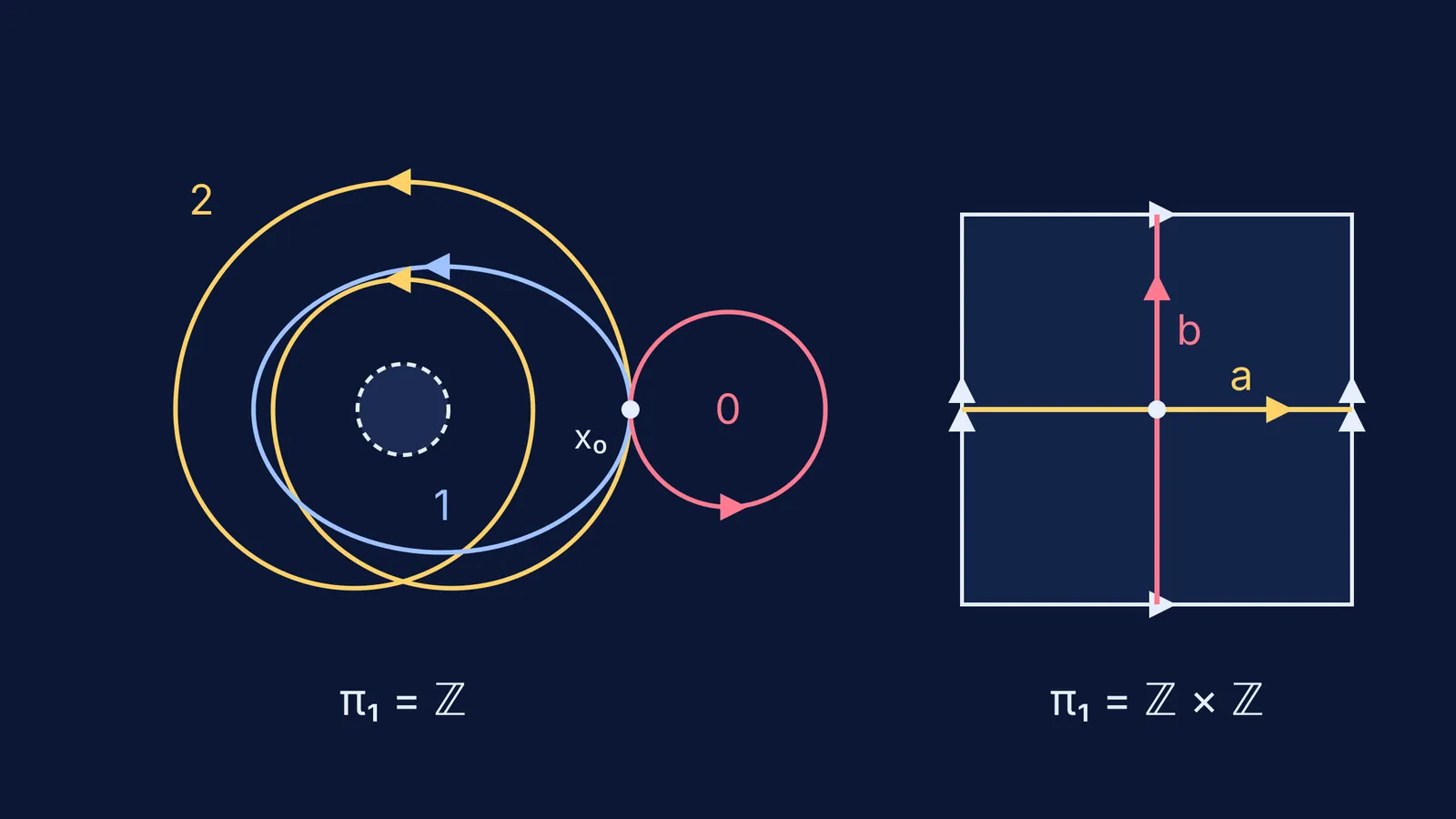
On the circle, a loop's class depends only on how many times it winds round, counted positive one way and negative the other (Wikipedia: the circle). Joining a loop that winds m times to one that winds n times gives one that winds m + n times. So π₁(S¹) is isomorphic to the integers under addition, Z.
A loop that goes round twice can wobble and backtrack as much as it likes, but no deformation turns it into one that goes round once: the count would have to jump from 2 to 1. A plane with one point removed has the same group, Z. The picture at the top shows loops winding 0, 1 and 2 times round such a hole.
Why are the disc and the sphere simply connected?
A path-connected space whose fundamental group is trivial is called simply connected (Wikipedia: the 2-sphere). In a disc, or any convex region, you slide every point of a loop along a straight line towards the base point, so every loop shrinks to a point while the base point stays put.
The sphere is simply connected too. A loop that misses one point can be pushed away from it and shrunk, but some loops pass through every point of the sphere, so a full proof needs more careful tools, such as the Seifert–van Kampen theorem.
What is the fundamental group of the torus?
The torus, the surface of a doughnut, has fundamental group Z×Z (Wikipedia: oriented surfaces). Picture it as a square with opposite edges glued. Loop a goes once round the long way, loop b once through the hole, and every loop is classified by a pair of integers (m, n): how many times it goes round each way.
The key relation is aba⁻¹b⁻¹ = 1. Put the base point at a corner, so a and b run along the square's edges. Going a, then b, then back along a, then back along b, traces the boundary of the square, and the square is a disc you can shrink. So ab = ba, which is why the answer is the commutative group Z×Z.
How does the fundamental group prove Brouwer's fixed-point theorem?
Brouwer's fixed-point theorem says every continuous map from a closed disc to itself leaves some point fixed. Jacques Hadamard proved the general case in 1910, and Brouwer published his own general proof in 1911 in Mathematische Annalen, volume 71. In two dimensions the fundamental group gives a short proof, set out in the Wikipedia article on the theorem. Work through it:
Suppose a continuous f from the disc D to itself has no fixed point, so f(x) ≠ x for every x.
Draw the ray from f(x) through x until it meets the boundary circle at r(x).
r is continuous and fixes every point already on the circle: a retraction of the disc onto its edge.
It would give a surjective homomorphism from π₁(D), which is trivial, onto π₁(S¹) = Z. A one-element group cannot map onto Z, so some point is fixed.
For a combinatorial route to the same theorem, see Sperner's lemma and its triangle colouring proof, and for what loops do to the plane, the Jordan curve theorem and the ray test.
How should you learn this, step by step?
Draw loops in a disc and a ring, and decide by hand which ones shrink.
Compute winding numbers with the ray-crossing count above.
Draw the torus square and check that aba⁻¹b⁻¹ traces its boundary.
Rewrite the Brouwer proof from memory in four lines.
If a word such as homotopy or isomorphism is shaky, look it up in the Fermi Concept Library. To practise with the reasoning explained step by step, try the Fermi Problem Library.