

On this page
Topology ignores length, angle and size, and keeps only what survives when a shape is stretched or bent without tearing. You can test every idea in it with a cube, a football and a cup of chai.
What is topology in simple words?
Topology studies the properties of a shape that are preserved under continuous deformations such as stretching, twisting, crumpling and bending, without opening holes, closing holes, tearing or gluing (Wikipedia: Topology).
Think of every object as soft clay. You may press, pull and roll it, but not poke a new hole, seal an old one, or cut and re-stick it. Two shapes are the same if one can become the other under those rules. So a cricket ball and a brick are the same to a topologist. What tells shapes apart is coarser: how many pieces, and how many holes go right through.
In 1736 Leonhard Euler proved that nobody could walk across all seven bridges of Königsberg exactly once, and that argument "laid the foundations of graph theory and foreshadowed the idea of topology" (Wikipedia: Seven Bridges of Königsberg).
Why is a coffee mug the same as a doughnut?
A continuous transformation can turn a coffee mug into a doughnut, which is why people joke that a topologist cannot tell the two apart (Wikipedia: Topology).
Picture a clay mug. Push the bottom up until the hollow disappears, then let the lump shrink into the handle. You are left with a ring, a torus. The hole your finger goes through was never opened or closed.
Mathematicians call the number of holes of a surface its genus. A sphere has genus 0, while a torus has genus 1, as does the surface of a coffee mug with a handle (Wikipedia: Genus)).
Try sorting things at home by genus, treating each as solid clay:
Genus 0: a ball, a steel plate, a tumbler, a pencil.
Genus 1: a mug, a bangle, a rubber band, a drinking straw.
Genus 2: a pair of scissors (two finger loops), a two-hole button.
How does V − E + F count the holes?
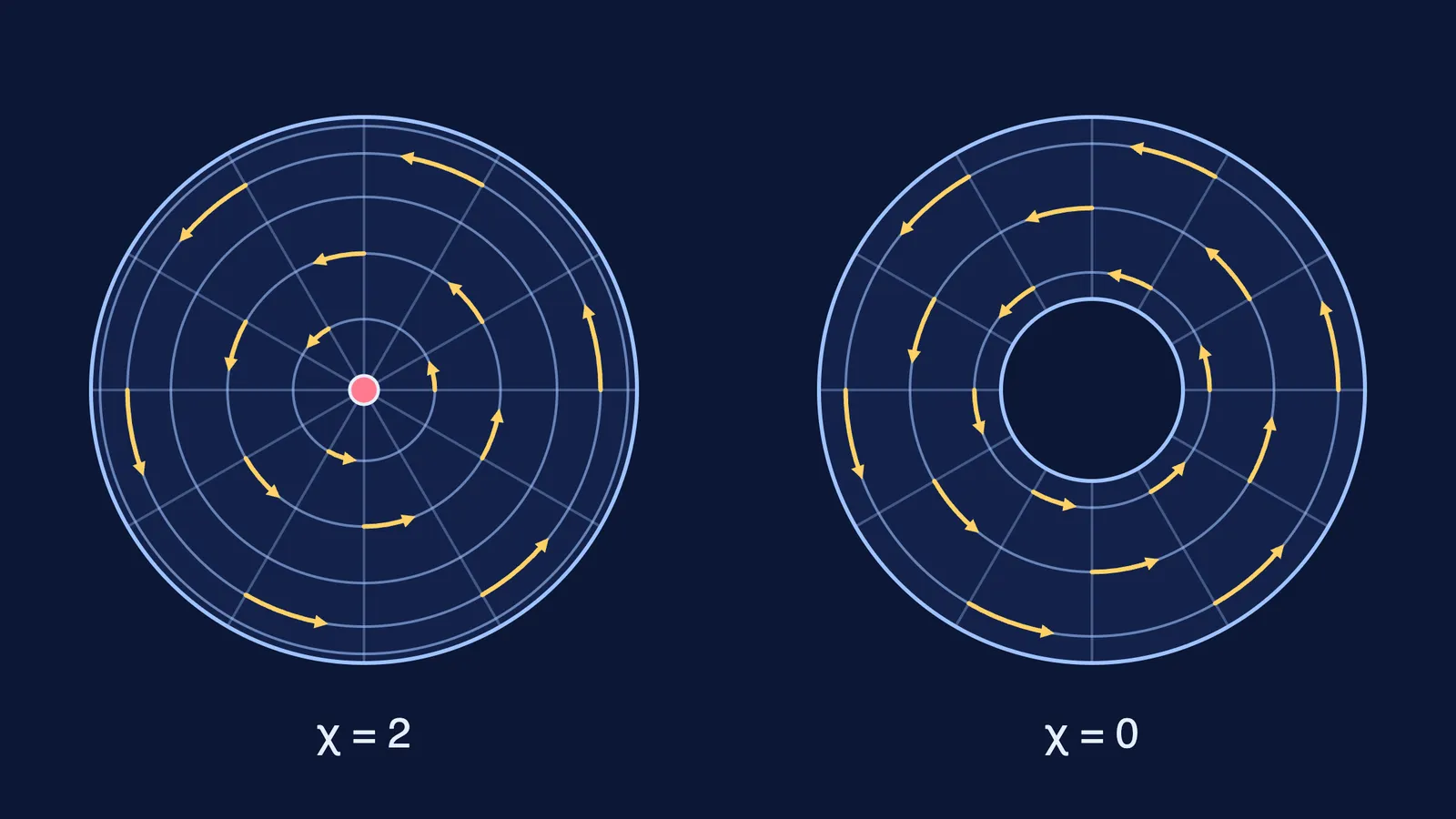
For the surface of a solid with flat faces, the Euler characteristic is χ = V − E + F, where V counts vertices (corners), E edges and F faces (Wikipedia: Euler characteristic). The same page notes that any convex polyhedron has χ = 2, a result Euler stated in 1758, and that doughnut-shaped polyhedra have χ = 0, like the torus.
Work it through with three solids:
A cube: 8 corners, 12 edges, 6 faces. 8 − 12 + 6 = 2.
A football (the truncated icosahedron): 60 vertices, 90 edges and 32 faces, 12 pentagons and 20 hexagons (Wikipedia: Truncated icosahedron). 60 − 90 + 32 = 2.
A square picture frame: 16 corners (8 front, 8 back), 32 edges (12 front, 12 back, 8 joining them) and 16 faces (4 each on front, back, outer rim, inner rim). 16 − 32 + 16 = 0.
The cube and football look nothing alike, yet both give 2; the frame has a hole and gives 0. For a closed surface with g holes the rule is χ = 2 − 2g (Wikipedia: Genus)), so each hole lowers χ by 2.
What is the hairy ball theorem?
The hairy ball theorem says that you cannot comb the hair on a ball flat without leaving at least one point where the hair stands up, a cowlick (Wikipedia: Hairy ball theorem). Henri Poincaré proved it for the ordinary sphere in 1885, and L. E. J. Brouwer extended it to higher even dimensions in 1912, according to the same page.
The page adds a careful weather example. Because wind also moves up and down, what is strictly true is that every shell of atmosphere around the Earth has a point where the wind is not moving horizontally.
A hairy doughnut, by contrast, can be combed flat, and here the Euler characteristic returns. The Poincaré–Hopf theorem says the zeros of such a field, each counted with a whole number called its index, add up to χ (Wikipedia: Poincaré–Hopf theorem). A sphere has χ = 2, so it must have zeros. A torus has χ = 0, so it can have none.
How can you try topology at home this week?
A short plan:
Day 1: sort household objects by genus.
Day 2: count V, E and F on a pyramid and a matchbox, and check you get 2.
Day 3: build a square frame from straws, count it, and confirm 0.
Day 4: draw arrows all over a ball and try to avoid a cowlick. Then try a bangle.
If a shape is hard to picture, the Fermi Simulation Lab has interactive simulations for ideas that are easier to see than to read. If a term such as vertex or polyhedron feels shaky, the Fermi Concept Library gives each concept in mathematics its own lesson.
Next, read about Felix Klein and his one-sided bottle, János Bolyai's geometry where parallel lines multiply, and the theorems hidden in origami folds.


