On this page
Felix Klein gave students two ideas that still turn up in maths today. One is a strange surface you cannot fully build in our world. The other is a simple question that sorts every kind of geometry: what stays the same when you move things around?
Who was Felix Klein?
Felix Klein was a German mathematician, born in Düsseldorf on 25 April 1849 and died in Göttingen on 22 June 1925, according to the MacTutor History of Mathematics biography. He became a professor at Erlangen in 1872, when he was just 23. In 1886 he took a chair at Göttingen, where he worked to make the university a world centre for mathematics.
What is a Klein bottle?
A Klein bottle is a closed surface with no separate inside or outside, named after Felix Klein, who first described it in 1882 (Wikipedia, Klein bottle). Mathematicians call it non-orientable: you cannot pick one consistent direction pointing “out” of the surface everywhere.
Picture an ant walking on it. On a Klein bottle, the ant can walk along and come back to its starting point on what looks like the other face, without ever crossing an edge. The surface has no edge at all.
MacTutor describes it as best pictured as a cylinder looped back through itself to join its other end. “Through itself” is the catch. A true Klein bottle cannot sit in ordinary three-dimensional space without cutting through its own wall, but it can sit in four dimensions without doing so (Wikipedia). The glass Klein bottles you see in photos are 3D stand-ins, with one spot where the neck passes through the side.
It is close family to the Möbius strip. Joining the edges of two Möbius strips gives a Klein bottle, and cutting a Klein bottle in half along its plane of symmetry gives two mirror-image Möbius strips (Wikipedia). If the Möbius strip is new to you, start with our story of August Möbius and his one-sided strip.
How do you make a Klein bottle from a square?
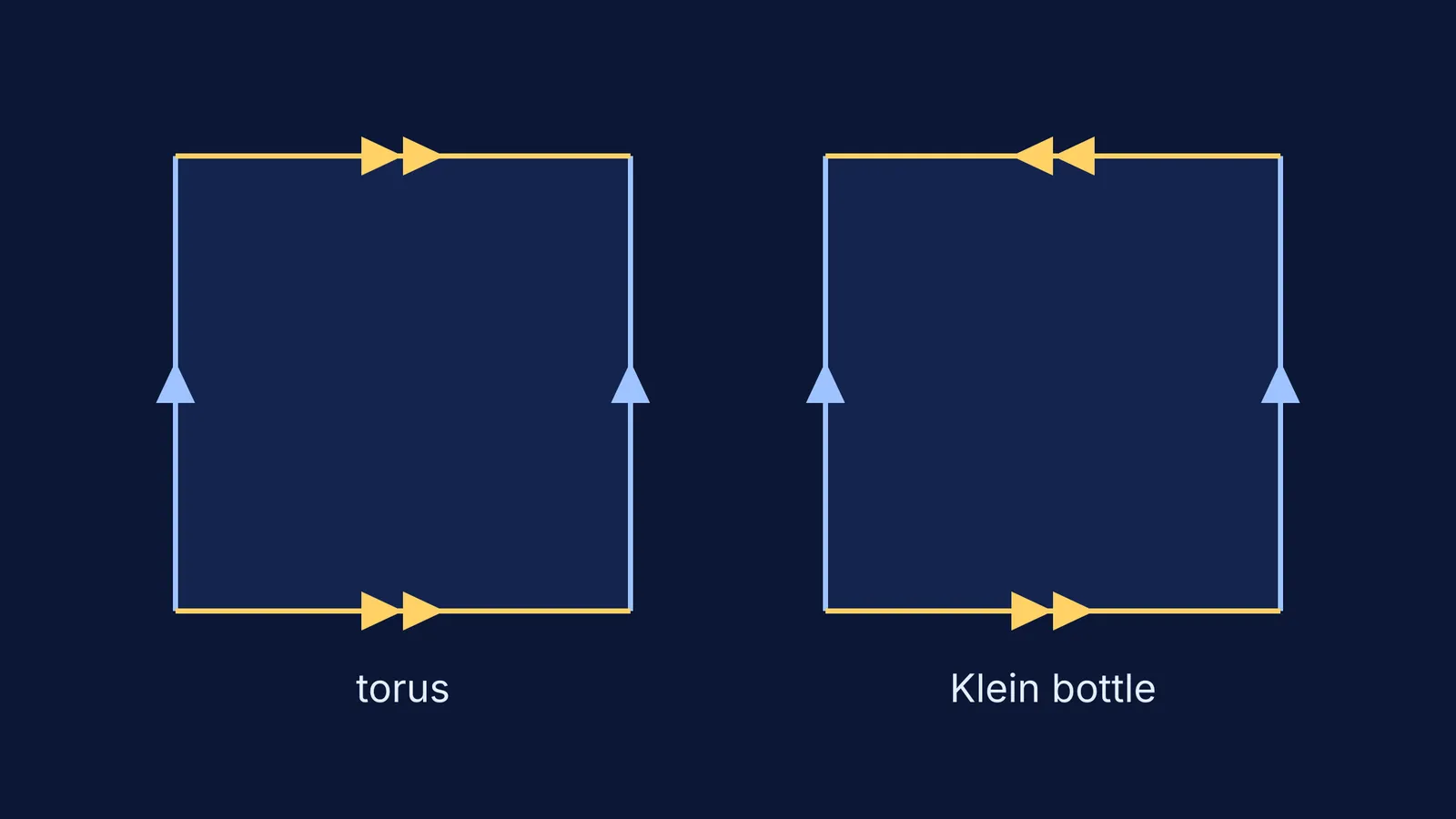
Topologists build surfaces by gluing the edges of a square. For a Klein bottle, glue the left edge to the right edge the same way round, and the bottom edge to the top edge the opposite way round (Wikipedia; see also the fundamental polygon table).
Here is the whole family, from one square of paper:
Glue one pair of opposite edges straight: you get a tube, with an inside, an outside and two edges.
Glue one pair with a half-twist: you get a Möbius strip, with one side and one edge (Wikipedia, Möbius strip).
Glue both pairs straight: you get a torus, the doughnut shape, which is closed and has two sides.
Glue one pair straight and the other pair reversed: you get a Klein bottle, which is closed and has one side.
Steps 1 and 2 work with paper. Step 4 cannot be done in 3D unless the tube passes through its own wall.
What was Klein's Erlangen programme?
In 1872 Klein published “Vergleichende Betrachtungen über neuere geometrische Forschungen” (“A comparative review of recent researches in geometry”), now called the Erlangen programme (Wikipedia, Erlangen program). An English translation made by M. W. Haskell in 1892 is free on arXiv.
Its idea fits in one sentence: geometry is the study of the properties of a space that stay unchanged under a given group of transformations (MacTutor). Change the group and you change the geometry. By then, non-Euclidean geometries like the one Nikolai Lobachevsky built had appeared with no clear way to compare them. Klein's question gave them one.
Which properties survive which moves?
Use this checklist on any figure. The bigger the group of moves, the fewer properties survive, which is why Euclidean geometry is more restrictive than affine geometry, and affine more restrictive than projective (Wikipedia).
Euclidean moves (slide, turn, reflect): lengths, angles and areas stay the same.
Affine moves (add stretches and shears): straight lines stay straight and parallel lines stay parallel, but lengths and angles can change (Wikipedia, Affine transformation). A circle can become an ellipse.
Projective moves (think shadows from a lamp): straight lines stay straight, but circles are not preserved, so a circle is not an object of projective geometry (Wikipedia).
You already use this in coordinate geometry. Shifting the origin or rotating the axes does not change the distance between two points, so you can choose axes that make the algebra easy. That is Klein's question in miniature. Physics asks the same question about symmetry, as Emmy Noether's work on symmetry shows.
How can you see these ideas for yourself?
Surfaces and transformations are easier to see than to read. The Fermi Simulation Lab has interactive simulations for ideas like these. If words such as “invariant” or “transformation” are where you get stuck, the Fermi Concept Library gives each concept in mathematics its own lesson.
Next time you meet a geometry figure, ask Klein's question first: which moves would leave this unchanged?