On this page
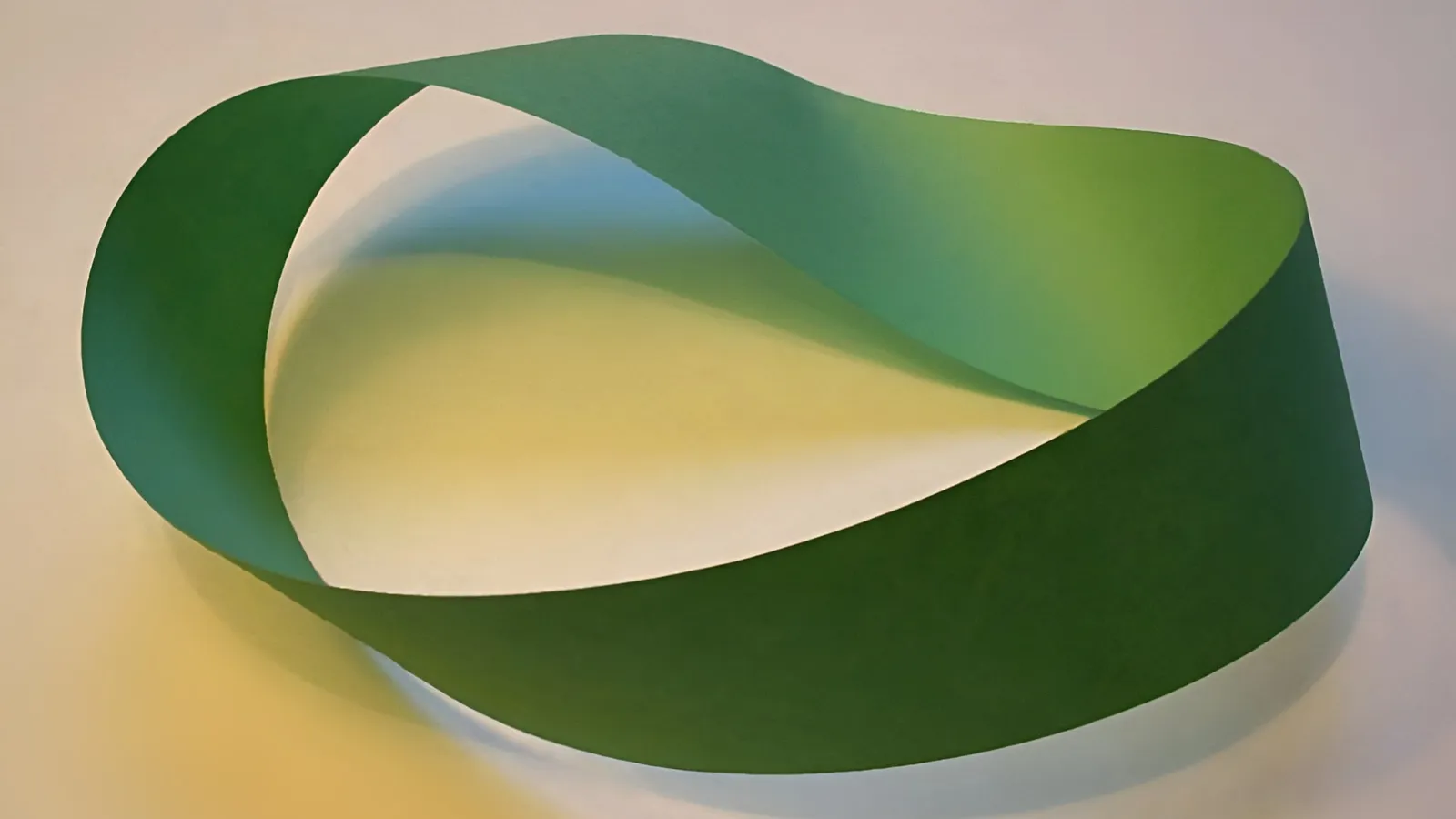
In September 1858, an astronomer in Leipzig worked out in his notebooks a strange surface: a band with only one side and only one edge. He was August Ferdinand Möbius, and the shape now carries his name. It also has a second discoverer, and you can make one yourself with a strip of paper and some tape.
Who was August Möbius?
Möbius was born on 17 November 1790 in Schulpforta, Saxony, and died in Leipzig on 26 September 1868, according to his MacTutor History of Mathematics biography. He spent his career at Leipzig, as professor of astronomy and as Observer at the observatory, and from 1848 he was the observatory's director.
He was also a geometer. His 1827 book Der barycentrische Calcul became a classic: in it he introduced homogeneous coordinates and discussed projective transformations (MacTutor).
How did Möbius discover the Möbius strip?
The strip came out of a question about polyhedra, solid shapes built from flat faces. MacTutor says Möbius found it in 1858 while working on a polyhedra question posed by the Paris Académie des Sciences (MacTutor). His notebooks date the idea to September 1858, and he published it in an 1865 paper whose title translates as 'On the determination of the volume of a polyhedron' (Ivars Peterson, Science News).
How did polyhedra lead to a twisted band? Möbius thought of surfaces as flat polygons glued together: twist a row of triangles and join the ends, and you get a one-sided surface. In the 1865 paper he also proved that some polyhedra cannot be given a volume at all (Science News).
A Möbius strip is a surface with one side and one edge; mathematicians call it non-orientable (Wikipedia: Möbius strip).
Did Möbius really discover it first?
No. Johann Benedict Listing, a German mathematician who was a professor at Göttingen, found the same surface independently, and Science News reports that he first came across it in July 1858, two months before Möbius (Science News). Listing's MacTutor biography agrees that the two found its properties at almost the same time and independently (MacTutor: Listing). Listing also published first, in the early 1860s, so MacTutor's Möbius biography gives him precedence.
Listing's 1847 Vorstudien zur Topologie was also the first published use of the word topology (MacTutor: Listing): the maths of properties, such as the number of sides or edges, that survive stretching and bending.
How do you make a Möbius strip, and what happens when you cut it?
You need A4 paper, scissors, tape and a pencil. Write down a prediction before each step.
Cut two long strips about 3 cm wide. Tape the first into a plain loop. Give the second a half-twist, then tape it.
Draw a line along the middle of the plain loop without lifting the pencil. It closes after one lap and the other face stays blank: two sides.
Do the same on the twisted band. After one lap you are back, but on the other face of the paper; the line meets its start only after two laps, covering both 'faces'. There was only ever one.
Run a finger along the edge of the twisted band. You trace the whole boundary in one go: one edge.
Cut the plain loop along your line and you get two separate rings. Cut the twisted band along its line and you get a single band twice as long (Science News), with four half-twists (Wikipedia).
Make a fresh twisted band and cut about one-third of the way in from the edge, keeping that distance all the way round. You get two linked loops: a thinner Möbius strip and a longer band with two half-twists (Wikipedia).
You can reason out step 5. The edge runs round twice before it closes, so it is twice as long as the centre line (Wikipedia). Cutting along the centre leaves the paper beside that edge in one piece, and it opens into one band as long as the edge.
If the twist is hard to hold in your head, Fermi's AI tutor can draw the figure with you and check your understanding as it goes, so you are not just memorising the result.
Where are Möbius strips used?
The shape appeared in machines before mathematicians named it: a 1206 work by Ismail al-Jazari shows a chain pump with a Möbius-strip drive chain. Machinists know that belts wear half as quickly when they form Möbius strips, because the whole surface takes the wear, though the earliest written description dates from 1871. The three-arrow recycling symbol, designed in 1970, is based on the shape too (Wikipedia: Möbius strip).
The lesson for a student is in how Möbius found it: he asked a careful question about polyhedra and paid attention when one object refused to behave. That habit helps on a tricky board-exam or JEE Main problem too.
To follow the ideas behind it, from surfaces to polyhedra, the Fermi Concept Library gives each mathematics concept its own lesson and its place in the map.
Take the band you made, hand it to someone at home, and ask them how many sides it has.