On this page
The story of ballooning is usually told from France in 1783. But 74 years earlier, the royal court in Lisbon watched a small hot-air balloon rise, and the man who launched it was born in Brazil.
Who was Bartolomeu de Gusmão?
Bartolomeu Lourenço de Gusmão was born in 1685 at Santos, in the province of São Paulo, Brazil, according to the Catholic Encyclopedia entry on him.
In 1709 he petitioned King John V of Portugal for a privilege for his invention of an airship, the same entry records. A later, bigger design, a ship to sail in the air shaped like a triangular pyramid filled with gas, was never built. He died in Toledo, Spain, on 18 November 1724.
What happened in Lisbon on 8 August 1709?
A public test of his airship planned for 24 June 1709 did not take place, says the Catholic Encyclopedia. On 8 August 1709, in the hall of the Casa da Índia in Lisbon, Gusmão made a ball rise to the roof by combustion, before the court.
The ICAO aviation history page calls it a model hot-air balloon and says "the rounded envelope of thick paper was inflated by heated air from burning materials carried in a suspended earthenware bowl". The same page lists the audience: King John V, Queen Maria Anna, Cardinal Conti, and members of the court and the diplomatic corps.
Accounts differ on the details. The British Balloon Museum and Library places the launch on the patio, not in the hall. The Wikipedia history of ballooning says the balloon rose about four metres. The sources agree on the principle: hot air from burning fuel lifted a light envelope.
Why does a hot-air balloon rise?
A balloon rises when the air it pushes aside weighs more than the balloon and everything in it. Heating air makes it less dense, so a bag of hot air weighs less than the same bag of the cooler air around it.
NASA's equation of state page gives the ideal-gas law as p = ρRT, with temperature on an absolute scale. NASA's Earth atmosphere model gives a pressure formula that comes to 101.29 kPa at sea level, and air density as ρ = p / [0.2869 × (T + 273.1)], with T in °C and p in kPa.
Plug in the numbers:
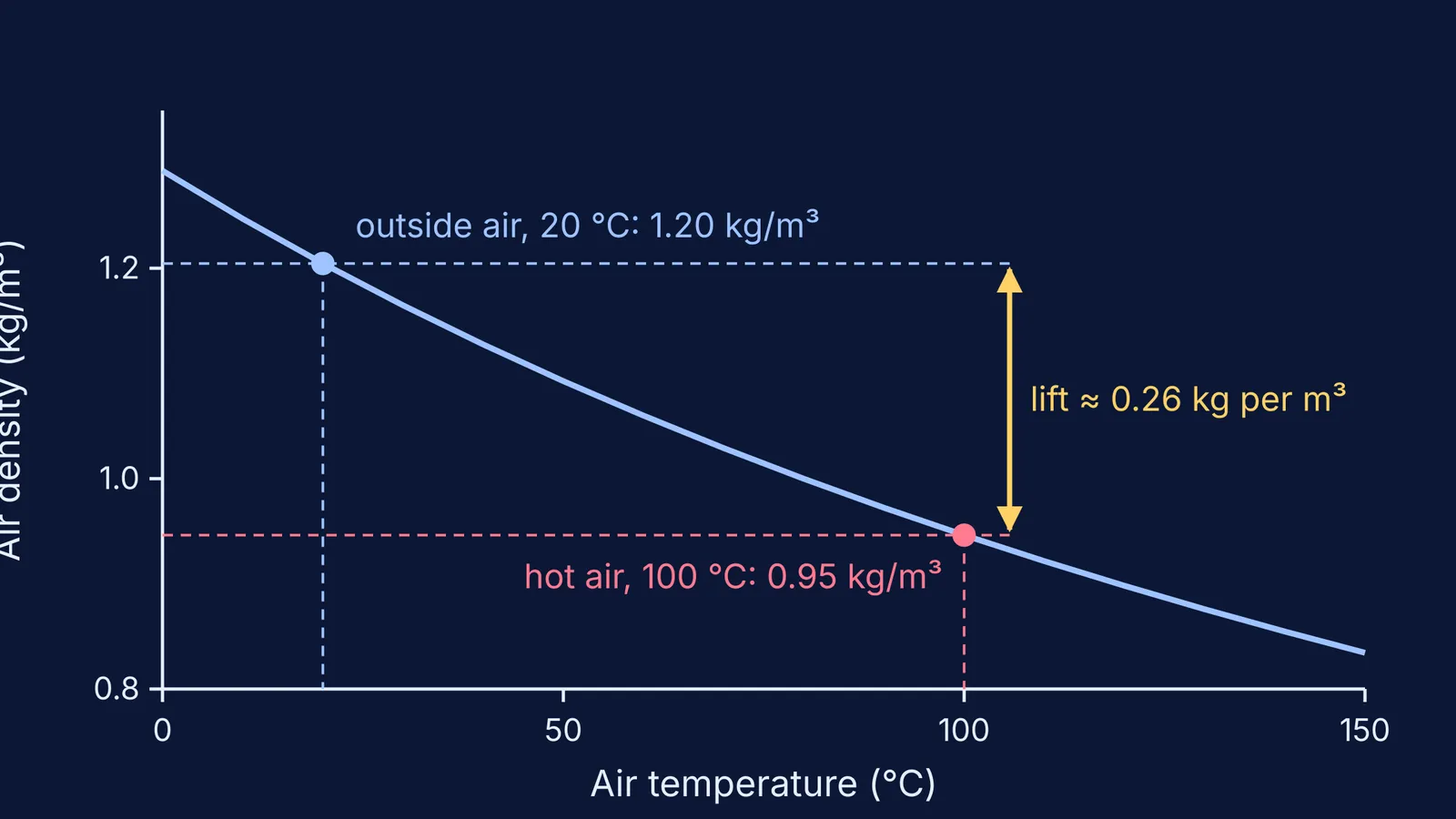
Outside air at 20 °C: 101.29 / (0.2869 × 293.1) ≈ 1.20 kg/m³.
Air heated to 100 °C: 101.29 / (0.2869 × 373.1) ≈ 0.95 kg/m³.
Difference: about 0.26 kg, or 258 g, of lift for every cubic metre of hot air.
The chart above shows that gap. Hotter air gives more lift, but the curve flattens, so each extra degree buys a little less.
How big did a paper balloon need to be?
Nobody recorded the exact size or paper of Gusmão's model, so we will assume a sphere of paper weighing 40 g per square metre, filled with air at 100 °C on a 20 °C day, giving the 258 g of lift per cubic metre worked out from NASA's density formula.
Lift = volume × 258 g/m³ = (4/3)πr³ × 258 g.
Envelope weight = surface area × 40 g/m² = 4πr² × 40 g.
Try r = 0.4 m: lift ≈ 0.268 m³ × 258 ≈ 69 g, paper ≈ 2.01 m² × 40 ≈ 80 g. Too heavy.
Try r = 0.8 m: lift ≈ 2.145 m³ × 258 ≈ 553 g, paper ≈ 8.04 m² × 40 ≈ 322 g. About 230 g is left for the bowl and fuel.
Break-even: set the two equal and r = 3 × 40 / 258 ≈ 0.46 m.
Lift grows with r³ but paper weight grows only with r², so a big enough balloon always wins. It is the same scaling behind Galileo's square-cube law, this time in the balloon's favour.
To see buoyancy rather than read about it, the Fermi Simulation Lab has interactive simulations for ideas that are easier to see than to read.
How does 1709 compare with the Montgolfiers in 1783?
The Montgolfier brothers gave the first public demonstration of their hot-air balloon on 4 June 1783, and it rose to about 300 m, according to ICAO. The first free flight with people aboard followed on 21 November 1783.
So Gusmão's model came 74 years earlier, but it carried no one, and his gas-filled airship was never built. Balloons later became scientific instruments: read how James Glaisher's balloon ascents reached the stratosphere, or jump ahead to powered flight with Santos-Dumont's 14-bis in Paris.
Can you work out the break-even size yourself?
Try it with tissue paper at 20 g per square metre and inside air at only 60 °C. Use the NASA density formula for 60 °C, find the new lift per cubic metre, then repeat step 5. You should get a break-even radius of about 0.41 m.
If the algebra trips you up, the Fermi Problem Library has worked problems with a step-by-step solver that explains the reasoning rather than printing an answer.