On this page
Why did James Glaisher take a balloon to high altitude in 1862?
In the mid-19th century, the atmosphere above the clouds was largely a mystery. Meteorologists knew that air grew colder and thinner as they climbed mountains, but they did not know exactly how temperature and humidity changed higher up.
James Glaisher, a scientist who had served as the Superintendent of the Department of Meteorology and Magnetism at the Royal Observatory in Greenwich, wanted direct measurements. He aimed to take precise readings of barometric pressure, temperature, and the chemical composition of the air at different heights. To do this, he needed a balloon. While the Montgolfier brothers had proven flight was possible with hot air decades earlier, Glaisher and his co-pilot Henry Tracey Coxwell used a massive coal-gas balloon to go much higher.
What happened when the air became too thin?
On 5 September 1862, the pair took off from Wolverhampton. Their goal was to go higher than anyone had ever gone before to see what happened to the air and to their own bodies.
As they passed 8,800 metres (28,900 feet), the extreme environment took a severe toll. The temperature plummeted, and the lack of oxygen caused Glaisher to lose his vision and then his consciousness.
Coxwell was also suffering from hypoxia and severe frostbite. He realised they were still climbing and would die if they did not vent the balloon's gas to descend. However, he had lost all sensation in his frozen hands and the valve-line had become entangled. In a desperate final effort, Coxwell climbed into the rigging and pulled the release valve with his teeth just before he, too, passed out.
How high did James Glaisher go in 1862?
Because Glaisher passed out, no one was awake to read the instruments at their highest point. His last recorded reading before losing consciousness was around 8,800 metres (28,900 feet).
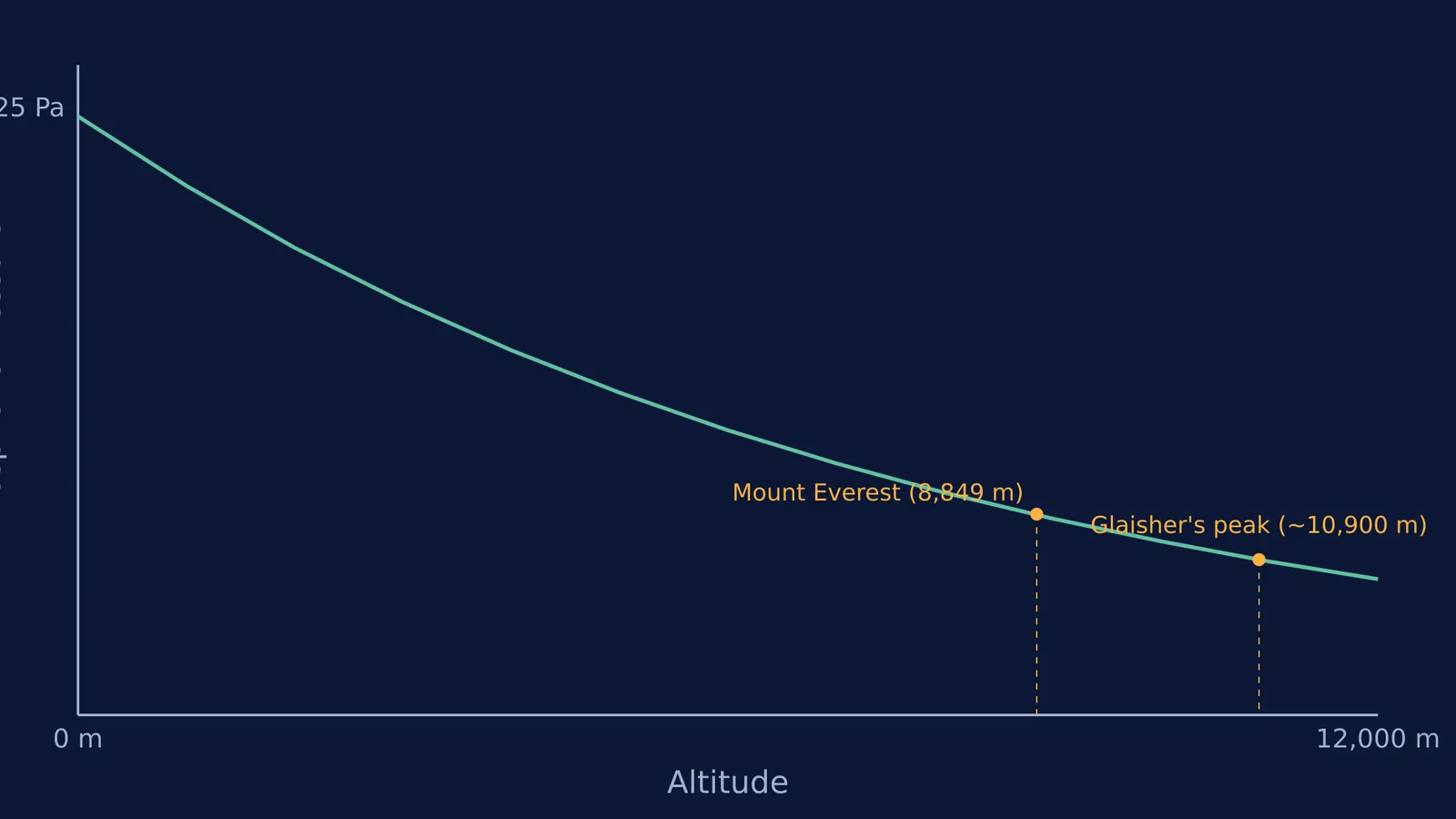
Based on the balloon's rate of ascent and descent while they were unconscious, historical estimates suggest they reached between 9,500 metres (31,200 feet) and 10,900 metres (35,800 feet) above sea level. For comparison, Mount Everest is 8,849 metres tall, and modern commercial jets fly at around 8,800 to 12,500 metres.
They had reached the edge of the stratosphere in an open wicker basket without oxygen tanks. The gas released by Coxwell eventually brought them down to a lower altitude, where they both woke up and managed a safe landing.
How to solve altitude and pressure problems
In physics and chemistry, exam questions often ask you to calculate how atmospheric pressure changes with height. Instead of just plugging numbers into a calculator, use this step-by-step framework to check your reasoning:
Start with standard pressure: Always ground your calculation at 1 atmosphere, or 101,325 Pascals, at sea level.
Apply the exponential drop: For simple problems where temperature is treated as constant, pressure drops exponentially. Use the barometric formula: P = P₀ e^(−Mgh/RT), where M is the molar mass of air.
Use the "half-pressure" rule of thumb: To quickly check if your answer makes sense, remember that Earth's air pressure roughly halves for every 5,600 metres you go up. At Glaisher's peak of 10,900 metres, the pressure was only about one-quarter of what it is at sea level.
Check the temperature assumption: Glaisher's flights proved that temperature is not constant. If an exam problem involves the real atmosphere rather than an ideal model, ensure you are using the given temperature lapse rate before integrating.
What we learn from James Glaisher's ascents
Glaisher and Coxwell made numerous flights between 1862 and 1866, publishing their findings in the 1871 book *Travels in the Air*. Their data proved that temperature does not drop at a constant rate as you go higher, a discovery that laid the foundation for modern atmospheric physics. Decades later, physicist Victor Hess used balloon flights to discover cosmic rays, continuing this tradition of high-altitude research.
When studying how gases behave or how temperature drops with altitude today, having a clear mental model helps. If you are trying to visualise the relationship between pressure, temperature and altitude in physics, the Simulation Lab lets you run interactive simulations to see these effects clearly. And if you are working through the maths of the ideal gas law, Fermi's AI tutor can help you build a plan and work out the equations step by step.
Glaisher's flights are a reminder of the lengths scientists went to before modern technology. He put his own body on the line to understand the air we breathe, showing that true scientific inquiry sometimes means venturing into the unknown.