

On this page
On 23 October 1906, Brazilian aviator Alberto Santos-Dumont climbed into a wicker basket in the middle of an unusual flying machine at the Château de Bagatelle in Paris. Driven by a 50-horsepower engine, the aircraft rolled across the grass, lifted into the air and flew over 50 metres.
This brief journey in the 14-bis was a historic milestone. It was the first heavier-than-air powered flight in Europe to be officially observed, measured and certified by an aeronautical body.
Why did Santos-Dumont build an airplane?
Before attempting to build an airplane, Santos-Dumont was already one of the most famous inventors in Europe. He had made his name building and flying a series of non-rigid airships, or dirigibles, over Paris. These lighter-than-air craft relied on gas balloons for lift, but by the early 20th century, European inventors were turning their attention to winged machines.
To test his new heavier-than-air design, Santos-Dumont initially attached the airplane frame to the bottom of his Number 14 airship. This allowed him to test the controls and balance in midair without risking a crash. Because of this testing method, the new machine became known as the 14-bis, meaning "14-again".
What counted as an official flight?
By 1906, reports of the Wright brothers' flights in the United States had reached Europe, but their tests had been largely private. European aviation enthusiasts wanted public, verified demonstrations. To encourage this, wealthy patrons offered significant cash prizes.
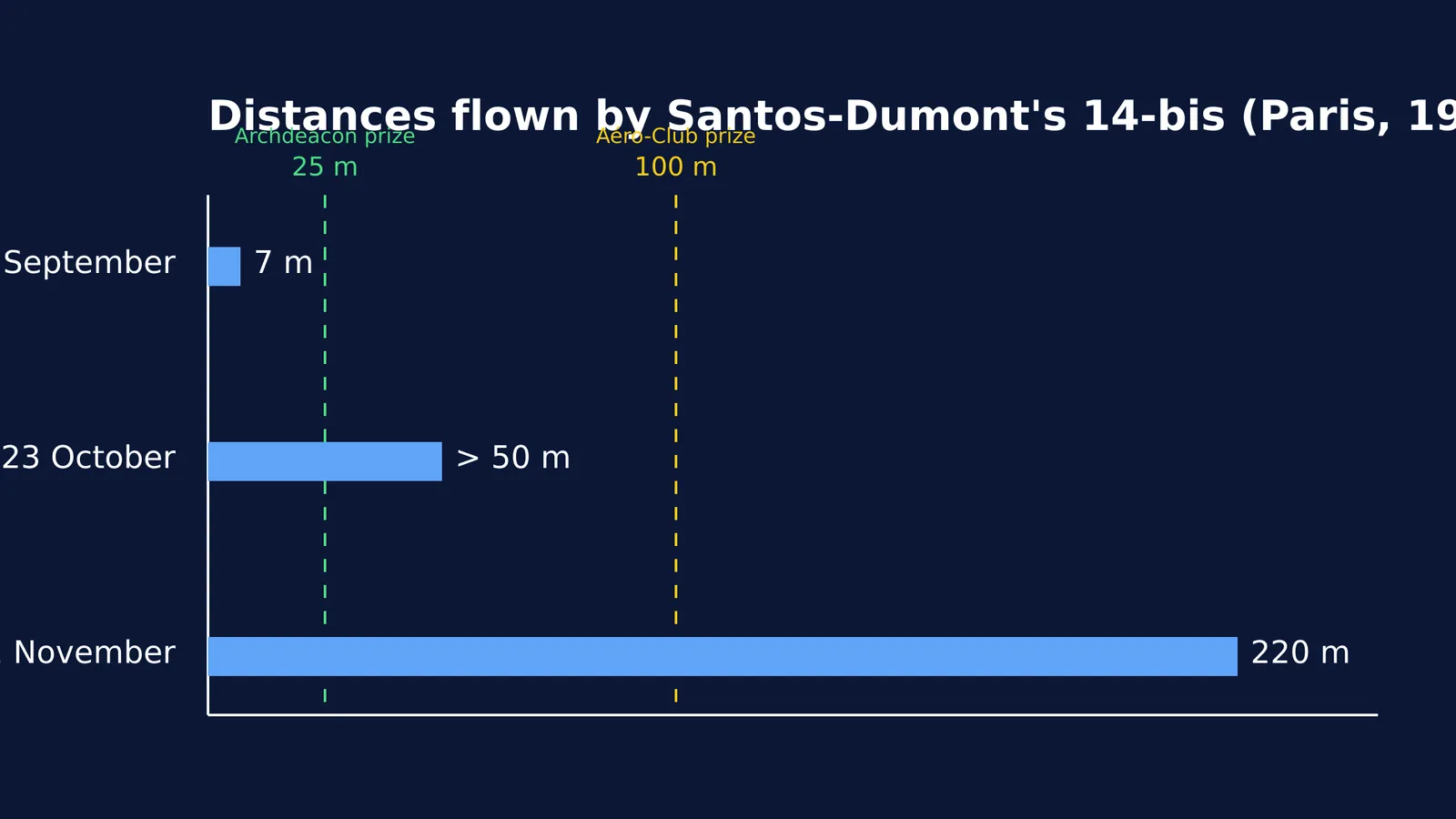
Ernest Archdeacon, a founder of the Aéro-Club de France, put up a prize of 1,500 francs for the first person to fly a heavier-than-air craft for at least 25 metres. Santos-Dumont built the 14-bis specifically to win it. The rules required that a panel of officials measure the distance and ensure the flight was powered entirely by the aircraft's own engine, without external help.
On 13 September 1906, Santos-Dumont made his first attempt in front of the judges. The plane managed a brief hop of 7 metres, but landed hard and broke its propeller. A month later, on 23 October, he returned and flew over 50 metres, easily surpassing the target and winning the prize.
Why is the 14-bis called a canard?
The 14-bis looked like a flying box kite. It was built from bamboo and pine, joined by aluminium sockets and covered in Japanese silk. Santos-Dumont stood in a wicker basket in the centre of the aircraft.
Power came from an Antoinette V8 engine. Santos-Dumont had originally fitted a 24-horsepower engine, but soon realised he needed more thrust and upgraded to the 50-horsepower version to sustain flight.
If you are trying to picture how engine thrust and wing shapes create lift, the Fermi Simulation Lab has interactive simulations for ideas that are easier to see than to read.
How did the 14-bis take off without a catapult?
One of the most important features of the 14-bis was its landing gear. The Wright brothers used a catapult and launch rail system to get their early Flyers into the air. Santos-Dumont's aircraft had a wheeled undercarriage, allowing it to accelerate across the ground and take off entirely under its own power.
This unassisted takeoff was seen by the French crowds as the true test of a practical flying machine. It proved that an aircraft did not need permanent infrastructure to launch.
When tackling complex mechanics topics like aircraft motion, having a structured approach is helpful. Fermi's AI tutor can work out what you already know about forces and kinematics, and build a plan for the session, so you sit down to a clear next step.
How far did Santos-Dumont fly in 1906?
Santos-Dumont did not stop at over 50 metres. After winning his first prize, he realised the plane struggled with lateral stability, so he added octagonal ailerons between the outer wing cells.
To control these new surfaces, he devised a mechanism where cables ran directly to the shoulders of his flight suit. By shifting his weight from side to side in the basket, he could pull the cables to balance the wings.
With this improved control, he returned to Bagatelle on 12 November 1906. In front of a large crowd and a camera crew from Pathé, he flew the 14-bis for 220 metres in 22 seconds. This won him a second prize from the Aéro-Club de France for exceeding 100 metres, setting the first world distance record officially recognised by the Fédération Aéronautique Internationale.
Related reading:


