

On this page
On 17 December 1903 Orville Wright flew for 12 seconds. Its numbers make a good Class 11 problem in relative velocity, and they show why the Wrights could fly so slowly over the sand. This post sets out what the brothers did, using the Smithsonian's record and their own account, works through the numbers, and ends with what you can borrow from their way of working.
What happened at Kitty Hawk on 17 December 1903?
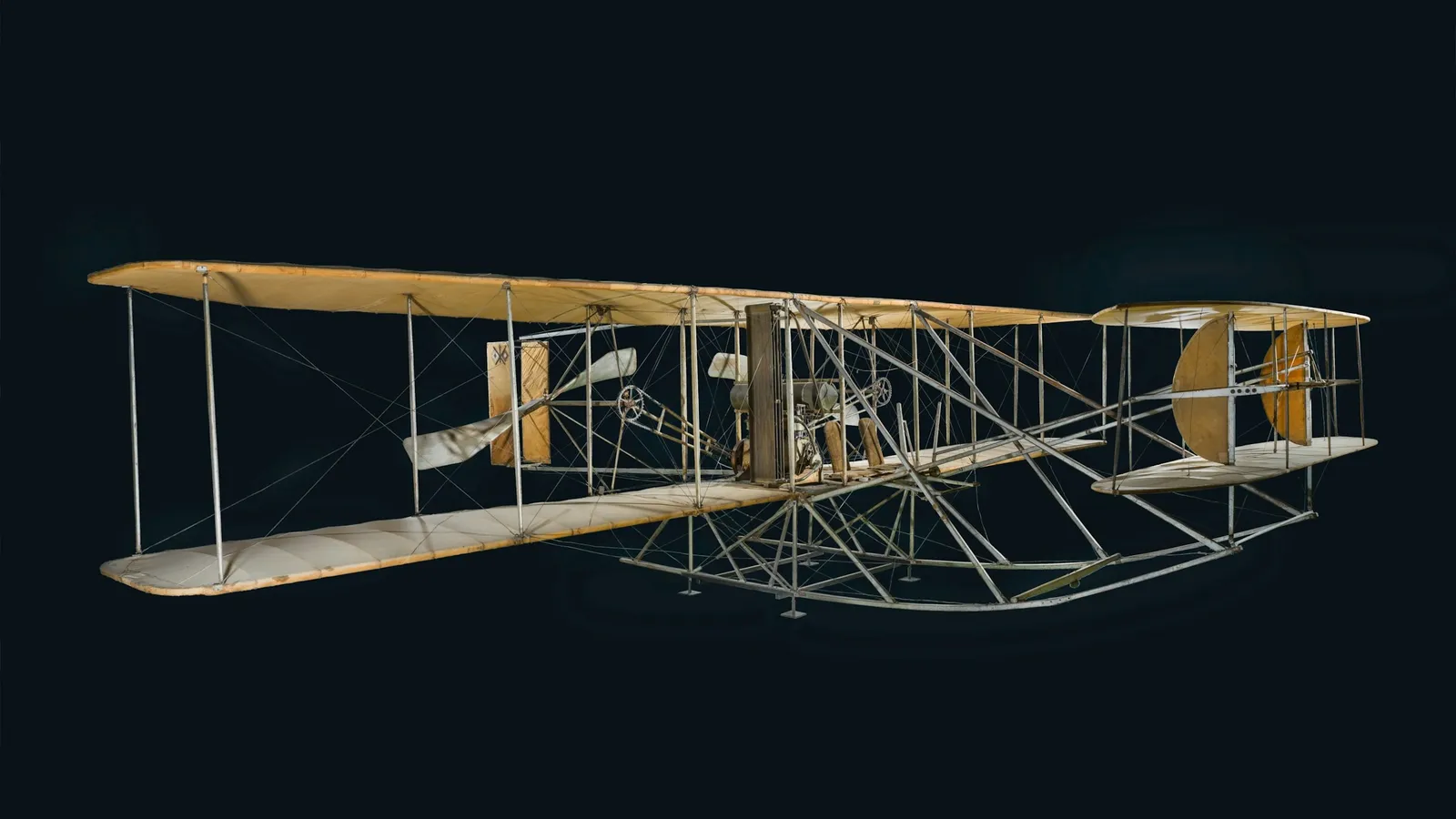
The National Air and Space Museum record of the 1903 Wright Flyer says that at 10:35 a.m. Orville lifted off at Kitty Hawk, North Carolina, "for a 12-second flight, traveling 36 m (120 ft)". The brothers took turns for three more flights that morning. On the fourth, Wilbur covered 852 feet in 59 seconds. Soon after, a gust of wind overturned the machine and it never flew again.
Wilbur had already tried on 14 December, after winning a coin toss, but the attempt failed and slightly damaged the Flyer. The National Park Service account adds that he "oversteered with the elevator" and the machine stalled into the sand.
How did two bicycle makers get there?
They did not start with an engine. According to the museum, the brothers began serious study in 1896 after the fatal crash of the glider pioneer Otto Lilienthal, and Wilbur wrote to the Smithsonian on 30 May 1899 asking for publications on flight. They then built a kite in 1899 to test wing warping, a way to twist the wing tips so one side lifts more than the other and the machine banks.
Their gliders of 1900 and 1901 controlled well but lifted far less than predicted. In their own book, The Early History of the Airplane, they explain that in 1901 they increased the wing area from 165 to 308 square feet, and the lift "again fell very far short of calculation". They concluded that "the tables of air-pressures in general use were incorrect". So in late 1901 they built a small wind tunnel with instruments that measured lift and drag on model wings.
The 1902 glider, designed from that data, worked. The museum records between seven hundred and one thousand glides that year, the best covering 622.5 feet in 26 seconds. Only then did they add a 12-horsepower engine, built with their mechanic Charles Taylor, and propellers they treated as rotating wings.
How fast was the first flight?
Orville's own account gives the numbers. The wind was "over 35 feet per second", and the machine's speed over the ground was ten feet per second. Take forward as positive and use the relative velocity relation from the NCERT Class 11 chapter Motion in a Straight Line (section 2.5):
Ground speed: 120 ft ÷ 12 s = 10 ft/s. In SI units, 10 × 0.3048 = 3.05 m/s, about a gentle jogging pace.
Velocity of the air relative to the ground: the wind blew head-on, so it is −35 ft/s.
Velocity of plane relative to ground = velocity of plane relative to air + velocity of air relative to ground. So 10 = v − 35, which gives v = 45 ft/s.
Airspeed: 45 × 0.3048 = 13.7 m/s.
Orville then wrote that the flight "was equivalent to a flight of 540 feet made in calm air". Check: 45 ft/s × 12 s = 540 ft, about 165 m.
Now the fourth flight. Ground speed was 852 ft ÷ 59 s = 14.4 ft/s, or 259.7 m ÷ 59 s = 4.40 m/s. The brothers measured the wind just before it at "between 9 and 10 meters per second". The airspeed was therefore about 4.4 + 9 = 13.4 m/s to 4.4 + 10 = 14.4 m/s.
Look at the two airspeeds side by side: about 13.7 m/s and 13.4 to 14.4 m/s. The Flyer moved through the air at much the same speed both times. The ground speed rose from 3.05 to 4.40 m/s mainly because the wind had dropped. Lift depends on how fast the wing meets the air, so flying into a strong wind let the Wrights take off and land at a low ground speed.
The Park Service page uses a different wind figure, 27 mph, and gets a ground speed of 6.8 mph and an airspeed of 34 mph, about 15.2 m/s. Different wind estimates give slightly different answers.
What mistakes do students make with problems like this?
Subtracting the headwind. A headwind lowers ground speed, so airspeed is ground speed plus headwind. Write the vector relation with signs instead of guessing.
Mixing units. The sources use feet, miles per hour and metres per second. Convert everything to m/s first: 1 ft = 0.3048 m and 1 mph = 0.447 m/s.
Calling ground speed "the speed". For lift, airspeed is what counts. Say which frame you mean.
If frames of reference still feel slippery, our guide to relative velocity in river and rain problems uses the same relation in two dimensions. When you find it hard to picture the plane, air and ground moving together, the Fermi Simulation Lab has interactive simulations for ideas that are easier to see than read.
What can a student take from the Wrights' way of working?
Test the inputs. They did not trust a published table because it was published. When the numbers and the glider disagreed, they measured again.
Solve one problem at a time. Control came first with the kite, then lift with the tunnel and gliders, and power last.
Practise a lot before the big attempt. Hundreds of glides in 1902 made them pilots before they had an engine.
Keep records. Wind speed, distance and time were written down, which is why you can redo their sums today.
By 5 October 1905, the museum notes, Wilbur flew a third Flyer for 39 minutes over a closed course of 24.5 miles. The two forces they measured, lift and drag, had been separated by George Cayley almost a century earlier.
Tonight, take one relative velocity question from your textbook, write the vector relation with signs before any numbers, and then check your answer against the Wrights' 45 ft/s.


