On this page
In November 1823, a 20-year-old sublieutenant in the army engineering corps wrote home to his father with news: "From nothing I have created another entirely new world." That young officer was János Bolyai, and the new world was a geometry where one of Euclid's oldest rules does not hold, according to D. J. Struik's entry in the Complete Dictionary of Scientific Biography.
What is the parallel postulate, and why did people doubt it?
Euclid's fifth postulate says that if a line crossing two other lines makes interior angles on one side adding up to less than two right angles, those two lines will meet on that side (Euclid's Elements, Book I, Postulate 5). In school language: through a point outside a line, exactly one parallel can be drawn.
For centuries mathematicians tried to prove it from the rest, usually by assuming it was false and hunting for a contradiction. None turned up (Clark University notes on Postulate 5).
János's father, Farkas Bolyai, a mathematics professor, had spent years on the problem himself. In 1820 he warned his son to stay away from it: "I know this way until its end—I also have measured this bottomless night," he wrote, in the translation quoted by Struik.
How did János Bolyai build non-Euclidean geometry?
János was born on 15 December 1802 in Kolozsvár (now Cluj, Romania) and trained at the Royal Engineering College in Vienna from 1818 to 1822 (MacTutor biography). He joined the army as an engineer in 1823 and served 11 years, retiring because of illness in 1833.
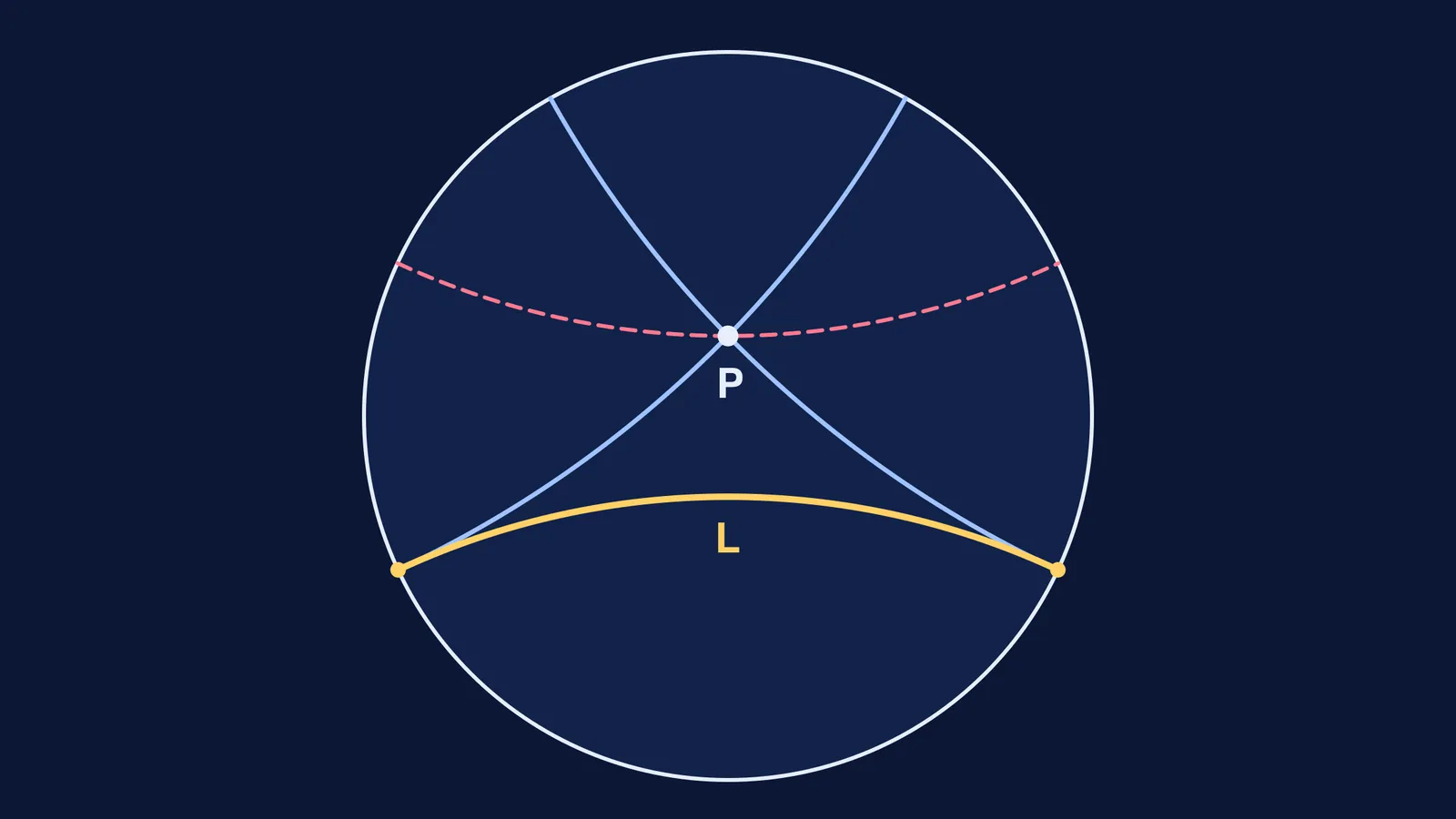
His key move was to stop trying to prove the postulate and instead take its opposite seriously. Suppose that through a point P outside a line L there is not one line missing L, but a whole pencil of them. Then work out everything that follows.
In hyperbolic geometry, infinitely many lines through P do not meet L (Wolfram MathWorld). The angle sum of a hyperbolic triangle is less than 180 degrees (MathWorld).
He also separated the results that hold whether or not the parallel postulate is true, which we now call absolute geometry, from those that depend on it (MacTutor).
He published it as a 24-page appendix to his father's textbook, the Tentamen of 1832 (Struik). It was the only work he published in his lifetime.
What did Gauss say about Bolyai's work?
Farkas sent the Appendix to his old friend Carl Friedrich Gauss. Gauss replied on 6 March 1832 that he could not praise it, "since to praise it would be to praise myself", because the results agreed almost everywhere with his own meditations, which had occupied him in part for 30 to 35 years (Struik).
Gauss had never published those ideas. For János, the letter was a terrible blow.
A second blow came later. In 1848 he read the work of Nikolai Lobachevsky, who had independently published the same kind of geometry back in 1829 (MacTutor). Bolyai never published again, but he left more than 20,000 pages of mathematical manuscripts when he died in 1860.
Full recognition came only after his death, with the work of Eugenio Beltrami (1868) and Felix Klein (1871) (Struik).
How can you see a geometry where parallels multiply?
The hero image above uses the Poincaré disc. In this model the whole plane is the inside of a circle, and a "line" is either a diameter or an arc of a circle that meets the boundary at right angles (MathWorld). Try it with a compass:
Draw a big circle. This is the entire hyperbolic plane; its edge is infinitely far away.
Draw line L as an arc near the bottom that meets the edge at right angles at two points, A and B.
Mark a point P above L.
Draw the arc through P that meets the edge at right angles at A, and the one that does the same at B. Neither crosses L inside the disc.
Now draw any arc through P that stays between those two. It never meets L either. You have found infinitely many parallels.
Bonus: join three points with such arcs, draw the tangent to each arc at every corner, and measure the angles between the tangents. The angles add to less than 180 degrees.
If the drawing will not come out right, Fermi's AI tutor can draw the figure on a board and check your understanding as it goes. To brush up on the circle theorems behind step 2, the Fermi Concept Library covers every concept in mathematics, each with its own lesson.
What can students learn from Bolyai's method?
The habit behind his discovery works on ordinary problems too:
Name the assumption. Write down the rule you are relying on.
Flip it. Ask what changes if it were false.
Follow it honestly. Derive consequences step by step, without forcing the answer you expect.
Sort what survives. Like Bolyai's absolute geometry, notice which results did not need the assumption at all.
To see where the postulate he questioned came from, read our piece on how Euclid's Elements taught the world to prove.