

On this page
Fold a paper crane, then open it out flat. The square is now a web of creases, and wherever several creases meet at a point, two rules hold: one about the angles between them, and one about how many fold each way. You can check both with a protractor and two pens.
What do Kawasaki's and Maekawa's theorems say?
Start with three terms from the mathematician Thomas Hull's survey of flat-folding results. A crease pattern is the map of lines left on the paper when you unfold a model. A mountain crease sticks up towards you like a ridge; a valley crease sinks away like a gutter. A model is flat-foldable if it can be pressed flat in a book without making new creases.
Now take one point inside the paper where 2n creases meet, and call the angles between neighbouring creases α1, α2, … α2n, going round in order.
Kawasaki's theorem: the vertex folds flat if and only if α1 − α2 + α3 − … − α2n = 0 (Hull's survey).
On a flat sheet, that is the same as saying every other angle adds up to 180°, and so do the rest (Kawasaki's theorem on Wikipedia).
Maekawa's theorem: if M creases at the vertex are mountains and V are valleys, then M − V = 2 or −2 (Hull).
One quick consequence: M + V = (M − V) + 2V = ±2 + 2V, which is always even, so a flat-folded vertex never has an odd number of creases. Counting, then showing the count must be even, is the same move used in parity arguments in olympiad maths.
The first theorem is named after Toshikazu Kawasaki and the second after Jun Maekawa, though Jacques Justin and others found both independently (Kawasaki's theorem and Maekawa's theorem on Wikipedia).
Why do the two rules have to be true?
Kawasaki first. The proof in Hull's survey imagines an ant walking once round the vertex on the folded paper, counting the angles it crosses as positive when it travels left and negative when it travels right. Each crease flips the paper over, so the direction alternates: α1 one way, α2 the other, and so on. Arriving back where it started means the alternating sum is zero. That proves a flat vertex must obey the rule; the converse needs a separate argument.
Maekawa uses the angle sum of a polygon. Fold the vertex flat and snip off the tip: the cut edge forms a flat polygon with n = M + V corners. The proof Hull gives, credited to Siwanowicz, treats each valley as an interior angle of 0° and each mountain as one of 360°. Interior angles sum to (n − 2) × 180°, so 360M = (M + V − 2) × 180, which simplifies to M − V = −2. Seen from the other side, mountains become valleys, giving +2. If angles round a point feel shaky, revise why angles around a point add up to 360° first.
How do you check the theorems on an unfolded paper crane?
Fold a crane from a square sheet but stop before spreading the wings, so the model still presses flat.
Unfold it gently and lay it coloured side up. Do not turn it over: whether a crease is a mountain depends on which side you look at.
Pick a point inside the square, not on the edge, where several sharp creases meet.
Trace mountains in red and valleys in blue, then count them. You should get an even total with M − V equal to 2 or −2.
Measure each angle and add every other one. Both sums should come out close to 180°.
Expect a degree or two of error: Hull notes that folding errors often leave real models slightly out of flat, while the theorems assume perfect folds in paper with no thickness.
Worked example: can you find the missing angle?
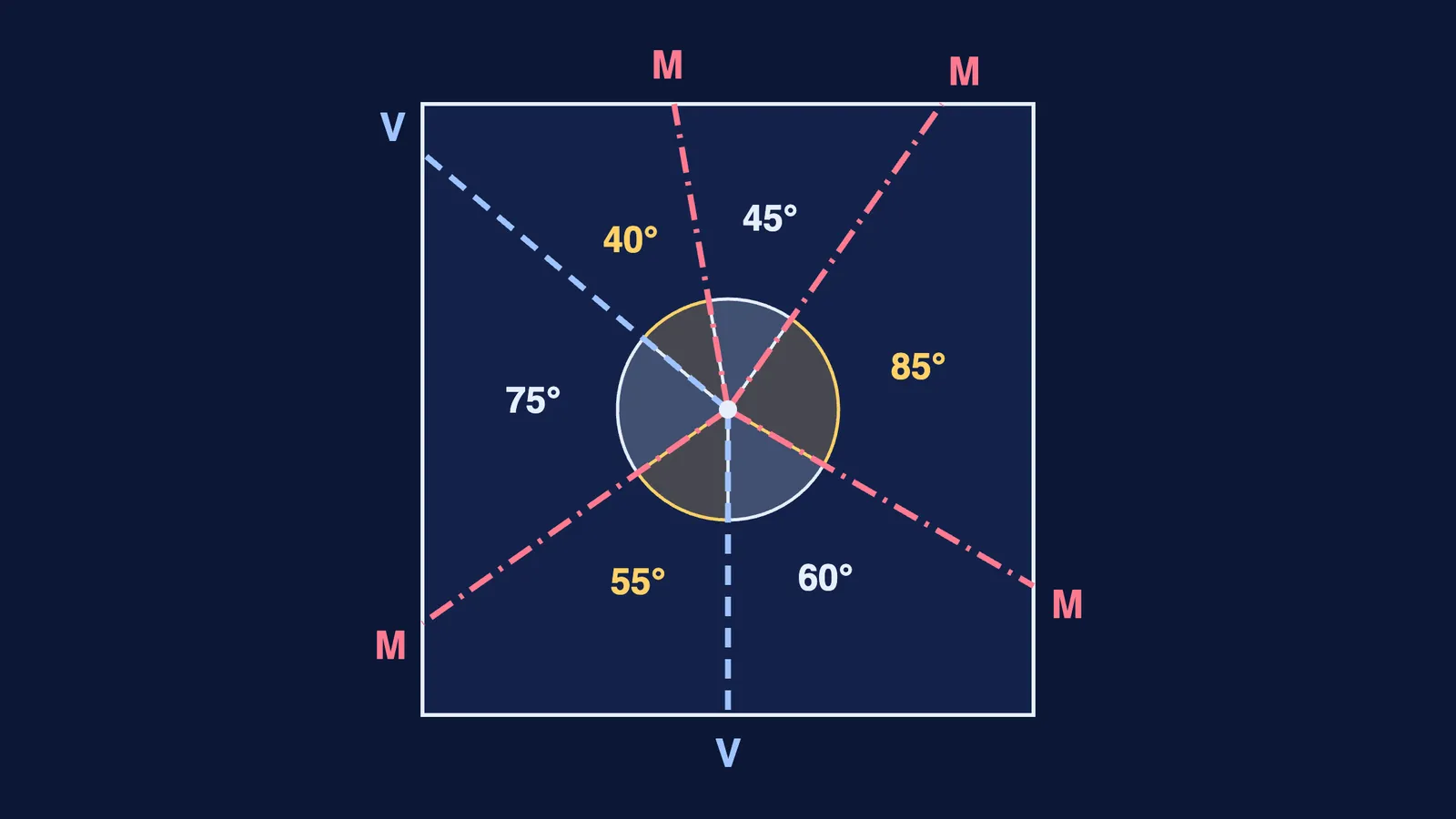
Six creases meet at a vertex. Going round, the angles are 40°, 75°, 55°, 60°, 85° and x. What must x be for the vertex to fold flat?
Odd positions: 40 + 55 + 85 = 180°. That set already works.
Even positions must also make 180°: 75 + 60 + x = 180, so x = 45°.
Check: all six angles add to 360°, as they must on flat paper.
Maekawa then allows 4 mountains and 2 valleys, or the reverse. One assignment that folds, shown in the diagram at the top, is M, V, M, V, M, M, going round from the crease between the 45° and 40° angles. It follows the method in the proof of Kawasaki's theorem: mountain-fold one side of the smallest angle, valley-fold the other, fold that flap away and repeat. Here the 40° flap goes first, then the 55° one.
For contrast, try 70°, 100°, 120° and 70°. Alternate angles give 70 + 120 = 190°, not 180°, so no amount of care will press that vertex flat.
Why is flat folding hard in general?
Kawasaki's test works one vertex at a time. A pattern can pass at every vertex and still fail, because flaps of paper collide. Hull's survey records that in 1996 Bern and Hayes proved the general question of whether a crease pattern folds flat is NP-hard, so no easy test that settles every pattern is expected.
If the angle work was the hard part, try a five-step order for angle chasing. To revise polygon angle sums or parity, the Fermi Concept Library gives each mathematics concept its own lesson and its place in the map, and the Fermi Problem Library has worked problems with a step-by-step solver that explains the reasoning rather than printing an answer.
Then fold a second crane and test a different vertex.


