

On this page
Many "find the angle" questions where lines cross come down to three rules used in the right order. This guide covers all three, works through one figure with five unknown angles, and gives you a checklist for picking which rule to use next.
Why do angles around a point add up to 360 degrees?
Turn on the spot until you face the same way again: that is one full turn. NCERT's Class 6 textbook defines the degree by splitting the angle at the centre of a circle into 360 equal parts, so a full turn measures 360° (NCERT Ganita Prakash, Grade 6, Chapter 2). Any set of angles that meet at one point and fill the space around it without overlapping makes up that full turn, so they must add to 360°.
Why 360 and not some other number? The same chapter says the reason is not fully known, but it gives two clues. The choice is old: the Rigveda speaks of a wheel with 360 spokes (Verse 1.164.48). It is also practical, because 360 is the smallest number that can be divided evenly by every number up to 10 except 7 (NCERT Grade 6, Chapter 2). That means a circle can be cut into 2, 3, 4, 5, 6, 8, 9 or 10 equal parts and each part is still a whole number of degrees.
What other angle rules do you use with the 360° rule?
When lines cross, two more facts do most of the work. Both are in the Class 7 chapter "Parallel and Intersecting Lines" (NCERT Ganita Prakash, Grade 7, Chapter 5):
Linear pair: two angles that sit next to each other on a straight line add up to 180°, because a straight angle is half of a full turn.
Vertically opposite angles: when two lines cross, the angles directly across from each other are always equal.
The second rule comes from the first. If ∠a + ∠b = 180° and ∠b + ∠c = 180°, then ∠a must equal ∠c. Our post on why vertically opposite angles are equal goes through the full two-line proof. If you mix up 90° and 180° pairs, start with complementary and supplementary angle problems.
How do you find several unknown angles around a point?
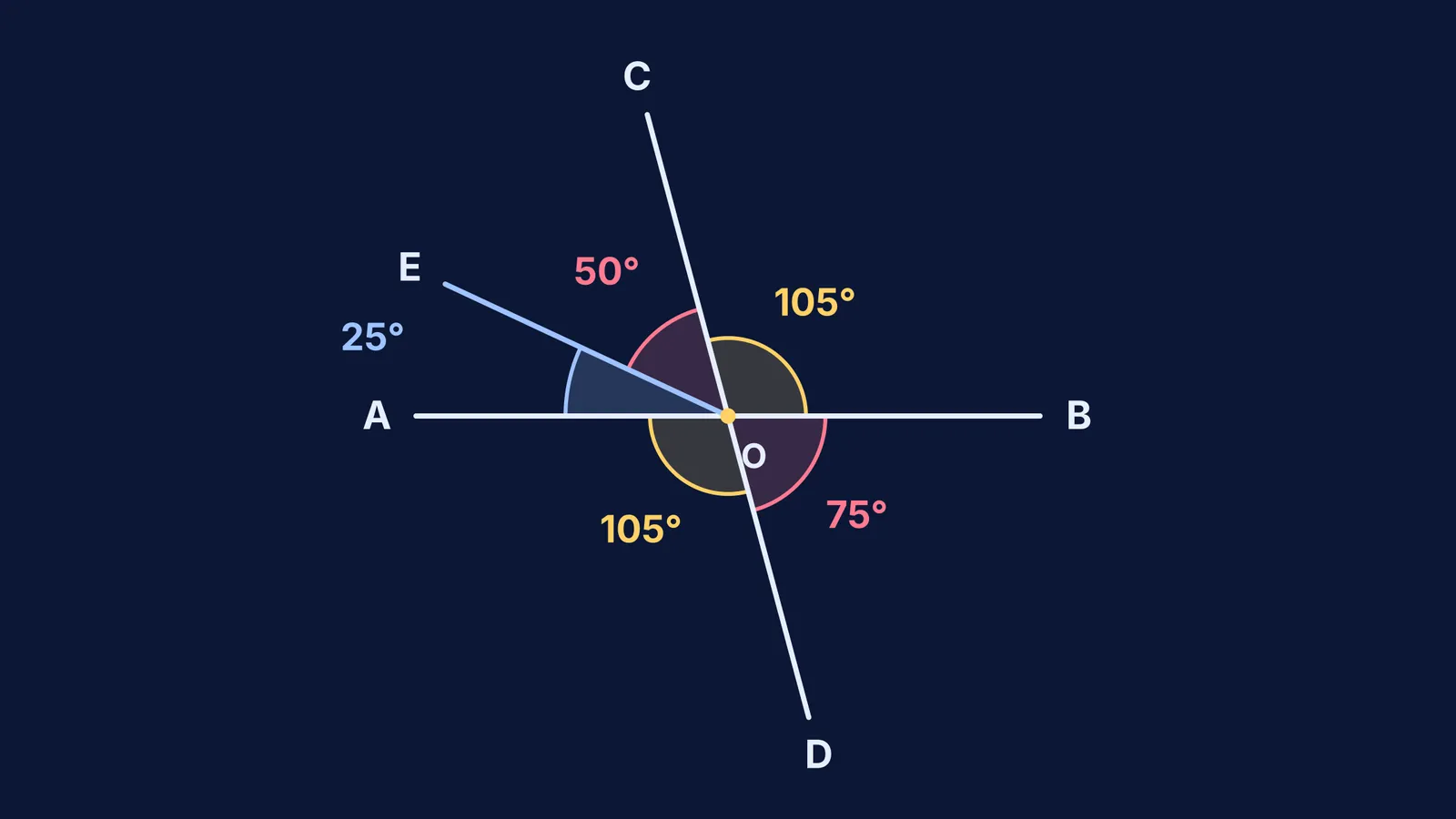
Here is a figure like the one at the top of this page. Lines AB and CD cross at O, and a ray OE comes out of O between OA and OC. You are told:
∠BOC = 3x
∠AOD = x + 70°
∠BOD = z
∠EOC = 2y and ∠AOE = y
Find x, y and z, and all five angles.
Look for an equation with only one unknown. ∠BOC and ∠AOD are vertically opposite, so 3x = x + 70°. That gives 2x = 70°, so x = 35°. Now ∠BOC = 105° and ∠AOD = 105°.
Use a linear pair. ∠BOD and ∠BOC sit next to each other on line CD, so z + 105° = 180°, which gives z = 75°.
Use the full turn. Going round O: y + 2y + 105° + 75° + 105° = 360°. So 3y + 285° = 360°, which gives 3y = 75° and y = 25°. That makes ∠AOE = 25° and ∠EOC = 50°.
Check with a rule you haven't used yet. A, O and B lie on one straight line, so ∠AOE + ∠EOC + ∠COB should be 180°. It is: 25° + 50° + 105° = 180°.
The easy mistake is to start with step 3. If you try the full turn first, you get one equation with three unknowns and nowhere to go. Save the 360° rule for the end, when it has only one unknown left.
Which angle rule should you use first?
Before you write anything, mark every angle on the figure and run through these checks in order:
Is there a pair of vertically opposite angles? Make them equal. This often gives a one-unknown equation straight away.
Is there a straight line with two or three angles on it? Make them add to 180°.
Is only one angle around the point still unknown? Now use the full turn: everything adds to 360°.
Do you have an answer? Check it with a rule you didn't use.
This order handles figures like the one above. When there is a triangle in the figure as well, add its angle sum of 180°. Our guide to finding x in triangle angle sum problems shows how.
Where can you practise?
Try a figure yourself first, then compare your steps with a worked solution. The Fermi Problem Library has worked problems with a step-by-step solver that explains the reasoning rather than printing an answer, so you can see which rule each line uses. If straight angles or degree measure still feel shaky, the Fermi Concept Library has a lesson on each concept in mathematics, so you can review it before trying the next problem.


