On this page
Chapter 4 of *Khel Praveen*, the new NCERT Physical Education and Well-being book for Class 9 (First Edition, April 2026), is short, but it gives you the vocabulary the rest of the year uses. It defines fitness, splits it into two types and names eleven components. Here is each one, with fresh everyday examples.
What does Chapter 4 cover, and how is it assessed?
The chapter sits in Unit 1 of the NCERT Khel Praveen Unit 1 PDF. In the CBSE 2026-27 Physical Education and Well-being curriculum, the same ideas appear under curriculum Unit 2, "Health, Fitness and Wellness", alongside wellness and First Aid. The unit numbers differ, so go by topic.
The subject carries 100 marks: 20 for theory and 80 for practical work. In the theory part, each curriculum unit carries 2 marks (2 marks × 8 units = 16), plus a 4-mark viva. Those 2 marks cover the whole of curriculum Unit 2, not this chapter alone. The subject is assessed in school through tests, projects and practical work, not a board exam.
Health vs fitness vs wellness: what is the difference?
Fitness: the book defines it as the body's ability to work efficiently, stay healthy and get through daily activities without tiring (Unit 1).
Health: Chapter 21 of the same book follows the WHO: health means full well-being of body, mind and social life, not just the absence of illness (Unit 6).
Wellness: the end-of-unit questions in Unit 1 treat overall wellness as physical, mental, emotional and social health taken together.
In short: fitness is what your body can do; health is how body, mind and relationships are doing; wellness is the whole picture.
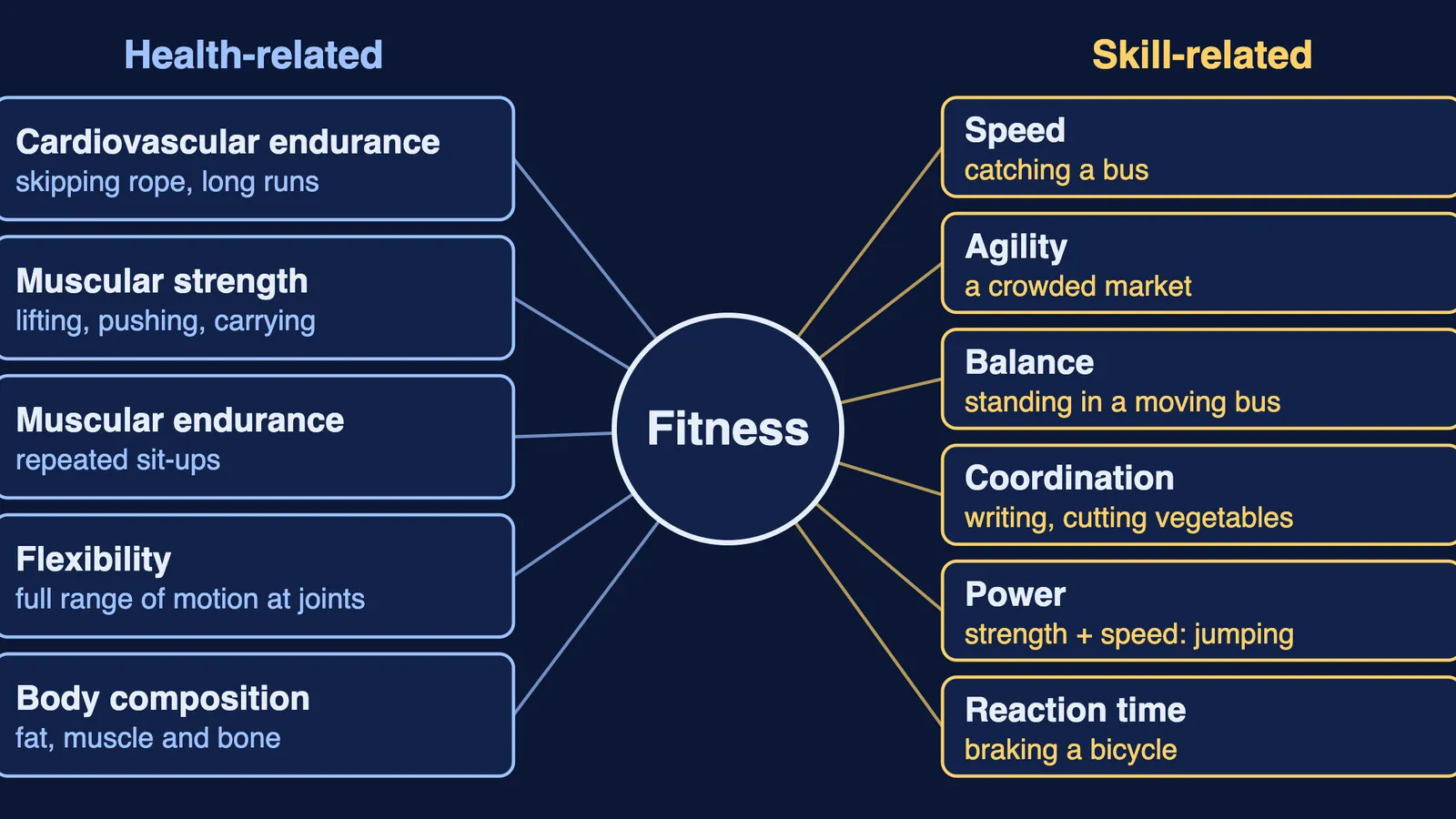
What are the health-related fitness components?
These matter for everyone, sporty or not. Definitions follow the Khel Praveen chapter.
Cardiovascular endurance: how well the heart and lungs keep oxygen flowing during long activity. Example: pedalling to tuition for twenty minutes without stopping.
Muscular strength: a muscle's ability to overcome resistance, which the book says can be body weight, air, water or an object. Example: lifting a full water bucket off the floor.
Muscular endurance: muscles working for a long time without tiring. Example: doing twenty squats in a row during a sports period.
Flexibility: joints moving through their full range. Example: reaching your toes after a long sitting session.
Body composition: how much of your body is fat, muscle and bone. The book links a healthy balance to a balanced diet and regular activity.
What are the skill-related fitness components?
The book stresses these are not only for athletes; everyone uses them daily.
Speed: getting from one point to another quickly. Example: a 50-metre dash on sports day.
Agility: changing direction quickly while staying balanced. Example: weaving between cones in a zig-zag PE drill without losing your footing.
Balance: holding body position, still or moving. Example: tying a shoelace while standing on one foot.
Coordination: body parts working smoothly together. Example: rolling a chapati evenly with both hands.
Power: strength and speed combined for an explosive movement. Example: a standing broad jump.
Reaction time: how fast you respond to a signal. Example: pressing the buzzer first in a school quiz.
How do you tell the two types apart quickly?
Ask two questions about any activity:
Does it build or describe what the body can sustain or carry (heart and lungs, muscles, joints, body make-up)? It is health-related.
Is it about moving with quickness, timing or control? It is skill-related.
Worked example: a game of stapu (hopscotch). Hopping on one leg needs balance. Landing exactly in the right box after tossing the marker needs coordination. Pushing off for a long hop needs power. Playing several rounds without your legs giving out needs muscular endurance. Four components, three skill-related and one health-related. In answers, name the component, then the action that shows it.
What practice questions can you try?
Mark values are our suggestion, sized for the 2-mark unit format.
Define fitness in your own words and name its two types. (1 mark)
Give one reason why body composition is grouped with health-related rather than skill-related fitness. (1 mark)
A cyclist spots a pothole late and swerves around it. Name two skill-related components at work and link each to part of the action. (2 marks)
How is health different from fitness? Give one example of a person who is fit but not fully healthy. (2 marks)
Carrying a heavy school bag up three floors uses more than one component. Name one health-related and one skill-related component involved, and explain each. (2 marks)
Going further? See the Class 11 guide to physical fitness, wellness and lifestyle, and the Class 11 guide to test, measurements and evaluation for how fitness is measured.
Not sure which part of the unit to revise first? Fermi's AI tutor works out what you already know and builds a plan for the session.