On this page
Finding Common Ground is Chapter 3 of Ganita Prakash, Part II, NCERT's new Class 7 maths textbook (code gegp2, First Edition October 2025), per the book's imprint page. CBSE publishes no separate 2026-27 curriculum for Classes 6 to 8; they follow the NCERT book, and this chapter is assessed by the school. We follow the chapter PDF in its order, with our own numbers.
What does Finding Common Ground cover in Class 7 maths?
The chapter has three sections: "The Greatest of All" (HCF), "Least, but not Last!" (LCM) and "Patterns, Properties, and a Pretty Procedure!", on general statements and a method that finds both together. It builds on the Grade 6 chapter Prime Time.
The HCF (Highest Common Factor) is the greatest number that divides every number in a group; its other name is GCD, the Greatest Common Divisor.
The LCM (Lowest Common Multiple) is the least number that every number in a group divides into exactly.
How do you find the HCF using prime factorisation?
Listing all factors is slow and error-prone, so the book uses prime factorisation: every number has one fixed set of prime factors. Its division method keeps dividing by a prime until a prime is left.
The key word is subpart: any piece of a number's prime factorisation is a factor of it. The chapter also names a conjecture (a claim not yet proved) and a counterexample (one case where it fails).
The HCF is the largest subpart both factorisations share, so each shared prime is used the fewest times it appears in either number.
How do you find the LCM using prime factorisation?
A multiple contains the number's full prime factorisation, perhaps with extra primes, so the LCM must contain both, using each prime the most times it appears in any of the numbers. More copies give a common multiple, but not the lowest.
Worked example: HCF and LCM of 264 and 308
Cut ribbons of 264 cm and 308 cm into equal pieces, as long as possible, in whole centimetres.
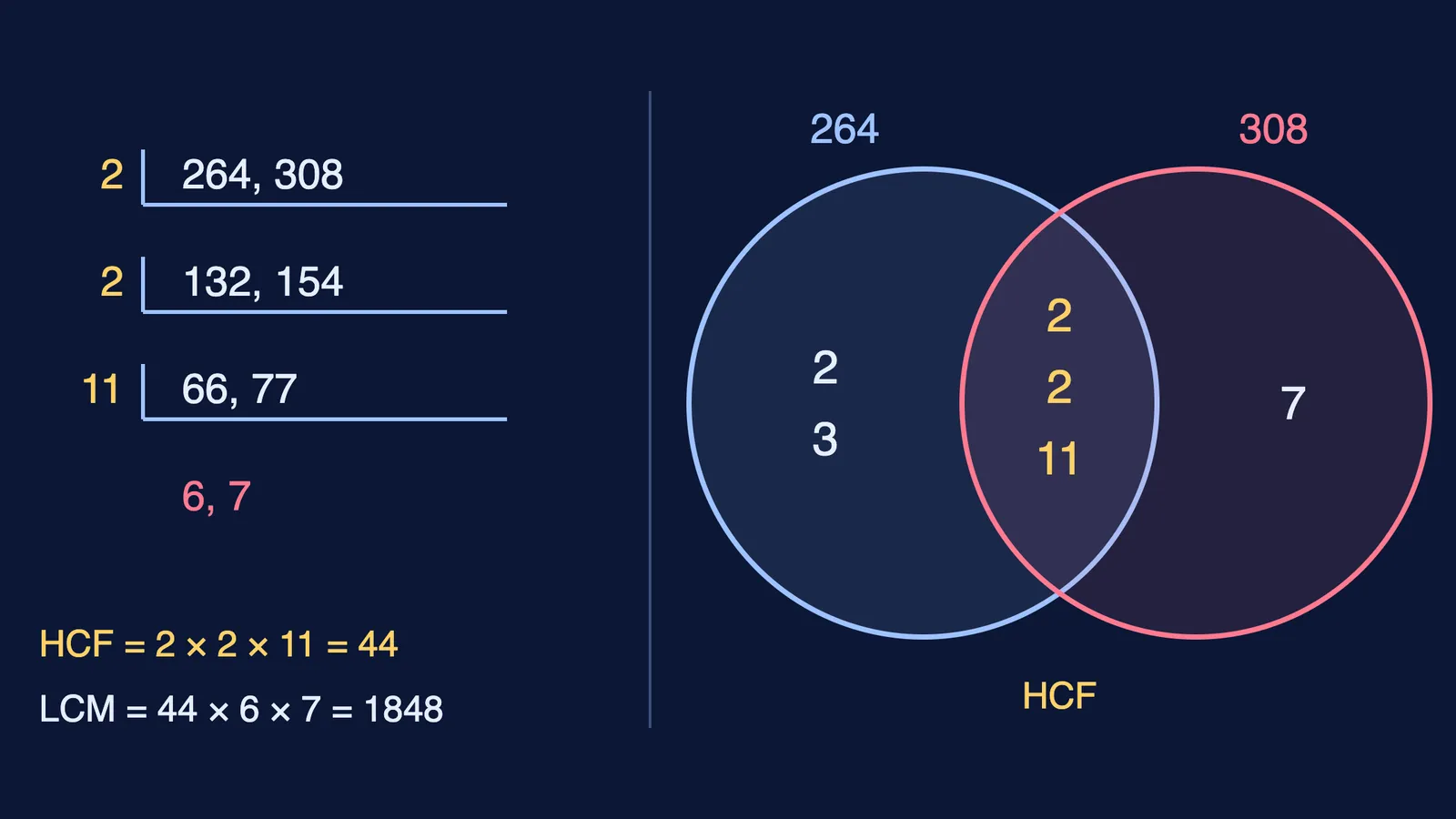
Factorise: 264 = 2 × 2 × 2 × 3 × 11 and 308 = 2 × 2 × 7 × 11.
Shared primes: 2 (fewest is two, in 308) and 11 (once each).
HCF = 2 × 2 × 11 = 44 cm. That gives 6 + 7 = 13 pieces.
Two cyclists take 264 s and 308 s per lap. When do they next meet at the start?
Most 2s is three (in 264); 3, 7 and 11 appear at most once.
LCM = 2 × 2 × 2 × 3 × 7 × 11 = 1848 s, or 30 min 48 s.
The book's efficient procedure for HCF and LCM (the ladder in the diagram above) divides both by common primes: 2, 2 and 11 leave 6 and 7, which share none, so HCF = 44 and LCM = 44 × 6 × 7 = 1848. Dividing by 44 in one step also works. Check: 44 × 1848 = 81,312 = 264 × 308.
What patterns does the chapter ask you to explain?
Section 3.3 asks for general statements, true in every case; finding them is called generalisation:
When the smaller number divides the larger, the smaller is the HCF; in algebra, the HCF of n and 5n is n.
Doubling both numbers doubles the HCF, since each gains one more shared 2.
The LCM never exceeds the product, because the product is itself a common multiple.
For two numbers, HCF × LCM = product. The book asks whether this holds for three; our HCF × LCM explainer shows where it breaks.
The exercises include a fraction sum posed by Mahaviracharya (850 C.E.), asking how to add five fractions efficiently; the LCM of the denominators helps. The letters in n and 5n lead into Chapter 7, Finding the Unknown, on algebra, per the About the Book note.
Practice questions and what to read next
Mark labels are our suggestion.
(1 mark) Write the prime factorisation of 294 by the division method.
(2 marks) Find the HCF and LCM of 99 and 165.
(2 marks) Asha conjectures that any two even numbers have HCF 2. Give a counterexample.
(3 marks) Two numbers have HCF 13 and LCM 546. One is 78. Find the other and check with prime factors.
(3 marks) Three lamps blink together, then every 4, 15 and 22 seconds. When do all three next blink together?
Answers: (1) 2 × 3 × 7 × 7. (2) HCF 33, LCM 495. (3) For example, 4 and 8 have HCF 4. (4) 91, since 78 = 2 × 3 × 13 and 91 = 7 × 13. (5) After 660 s, or 11 minutes.
For more Class 7 reasoning, try our Number Play Class 7 guide. Class 9's Ganita Manjari returns to the HCF through Euclid's method in our World of Algorithms guide.
Not sure which step of a factorisation trips you up? Fermi's AI tutor works out what you already know and builds a plan for the session.