On this page
Exploring Mixtures and their Separation is Chapter 5 of Exploration, the new NCERT Grade 9 science textbook (first edition, April 2026). Its key concepts in the CBSE 2026-27 Class IX Science curriculum are types of mixtures, concentration and separation techniques. Below are the main terms, grouped by topic. For the full chapter walk-through, read our Exploring Mixtures and their Separation Class 9 chapter guide.
What types of mixtures does the chapter describe?
Homogeneous mixture: a mixture with the same make-up everywhere; also called a solution. Example: sugar water, vinegar.
Heterogeneous mixture: a mixture whose parts are not spread evenly. Example: sand in water, oil and water.
Solute: the substance that gets dissolved. Example: sugar in sugar water.
Solvent: the substance that does the dissolving. Example: water in sugar water.
Miscible and immiscible liquids: miscible liquids mix fully (acetone and water); immiscible liquids stay in separate layers (mustard oil and water).
Alloy: a homogeneous mixture of two or more metals, or a metal and a non-metal. Example: brass (copper and zinc), bronze (copper and tin). Its metals cannot be recovered from it by physical separation methods.
How is the concentration of a solution expressed?
All three formulas are in section 5.2.2 of the NCERT chapter.
Concentration: a measure of the quantity of solute relative to the quantity of solvent, or of the whole solution.
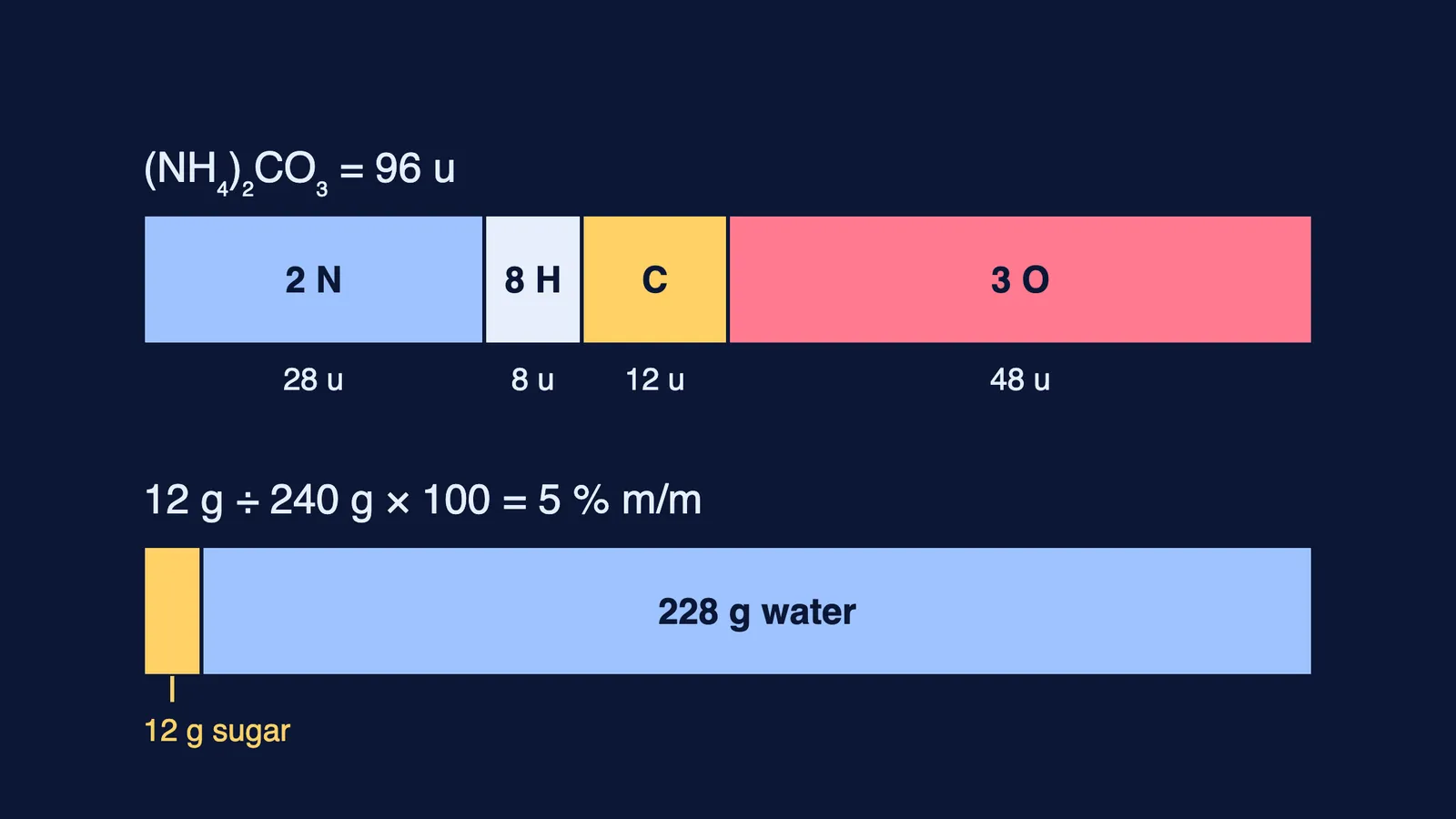
Mass by mass percentage (% m/m): grams of solute in 100 g of solution, (mass of solute / mass of solution) x 100. Example: 10 g salt in 90 g water gives 10% m/m.
Mass by volume percentage (% m/v): grams of solute in 100 mL of solution. Example: a hospital saline drip is usually 0.9% m/v, so 0.9 g of salt in every 100 mL.
Volume by volume percentage (% v/v): millilitres of a liquid solute in 100 mL of solution. Example: 1 mL pesticide made up to 100 mL of spray is 1% v/v. Don't confuse with: % m/v, where the solute is weighed, not measured by volume.
Solubility: the greatest mass of a solute that 100 g (or 100 mL) of a solvent can hold dissolved at a given temperature. Solids usually dissolve more when hot, gases less.
Saturated solution: a solution already holding its maximum solute at that temperature; any extra solute stays undissolved.
Solubility curve: a graph of solubility against temperature for a substance.
How are homogeneous mixtures separated?
Crystal: a solid whose particles sit in a regular, repeating geometric pattern. Example: rock salt, mishri.
Crystallization: getting pure crystals out of a saturated solution, usually by letting a hot saturated solution cool slowly. It relies on solubility changing with temperature and purifies solids. Don't confuse with: evaporation, which simply drives off the solvent.
Distillation: boiling off the liquid with the lower boiling point and condensing its vapour in a condenser to collect it pure. It separates miscible liquids whose boiling points differ by about 25 °C or more, or gets a liquid back from a solution. Example: acetone (about 56 °C) from water (100 °C).
Distillate: the pure liquid collected after condensing.
Fractional distillation: separation of liquids whose boiling points differ by less than 25 °C. Example: crude oil into petrol, kerosene, diesel and more.
Paper chromatography: a solvent rises up a paper strip and carries the parts of a mixture at different speeds, so they spread into separate spots. Example: colours in black sketch-pen ink.
How are heterogeneous mixtures separated?
Separating funnel: a funnel with a tap (stopcock) that separates immiscible liquids by density; the lower layer drains first. Example: water drains out below mustard oil.
Sublimation: a solid turning straight into vapour on heating. Example: camphor separated from sand; naphthalene; dry ice. Don't confuse with: evaporation, which starts from a liquid.
Deposition: vapour turning straight back into a solid on cooling.
Centrifugation: spinning a mixture very fast so heavier particles move outwards and collect at the bottom of the tube. Example: red blood cells from plasma.
Coagulation: the clumping of fine suspended particles into larger lumps once a coagulant is added. Example: alum (fitkari) in muddy water; lemon juice turning milk into paneer.
Sedimentation: heavier particles or clumps settling to the bottom under gravity. Don't confuse with: coagulation, which makes the clumps that then settle.
What is the difference between a solution, a suspension and a colloid?
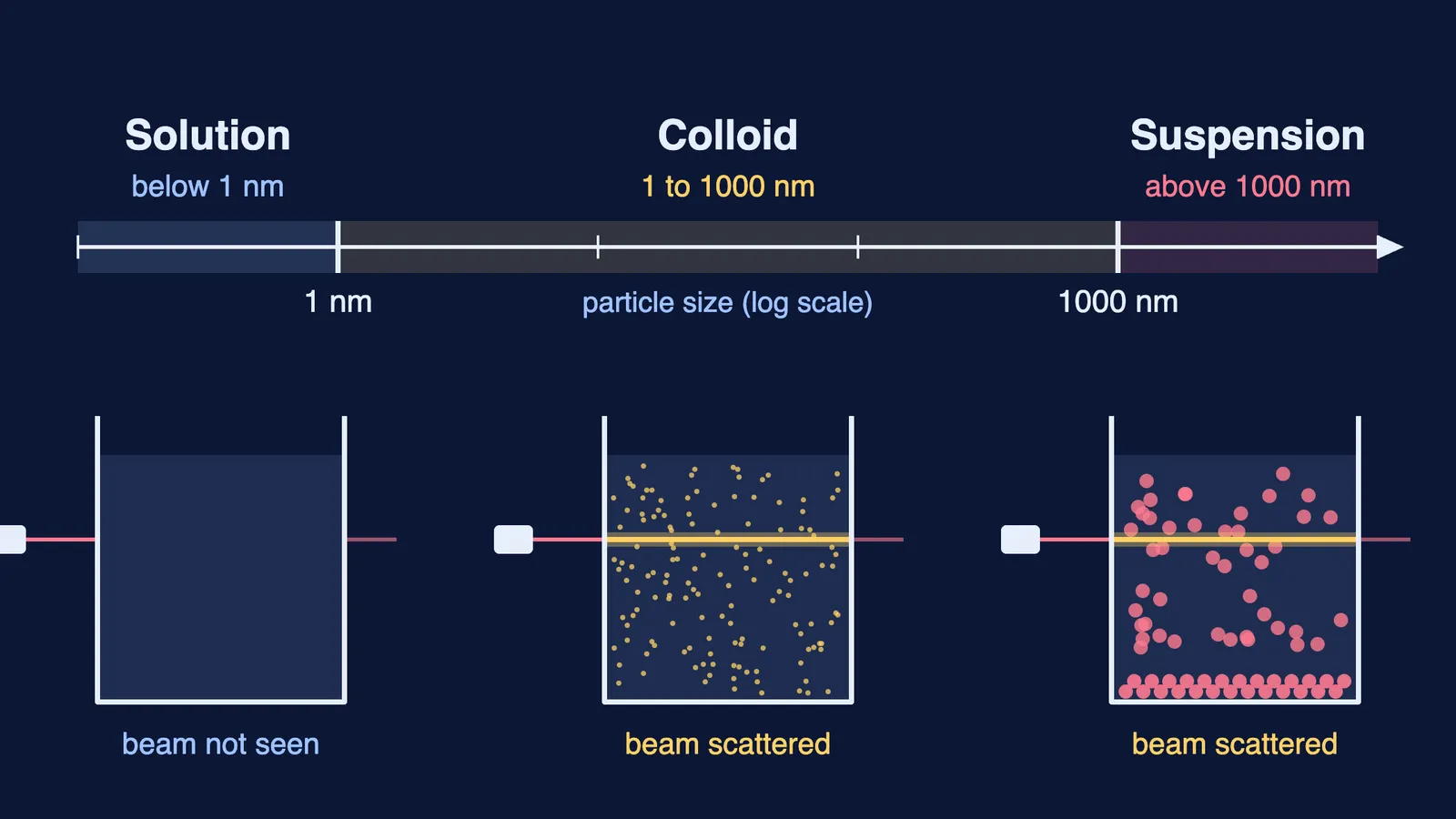
The size ranges come from section 5.4.4 of the NCERT chapter.
Suspension: a heterogeneous mixture whose undissolved particles, larger than 1000 nm across, are visible and settle over time. Example: sand or sawdust in water.
Colloid: a mixture with particles 1 to 1000 nm across that stay evenly spread and do not settle. Example: milk, blood, tomato sauce. A solution's particles are smaller than 1 nm.
Tyndall effect: scattering of light by particles, which makes a beam's path visible; named after John Tyndall. Colloids and suspensions show it; a clear solution does not. Example: a beam in a dusty room.
Dispersed phase: the particles (the part that behaves like a solute) scattered through a colloid.
Dispersion medium: the substance the particles are spread through. Don't confuse with: dispersed phase; in milk, fat droplets are the dispersed phase and water is the medium.
Emulsion: a colloid in which both phases are liquids. Example: milk (oil-in-water), butter (water-in-oil). Proteins act as emulsifying agents that keep it stable.
How to learn these terms
Learn the pairs together: solute and solvent, sublimation and deposition, dispersed phase and dispersion medium.
Make a three-column card for solution, colloid and suspension (particle size, settling, filtration, Tyndall effect) and fill it from memory.
Draw and label the distillation set-up and separating funnel from memory.
Match the chapter's mixtures (mud, blood, camphor and sand, salt water) to a method and the property it uses.
Work the three percentage examples by hand until you can write each formula cold.
If a term still feels fuzzy, the Fermi Concept Library gives every concept in chemistry its own lesson and its place in the map. Crystallisation, distillation, sublimation and chromatography come back as purification methods in Class 11 organic chemistry; see our Class 11 guide to organic chemistry basic principles and techniques.