On this page
Here are the key terms of Chapter 16 of the rationalised NCERT Class 11 Biology textbook (NCERT Chapter 16, Reprint 2026-27), grouped by topic, with examples and pairs not to confuse. For diagrams and questions, see our guide to Excretory Products and their Elimination for Class 11.
The CBSE 2026-27 Biology curriculum keeps this chapter under Human Physiology, and NCERT's Class 11 rationalisation list removes nothing from it.
What are ammonotelism, ureotelism and uricotelism?
Ammonia is the most toxic nitrogenous waste and needs the most water to remove; uric acid is the least toxic and needs the least (NCERT Chapter 16).
Ammonotelism: excreting nitrogen mainly as ammonia, which diffuses out across the body surface or gills. Example: bony fishes, aquatic amphibians.
Ureotelism: excreting nitrogen mainly as urea, made from ammonia in the liver. Example: mammals, marine fishes.
Uricotelism: excreting nitrogen as uric acid, as a paste or pellets, with minimal water loss. Example: birds, reptiles, insects.
Osmoregulation: keeping the water and ion content of body fluids steady.
Protonephridia (flame cells): simple tubules mainly for osmoregulation. Example: Planaria, Amphioxus. Don't confuse with: nephridia of earthworms.
Malpighian tubules: the excretory tubules of most insects, such as cockroaches. Don't confuse with: the Malpighian body of a nephron.
Green glands (antennal glands): the excretory organs of crustaceans such as prawns.
Which parts of the kidney and nephron should you know?
Each human kidney has nearly one million nephrons (NCERT Chapter 16).
Hilum: the notch in the middle of the kidney's inner, concave side where the ureter, blood vessels and nerves enter.
Renal pelvis and calyces: the funnel-shaped space inside the hilum and its cup-like projections.
Columns of Bertini: strips of cortex reaching down between the cone-shaped medullary pyramids.
Nephron: the functional unit of the kidney: a glomerulus plus a renal tubule.
Glomerulus: a knot of capillaries fed by the afferent arteriole and drained by the efferent arteriole (afferent in, efferent out).
Malpighian body (renal corpuscle): the glomerulus plus Bowman's capsule, the double-walled cup around it.
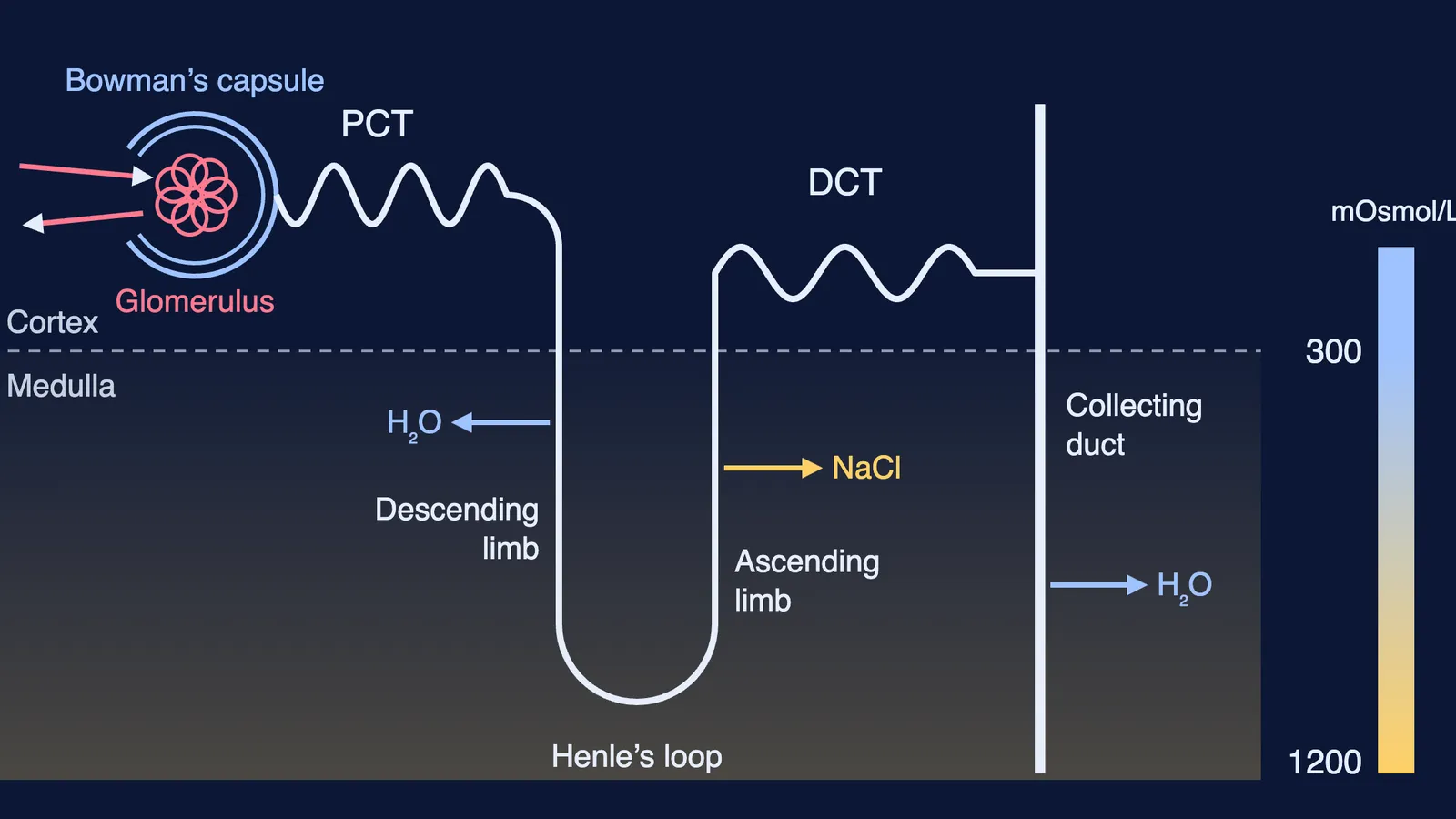
PCT, Henle's loop, DCT: the coiled proximal tubule, the hairpin loop with descending and ascending limbs, and the coiled distal tubule. Of these, only the loop dips into the medulla.
Collecting duct: the straight tube that collects from many DCTs and carries urine to the renal pelvis.
Cortical nephron: one with a short loop that barely enters the medulla; most nephrons are this type. Don't confuse with: the juxta medullary nephron, whose long loop runs deep into the medulla.
Vasa recta: the U-shaped capillary running beside Henle's loop; cortical nephrons have little or none of it.
How is urine formed, and what is counter current?
GFR is about 125 ml per minute, or 180 litres a day, yet only about 1.5 litres of urine leaves, so nearly 99 per cent of the filtrate is reabsorbed (NCERT Chapter 16).
Ultrafiltration: glomerular blood pressure forces plasma through filtration slits between podocytes into Bowman's capsule; almost everything in plasma passes through except proteins.
Glomerular filtration rate (GFR): how much filtrate both kidneys together produce each minute.
Reabsorption: tubule cells taking useful substances back from the filtrate, such as glucose and amino acids. Example: the PCT reclaims 70-80 per cent of electrolytes and water.
Tubular secretion: tubule cells adding H+, K+ and ammonia to the filtrate to keep pH and ion balance. Don't confuse with: reabsorption, which moves substances the other way.
Medullary gradient: tissue-fluid osmolarity rising from about 300 mOsmol/L in the cortex to about 1200 mOsmol/L in the inner medulla, mainly from NaCl and urea (NCERT Chapter 16).
Counter current mechanism: opposite flows in the two limbs of Henle's loop and of the vasa recta that keep this gradient, so the collecting duct can make urine nearly four times as concentrated as the filtrate. Don't confuse: the descending limb lets water out, not salt; the ascending limb does the reverse.
How do ADH, renin and ANF control the kidney?
Juxta glomerular apparatus (JGA): a sensitive patch where the DCT meets the afferent arteriole; when GFR falls, it releases renin.
Renin-angiotensin mechanism: renin turns angiotensinogen into angiotensin I, then angiotensin II, which narrows blood vessels to raise glomerular blood pressure and GFR, and triggers aldosterone release from the adrenal cortex.
Aldosterone: makes the distal parts of the tubule reabsorb Na+ and water, raising blood pressure and GFR.
ADH (vasopressin): released from the neurohypophysis after fluid loss; boosts water reabsorption, preventing diuresis (heavy urine flow). Don't confuse with: aldosterone, which acts through Na+.
Atrial natriuretic factor (ANF): from the heart's atria; widens blood vessels, lowers blood pressure and checks the renin-angiotensin mechanism.
Diabetes insipidus: water loss and dehydration when ADH is not made or released properly (NCERT Chapter 19). Don't confuse with: diabetes mellitus, signalled by glucose and ketone bodies in urine.
What do micturition, uremia and dialysis mean?
Micturition: releasing urine; the micturition reflex runs from bladder stretch receptors to the CNS and back.
Other excretory organs: lungs (CO2, water), liver (bilirubin, biliverdin in bile) and skin (sweat, sebum).
Uremia: harmful build-up of urea in blood when kidneys fail.
Hemodialysis: heparinised blood passes through a cellophane tube in dialysing fluid that matches plasma minus nitrogenous wastes, so the wastes diffuse out; anti-heparin is added before it returns.
Kidney transplantation: a donor kidney, ideally from a close relative to reduce rejection, replaces a failed one.
Renal calculi and glomerulonephritis: kidney stones made of salts such as oxalates, and inflamed glomeruli.
How to learn these terms
Tie the three "-telisms" to water: more water lets an animal afford a more toxic waste.
Draw one nephron across a cortex-medulla line, as above, labelling each part and the water and NaCl arrows.
Write hormones as chains: low GFR, renin, angiotensin II, aldosterone; fluid loss, ADH. Put ANF beside the first as its brake.
Make a numbers card (125 ml, 180 litres, 1.5 litres, 99 per cent, 300 to 1200) and name the term each belongs to. Our worked excretion post for NEET turns these numbers into problems.
If a term won't stick, the Fermi Concept Library covers every concept in biology, each with its own lesson and its place in the map.