On this page
Excretory Products and their Elimination is Chapter 16 of the NCERT Class 11 Biology textbook, and for 2026-27 it sits in Unit V, Human Physiology. This guide is for your CBSE school exam.
How many marks is Excretory Products in Class 11?
The CBSE Class XI Biology curriculum for 2026-27 gives Unit V, Human Physiology, 18 marks out of 70 in the theory paper. That 18 is shared by six chapters, from Breathing and Exchange of Gases to Chemical Coordination and Integration, and CBSE prints no separate figure for this chapter.
The curriculum's Chapter 16 list also names diabetes insipidus, which the current NCERT text does not describe; ask your teacher about it. NCERT's list of rationalised content for Class XI drops nothing from this chapter; the full chapter it removed from Unit V is Digestion and Absorption, which the curriculum says will be "assessed only formatively to reinforce understanding without adding to summative assessments".
What does the current NCERT chapter cover?
Work from the NCERT chapter (Reprint 2026-27).
Three wastes: ammonia is the most toxic and needs the most water; uric acid is the least toxic. Many bony fishes are ammonotelic, mammals and marine fishes ureotelic, birds and reptiles uricotelic.
The kidney: each one is 10-12 cm long and 120-170 g, with a cortex, a medulla and nearly one million nephrons.
The nephron: glomerulus plus renal tubule (Bowman's capsule, PCT, Henle's loop, DCT), draining into a collecting duct. Juxta medullary nephrons have long loops; cortical nephrons have short ones.
For flame cells, nephridia and Malpighian tubules, see our guide to matching each excretory organ to its animal.
How is urine formed, step by step?
The NCERT chapter names three processes: glomerular filtration, reabsorption and secretion.
Filtration: blood pressure in the glomerulus pushes plasma through three layers into Bowman's capsule. All but proteins pass: ultrafiltration. GFR is about 125 mL a minute, or 180 litres a day.
Reabsorption: just 1.5 of those 180 litres become urine, so the tubules reclaim close to 99 per cent. The PCT takes back almost every essential nutrient plus 70-80 per cent of the electrolytes and water.
Secretion: tubule cells add H+, K+ and ammonia to keep the ionic and acid-base balance.
Worked example with our own numbers (not NCERT's, which are about 125 mL a minute and 180 litres a day): a person's GFR is 120 mL a minute and they pass 1.2 litres of urine a day. Daily filtrate is 120 x 1440 = 172,800 mL, or 172.8 litres. Reabsorbed water is 172.8 - 1.2 = 171.6 litres, which is 171.6 / 172.8, about 99.3 per cent.
How does the counter-current mechanism work?
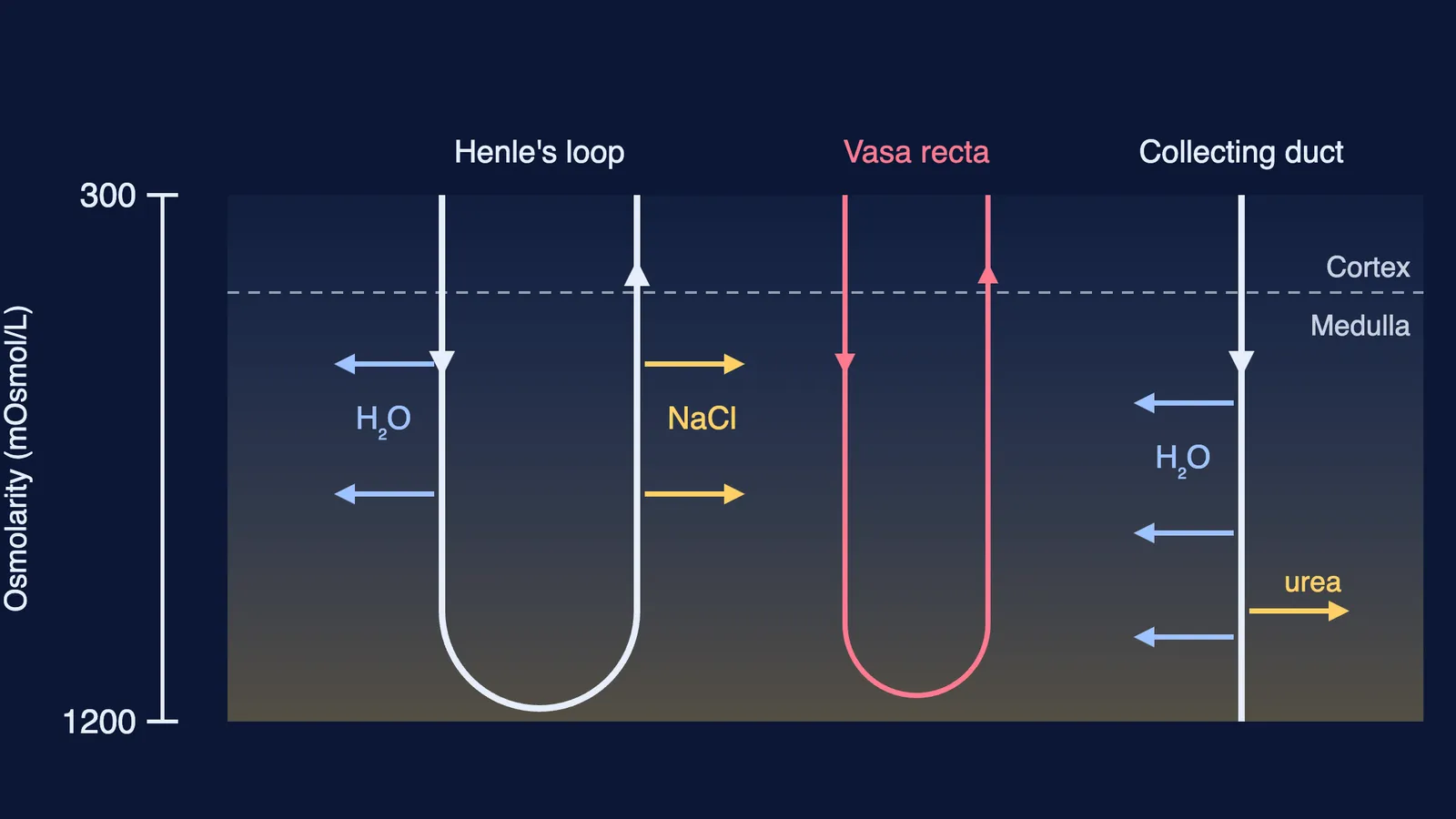
The descending limb of Henle's loop lets water out but holds back electrolytes, so the filtrate concentrates as it goes down. Water cannot cross the ascending limb, yet electrolytes leave it, so the filtrate is diluted going up. Blood in the vasa recta also flows in opposite directions in its two limbs. Together they keep the interstitium at about 300 mOsmol/L in the cortex rising to about 1200 mOsmol/L in the inner medulla, mainly through NaCl and urea (NCERT).
Water then leaves the collecting duct into this salty interstitium, so urine can become nearly four times as concentrated as the filtrate (1200 / 300 = 4).
Which hormones regulate kidney function?
The NCERT chapter gives three feedback routes.
ADH (vasopressin): released from the neurohypophysis when fluid is lost; increases water reabsorption, preventing diuresis.
Renin-angiotensin: a fall in GFR makes JG cells release renin; angiotensin II constricts vessels and triggers aldosterone, which makes the distal parts of the tubule reabsorb Na+ and water.
ANF: more blood reaching the heart's atria releases atrial natriuretic factor, which dilates vessels and lowers blood pressure, a check on renin-angiotensin.
Which questions should you practise?
The marks in brackets are our suggestion, not CBSE's. The curriculum prints a question-paper design only for Class XII.
A bony fish lives in a lake; a sparrow nests beside it. Name the main nitrogenous waste of each and link it to water. (2 marks)
Put these in the order filtrate meets them: DCT, Bowman's capsule, collecting duct, PCT, Henle's loop. (1 mark)
Assertion: the ascending limb of Henle's loop dilutes the filtrate. Reason: it is impermeable to water but moves electrolytes out. Choose the correct option. (1 mark)
GFR is 110 mL a minute and urine output is 1.1 litres a day. Find the percentage of filtrate reabsorbed. (2 marks)
After heavy sweating, trace how ADH and aldosterone help save water. (3 marks)
Why would a kidney with only cortical nephrons make less concentrated urine? (3 marks)
Explain how a dialysing unit clears urea, and why heparin and anti-heparin are both used. (5 marks)
Answer to question 4: filtrate is 158.4 litres a day, so 157.3 / 158.4 is about 99.3 per cent. Our Human Physiology guide for NEET maps the whole unit; see also our Class 11 guide to Structural Organisation in Animals.
Not sure where to begin? Fermi's AI tutor works out what you already know and builds a plan for the session, so you start from the gap.