On this page
This glossary follows the NCERT Class 12 Biology chapter on Evolution (2026-27 reprint) and the Chapter 6 topics in the CBSE Class 12 Biology syllabus 2026-27. Definitions are ours; examples are NCERT's. For answer-writing, see our guide to writing Evolution answers in the Class 12 board exam.
How did life begin on Earth?
The dates and conditions below are from the NCERT Evolution chapter.
Panspermia: the idea that life reached Earth from space as spores.
Spontaneous generation: the old belief that living things arise from rotting matter such as straw or mud. Louis Pasteur's sterilised-flask experiments showed life comes only from pre-existing life.
Chemical evolution: Oparin and Haldane's proposal that simple inorganic substances first formed varied organic molecules, and the first life came from these. Don't confuse with: biological evolution, the change in living forms once cells existed.
Miller's experiment: in 1953, S.L. Miller sent electric sparks through a sealed flask of CH4, H2, NH3 and water vapour and found amino acids formed.
What are the evidences for evolution?
Fossils and paleontological evidence: fossils are preserved hard parts, such as bones and shells, of past organisms in rock. Layers of different ages hold different life forms. Example: dinosaurs.
Embryological evidence: Ernst Haeckel's argument from features all vertebrate embryos share but adults lack, such as vestigial gill slits. Karl Ernst von Baer disproved it: embryos do not repeat other species' adult forms.
Homologous organs: organs with the same basic plan that do different jobs, pointing to a common ancestor. Example: forelimbs of whale, bat, cheetah and human, built from the same bones; thorns of Bougainvillea and tendrils of Cucurbita.
Analogous organs: organs that do the same job but are built differently. Example: wings of a butterfly and a bird; sweet potato (a root) and potato (a stem). Don't confuse with: homologous organs.
Divergent evolution: one ancestral structure changing in different directions for different needs. Produces homology.
Convergent evolution: different structures evolving towards the same function. Produces analogy. Example: the Tasmanian wolf (a marsupial) and the placental wolf.
Biochemical evidence: matching proteins and genes carrying out the same function in very different organisms, a sign of shared ancestry.
Artificial selection: people breeding chosen plants and animals, such as dog breeds.
Melanised moths: in England, white-winged moths outnumbered dark ones before industrialisation, but dark ones were commoner by 1920 after soot darkened tree trunks. Camouflaged moths escaped predators; neither type was wiped out.
Anthropogenic evolution: evolution driven by human action, such as pesticide-resistant pests or antibiotic-resistant microbes.
What is adaptive radiation?
Adaptive radiation: many species evolving from one ancestor within one geographical area, each spreading into a different habitat. Example: Darwin's finches on the Galapagos, where seed-eating ancestors gave rise to insect-eating and vegetarian forms; the marsupials of Australia. Don't confuse with: convergent evolution, which compares separate lineages that end up looking alike.
How do Darwin, Lamarck and de Vries differ?
Theory of special creation: the religious view that species were created as they are and never change.
Natural selection: Darwin's mechanism: individuals with heritable variations that suit the environment leave more offspring, so the population changes over generations.
Fitness: in Darwin's sense, reproductive success: how many offspring an individual leaves.
Branching descent: species splitting from common ancestors like branches of a tree. With natural selection, it is one of the two key ideas of Darwin's theory.
Use and disuse (Lamarckism): Lamarck's idea that organs change with use and these acquired characters are inherited, as in giraffes stretching their necks. It is no longer accepted. Don't confuse with: natural selection, where variation exists first and nature selects it.
Mutation and saltation: Hugo de Vries, working on evening primrose, described mutations as large, sudden, random changes and believed they create new species in a single step, which he called saltation. Don't confuse with: Darwin's gradual change.
What do Hardy-Weinberg and genetic drift mean?
Gene pool: all the genes and their alleles in a population. The frequencies of all alleles of a gene add up to 1.
Hardy-Weinberg principle: allele frequencies stay constant from generation to generation unless something disturbs them; this steady state is genetic equilibrium. With allele frequencies p and q, p² + 2pq + q² = 1. Worked example: if p = 0.7 and q = 0.3, then AA = 0.49, Aa = 0.42 and aa = 0.09.
Five disturbing factors: gene flow, genetic drift, mutation, genetic recombination and natural selection.
Gene flow: alleles moving between populations through repeated migration and breeding.
Genetic drift: allele frequencies changing by chance alone, strongest in small populations. Don't confuse with: gene flow, which needs migration.
Founder effect: drift in a small group that founds a new population; its allele frequencies may differ so much that, as NCERT notes, it becomes a new species.
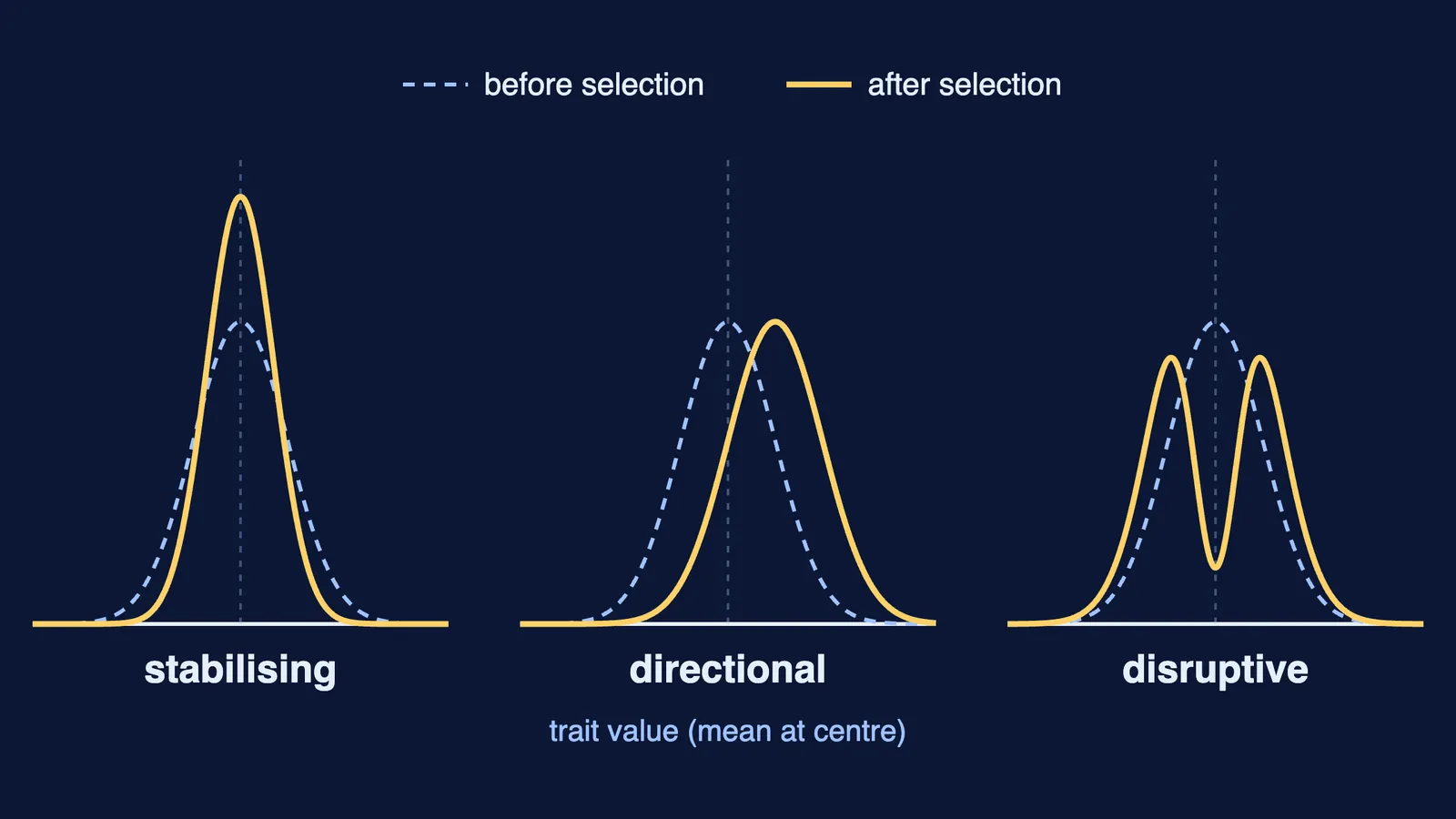
Stabilising, directional and disruptive selection: after selection, more individuals sit at the mean trait value (stabilising), away from it in one direction (directional), or at both extremes (disruptive).
Who were our human ancestors?
Ages and brain sizes are from the NCERT Evolution chapter; our human evolution timeline post puts them in order.
Dryopithecus and Ramapithecus: hairy primates of about 15 million years ago. Ramapithecus was more man-like, Dryopithecus more ape-like.
Australopithecines: lived in East African grasslands about 2 million years ago; mainly ate fruit.
Homo habilis: the first human-like being, with a brain of 650-800 cc; probably did not eat meat.
Homo erectus: known from fossils found in Java in 1891; about 1.5 million years ago, brain about 900 cc, probably ate meat.
Neanderthal man: brain about 1,400 cc; buried their dead.
Homo sapiens: arose in Africa and spread across continents.
How to learn these terms
Learn them as pairs: homologous and analogous, divergent and convergent, gene flow and genetic drift, Darwin and Lamarck, gradual change and saltation.
Tie each term to its NCERT example: finches for adaptive radiation, moths for natural selection, giraffe for Lamarck, evening primrose for de Vries.
Draw the three selection curves before and after selection.
Work one Hardy-Weinberg problem by hand, then try more in our Evolution for NEET post.
If a term still feels slippery, the Fermi Concept Library has every concept in biology, each with its own lesson.