On this page
Eight new JEE Advanced-style questions on electromagnetic induction and AC, easy to hard.
What does JEE Advanced test in EMI and AC?
The official JEE (Advanced) 2026 syllabus lists Faraday's and Lenz's laws, self and mutual inductance, and "RC, LR, LC and LCR (in series) circuits with d.c. and a.c. sources". Every question stays inside it. New to transients? Read our guide on how to prepare EMI and AC for JEE Advanced first.
How should you use this set?
Allow 35 minutes. For "one or more options correct", judge each option alone; our guide to JEE Advanced question types explains the formats.
Take μ₀ = 4π × 10⁻⁷ T m A⁻¹. Inductors are ideal unless a resistance is given.
Easy: flux, LR growth and coupled coils
Q1 (easy, single-correct). A flexible circular loop of radius 10 cm lies perpendicular to a uniform 0.40 T field that is rising at 0.20 T/s, while the radius shrinks at 5.0 mm/s. The induced emf is closest to:
(A) 1.3 mV (B) 5.0 mV (C) 6.3 mV (D) 7.5 mV
Answer: (B). Φ = Bπr², so dΦ/dt = πr²(dB/dt) + 2πrB(dr/dt) = 6.28 − 1.26 = 5.0 mV. Trap: (D) adds the terms; shrinking area lowers flux.
Q2 (easy, one or more options correct). At t = 0, a 10 V ideal battery is switched across a 2.0 H inductor in series with 4.0 Ω. Which are correct?
(A) The current starts rising at 5.0 A/s.
(B) The time constant is 0.50 s.
(C) The final stored energy is 12.5 J.
(D) At t = 0.50 ln 2 s, the inductor's voltage is 5.0 V.
Answer: (A), (B), (D). Initially all 10 V sits across L: di/dt = 5.0 A/s. τ = L/R = 0.50 s. At τ ln 2 the current is half of 2.5 A, so R and L share 10 V equally. Trap: (C) is LI²; the energy is ½LI² = 6.25 J.
Q3 (easy, numerical-value). A 50-turn coil of area 1.0 cm² sits coaxially at the centre of a 100-turn coil of radius 20 cm. Its current changes at 200 A/s. Find the emf in the small coil, in μV, to the nearest integer.
Answer: 314. The centre field μ₀N₁I/(2R) is nearly uniform over the small coil: M = μ₀N₁N₂a/(2R) = 1.57 μH and emf = 314 μV. Trap: 628, from dropping the 2 in 2R.
Medium: RC, LC and resonance width
Q4 (medium, single-correct). A 9.0 V battery charges a 10 μF capacitor through 3.0 kΩ, with 6.0 kΩ directly across the capacitor. The capacitor voltage 20 ms after switching on is closest to:
(A) 1.2 V (B) 2.2 V (C) 3.8 V (D) 5.7 V
Answer: (C). The capacitor sees 6.0 V behind 3.0 kΩ ∥ 6.0 kΩ = 2.0 kΩ, so τ = 20 ms and V = 6.0(1 − e⁻¹) = 3.8 V. Trap: (D), 9.0(1 − e⁻¹), which ignores the divider capping it at 6.0 V.
Q5 (medium, single-correct). A 20 μF capacitor at 50 V is connected at t = 0 across a 0.20 H inductor. When is the energy first shared equally, and what is the current then?
(A) 1.57 ms, 0.35 A (B) 1.57 ms, 0.25 A (C) 3.14 ms, 0.50 A (D) 0.79 ms, 0.35 A
Answer: (A). ω = 1/√(LC) = 500 rad/s and q = Q₀ cos ωt. Equal energies need q = Q₀/√2, so ωt = π/4 and t = 1.57 ms; the current is 0.50 A × sin(π/4) = 0.35 A. Trap: (B) halves the current, but energy goes as its square.
Q6 (medium, one or more options correct). A series circuit (R = 40 Ω, L = 50 mH, C = 5.0 μF) is driven at fixed rms voltage. Average power is half its resonant value at ω₁ < ω₂. Which are correct?
(A) ω₂ − ω₁ = 800 rad/s.
(B) At resonance, V_L is 5 times the source voltage.
(C) ω₁ω₂ = 4.0 × 10⁶ rad² s⁻².
(D) At ω₁, the current lags the source voltage.
Answer: (A), (C). Half power needs |ωL − 1/(ωC)| = R, giving ω₂ − ω₁ = R/L = 800 rad/s and ω₁ω₂ = 1/(LC). (B) fails: V_L/V = ω₀L/R = 2.5 with ω₀ = 2000 rad/s. Trap: (D); below resonance the capacitor dominates, so the current leads.
Hard: a rod that charges a capacitor, and parallel inductors
Q7 (hard, one or more options correct). A 0.10 kg rod of length 1.0 m rests on smooth horizontal rails joined at one end by a 0.40 F capacitor, in a vertical 0.50 T field; resistance is negligible. From t = 0 a constant 0.20 N force pulls the rod along the rails. Which are correct?
(A) The acceleration is constant at 1.0 m/s².
(B) A constant 0.20 A current flows.
(C) At t = 2.0 s, the capacitor's energy equals the rod's kinetic energy.
(D) Up to t = 2.0 s, the force does 0.20 J of work.
Answer: (A), (B), (C). With q = CBlv, i = CBla and the opposing force is B²l²Ca, so a = F/(m + B²l²C) = 1.0 m/s² and i = 0.20 A. At 2.0 s, v = 2.0 m/s: kinetic energy 0.20 J, capacitor energy ½C(Blv)² = 0.20 J. Over 2.0 m, F does 0.40 J. Trap: (D), which forgets the capacitor's energy.
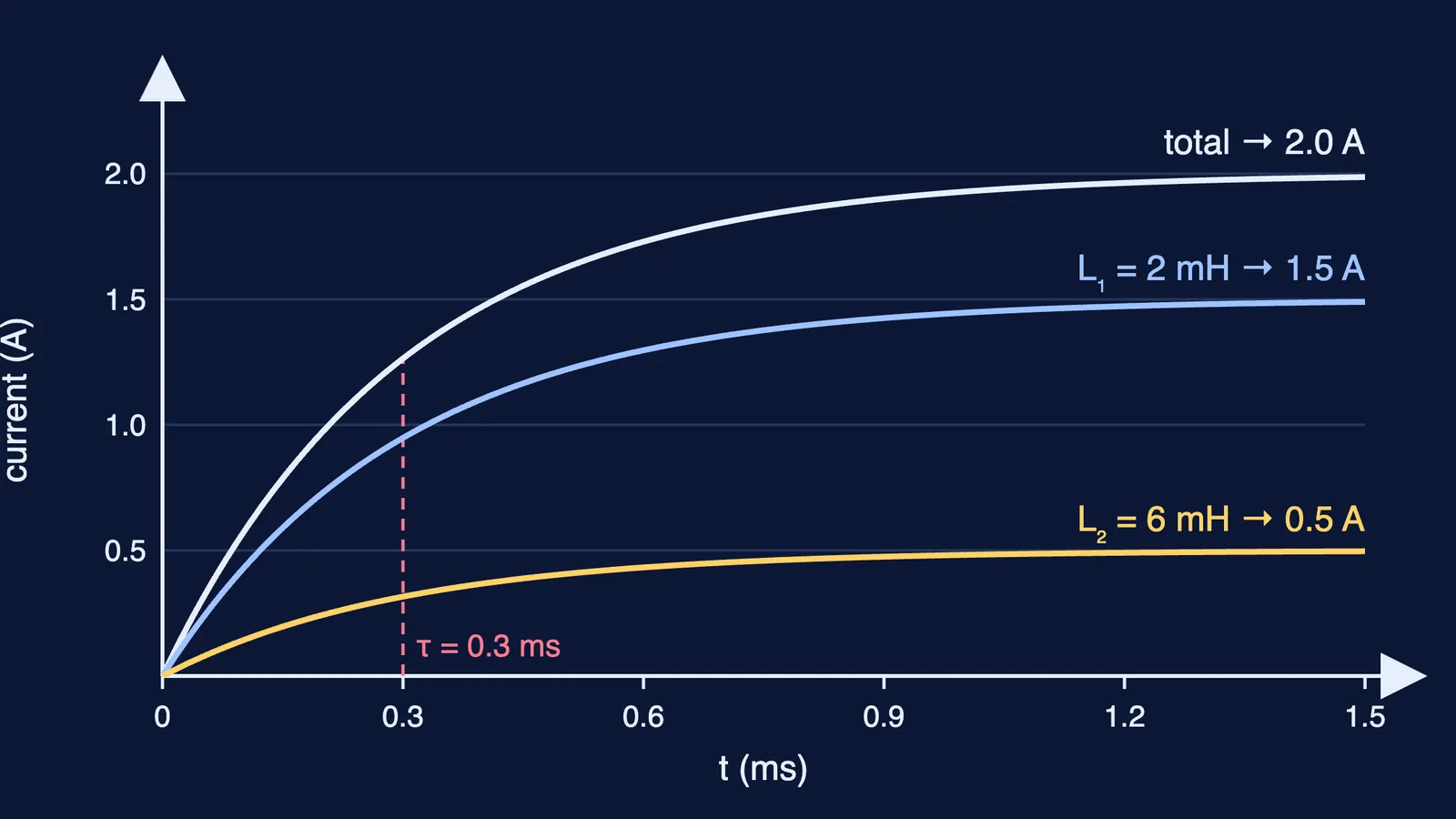
Q8 (hard, numerical-value). A 10 V battery and 5.0 Ω are switched across two parallel inductors, L₁ = 2.0 mH and L₂ = 6.0 mH, with no mutual coupling. Find the steady current through L₂, in A.
Answer: 0.50. Sharing one voltage, L₁i₁ = L₂i₂ at every instant. The final 2.0 A splits 3 : 1, so i₂ = 0.50 A (see the chart at the top). Trap: 1.0, an equal split; with no branch resistance, inductance sets it.
What should you do after marking this set?
Sort each miss into one bin: flux (Q1, Q3, Q7), transients (Q2, Q4, Q8) or oscillation and resonance (Q5, Q6). Practise the fullest bin; redo those questions in two days. For sign slips, read three common mistakes in finding induced current direction.
When a whole method breaks down, the Fermi Problem Library has worked problems with a step-by-step solver that explains the reasoning rather than printing an answer.