On this page
Eight original electrochemistry questions in JEE Advanced style, from easy to hard, each labelled by type: single correct, one or more correct, or numerical value. Every solution names the trap: the most tempting wrong answer and the slip behind it.
How should you use this JEE Advanced electrochemistry set?
The official JEE (Advanced) 2026 syllabus lists electrochemical cells, the Nernst equation, electrochemical work, the electrochemical series, Faraday's laws of electrolysis, specific, equivalent and molar conductivity, Kohlrausch's law, batteries, fuel cells and corrosion. Every question stays inside it.
Take E° values from Table 2.1 of the NCERT Class 12 electrochemistry chapter, at 298 K, with 2.303RT/F = 0.059 V and F = 96487 C mol⁻¹, as NCERT does. Molar masses (g mol⁻¹): Ag 108, Al 27, Cu 63.5, H₂SO₄ 98.08.
Give yourself 30 minutes and work on paper.
In "one or more correct" questions, judge each option on its own.
Read every trap line, even where you were right.
New to the chapter? Read our guide on how to prepare electrochemistry for JEE Advanced. For how each question type behaves in the paper, see JEE Advanced question types.
Easy: can you apply Faraday's laws and equivalent conductivity?
Q1 (easy, single correct). Two electrolytic cells, one with aqueous AgNO₃ and one with Al₂O₃ dissolved in molten cryolite, are connected in series. When 3.24 g of silver is deposited, the mass of aluminium deposited is:
(A) 0.810 g
(B) 0.270 g
(C) 0.405 g
(D) 2.43 g
Answer: (B). The same charge flows through both cells: 3.24 g Ag means 0.0300 mol of electrons. Al³⁺ needs 3 electrons per atom: 0.0300/3 × 27 = 0.270 g. Trap: (A), which uses one electron per Al atom.
Q2 (easy, single correct). A 0.0100 M Al₂(SO₄)₃ solution has conductivity 4.20 × 10⁻³ S cm⁻¹. Its equivalent conductivity, in S cm² eq⁻¹, is:
(A) 420
(B) 140
(C) 70
(D) 210
Answer: (C). One formula unit carries 2 × 3 = 6 units of positive charge, so the solution is 0.0600 N. Λeq = 1000κ/N = 1000 × 4.20 × 10⁻³/0.0600 = 70. Trap: (B), which counts the charge of one Al³⁺ ion (3) instead of both.
Medium: can you read the electrochemical series and count electrons?
Q3 (medium, one or more options correct). Using E° values (V): MnO₄⁻/Mn²⁺ 1.51, Cl₂/Cl⁻ 1.36, Br₂/Br⁻ 1.09, Fe³⁺/Fe²⁺ 0.77, Cu²⁺/Cu 0.34. Under standard conditions, which reactions are spontaneous?
(A) Fe³⁺ oxidises Br⁻ to Br₂
(B) Acidified MnO₄⁻ oxidises Cl⁻ to Cl₂
(C) Br₂ oxidises Fe²⁺ to Fe³⁺
(D) Cu reduces Fe³⁺ to Fe²⁺
Answer: (B), (C), (D). A reaction runs when the oxidant's couple is higher. E°cell is +0.15 V for (B), +0.32 V for (C) and +0.43 V for (D), but −0.32 V for (A). Trap: leaving out (D), because copper cannot displace iron. Here Fe³⁺ goes only to Fe²⁺, and that couple (0.77 V) is above copper.
Q4 (medium, numerical). A lead storage battery supplies 2.50 A for 2.00 hours. What mass of H₂SO₄, in grams, is consumed?
Answer: 18.3. 2.50 × 7200 = 18000 C, or 0.1866 mol of electrons. In Pb + PbO₂ + 2H₂SO₄ → 2PbSO₄ + 2H₂O, two electrons move per two H₂SO₄, so one H₂SO₄ per electron: 0.1866 × 98.08 = 18.3 g. Trap: 9.15, which forgets the sulphate used at the cathode.
Q5 (medium, single correct). A current of 0.193 A is passed for 500 s through 500 mL of brine with inert electrodes. Assume Cl₂ escapes completely and the volume stays 500 mL. The pH at 298 K is closest to:
(A) 11.0
(B) 11.3
(C) 2.7
(D) 11.6
Answer: (B). H₂ forms at the cathode and Cl₂ at the anode, leaving NaOH. The 96.5 C passed is 1.00 × 10⁻³ mol of electrons, giving 1.00 × 10⁻³ mol OH⁻ in 0.500 L, or 2.00 × 10⁻³ M. pOH = 2.70, so pH = 11.3. Trap: (A), which ignores the volume.
Hard: can you link E°, Ksp and the Nernst equation?
Q6 (hard, numerical). E°(Ag⁺/Ag) = 0.80 V and E°(AgBr/Ag, Br⁻) = 0.10 V. The Ksp of AgBr is x × 10⁻¹². Find x, to two decimal places.
Answer: 1.37. AgBr(s) → Ag⁺ + Br⁻ has E° = 0.10 − 0.80 = −0.70 V with n = 1. log Ksp = −0.70/0.059 = −11.86, so Ksp = 1.37 × 10⁻¹². Trap: adding the two potentials, which gives about 5.6 × 10⁻¹⁶.
Q7 (hard, one or more options correct). The cell Zn | Zn²⁺ (0.10 M) || Cu²⁺ (0.10 M) | Cu runs at 298 K. Which changes increase its emf?
(A) Diluting the zinc compartment tenfold with water
(B) Adding excess aqueous NH₃ to the copper compartment
(C) Adding Na₂S solution to the zinc compartment
(D) Doubling the area of both electrodes
Answer: (A), (C). E = 1.10 − 0.0295 log([Zn²⁺]/[Cu²⁺]). Lowering [Zn²⁺] raises E: dilution adds 0.0295 V, and precipitating ZnS adds far more. NH₃ binds Cu²⁺ as [Cu(NH₃)₄]²⁺, so free [Cu²⁺] falls and E drops. Trap: (D). Bigger electrodes deliver more current, but emf is intensive.
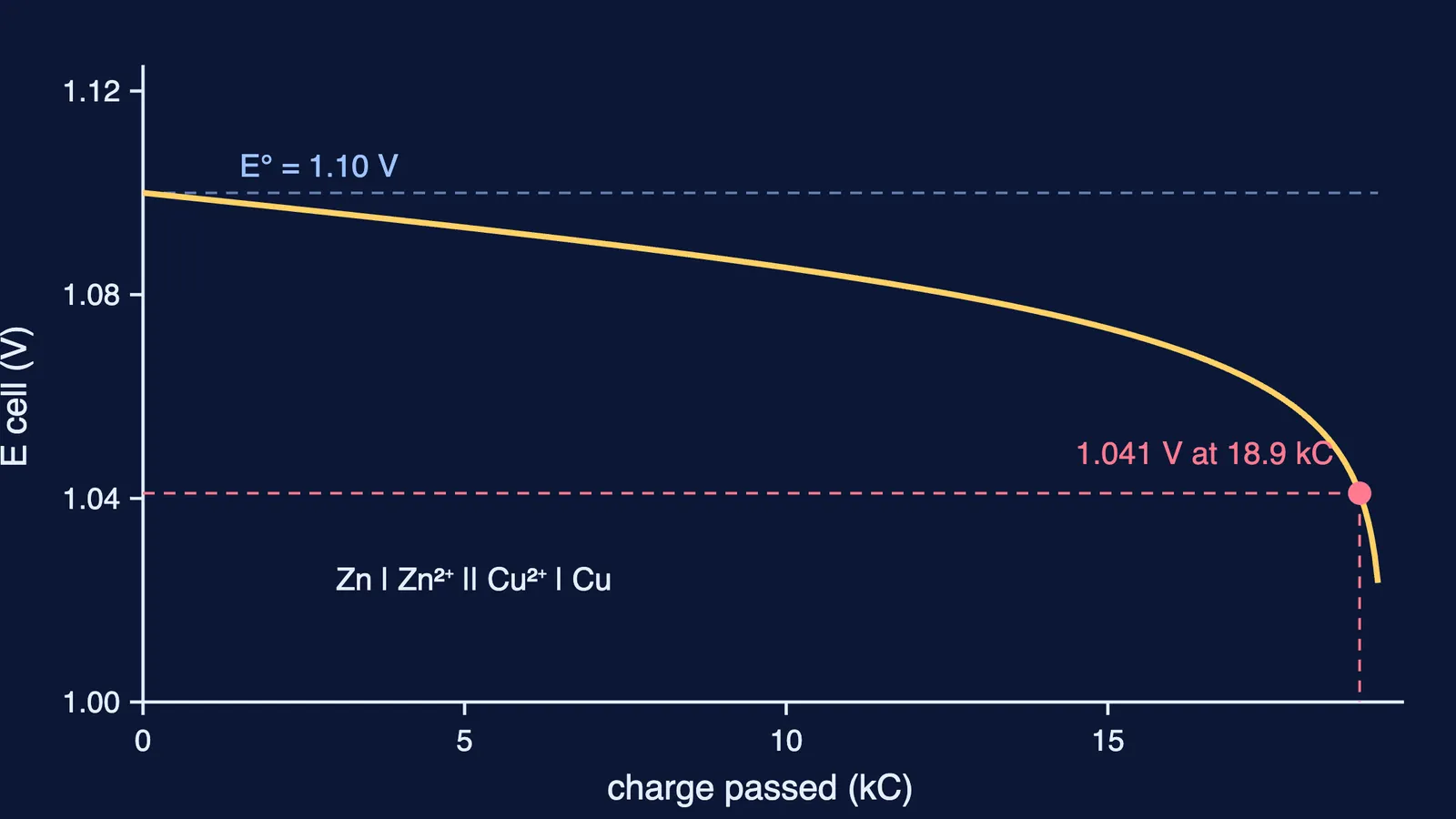
Q8 (hard, numerical). A Daniell cell has 200 mL of 0.50 M ZnSO₄ and 200 mL of 0.50 M CuSO₄ and is allowed to discharge. What mass of copper, in grams, has been deposited when its emf has fallen by 0.059 V?
Answer: 6.22. With n = 2, a 0.059 V fall means log([Zn²⁺]/[Cu²⁺]) = 2, so the ratio is 100. If x M of Cu²⁺ reacts, (0.50 + x)/(0.50 − x) = 100, giving x = 0.490 M. Moles of Cu = 0.200 × 0.490 = 0.0980, which is 6.22 g (18.9 kC of charge). Trap: 5.20, from using n = 1, which gives a ratio of 10.
What should you do after checking your answers?
Sort each miss into one of three bins: counting electrons (Q1, Q2, Q4, Q8), reading E° and signs (Q3, Q6) or tracking concentrations through Q (Q5, Q7). Practise the fullest bin this week. Our post on four common electrochemistry numerical mistakes shows each fix.
If a whole method breaks down, the Fermi Problem Library has worked problems with a step-by-step solver that explains the reasoning rather than printing an answer.
Redo your misses in two days without the solutions.