On this page
NCERT Class 12 Biology covers Ecosystem in Chapter 12 (Reprint 2026-27), and the NEET (UG) 2026 syllabus places it in Unit 10, Ecology and Environment. Every order below is NCERT's, with its section; we wrote the 12 questions; none is a past or predicted item.
Which sequences does NCERT give in the Ecosystem chapter?
Pond functions (12.1), a repeating cycle: autotrophs turn inorganic into organic material using sunlight → heterotrophs eat the autotrophs → dead matter is decomposed and mineralised → nutrients go back to autotrophs for reuse.
Productivity (12.2): GPP → part used in plant respiration (R) → NPP (GPP − R) → used by herbivores and decomposers → secondary productivity by consumers.
Humus route (12.3): detritus → humification → humus, very slow to decompose → degraded by some microbes → mineralisation releases nutrients.
Sun to consumers (12.4): incident solar radiation → its photosynthetically active part (PAR) → plants capture a small share and make food → consumers, one way only.
Grazing food chain levels (12.4): producer → herbivore (primary consumer) → primary carnivore (secondary consumer) → secondary carnivore.
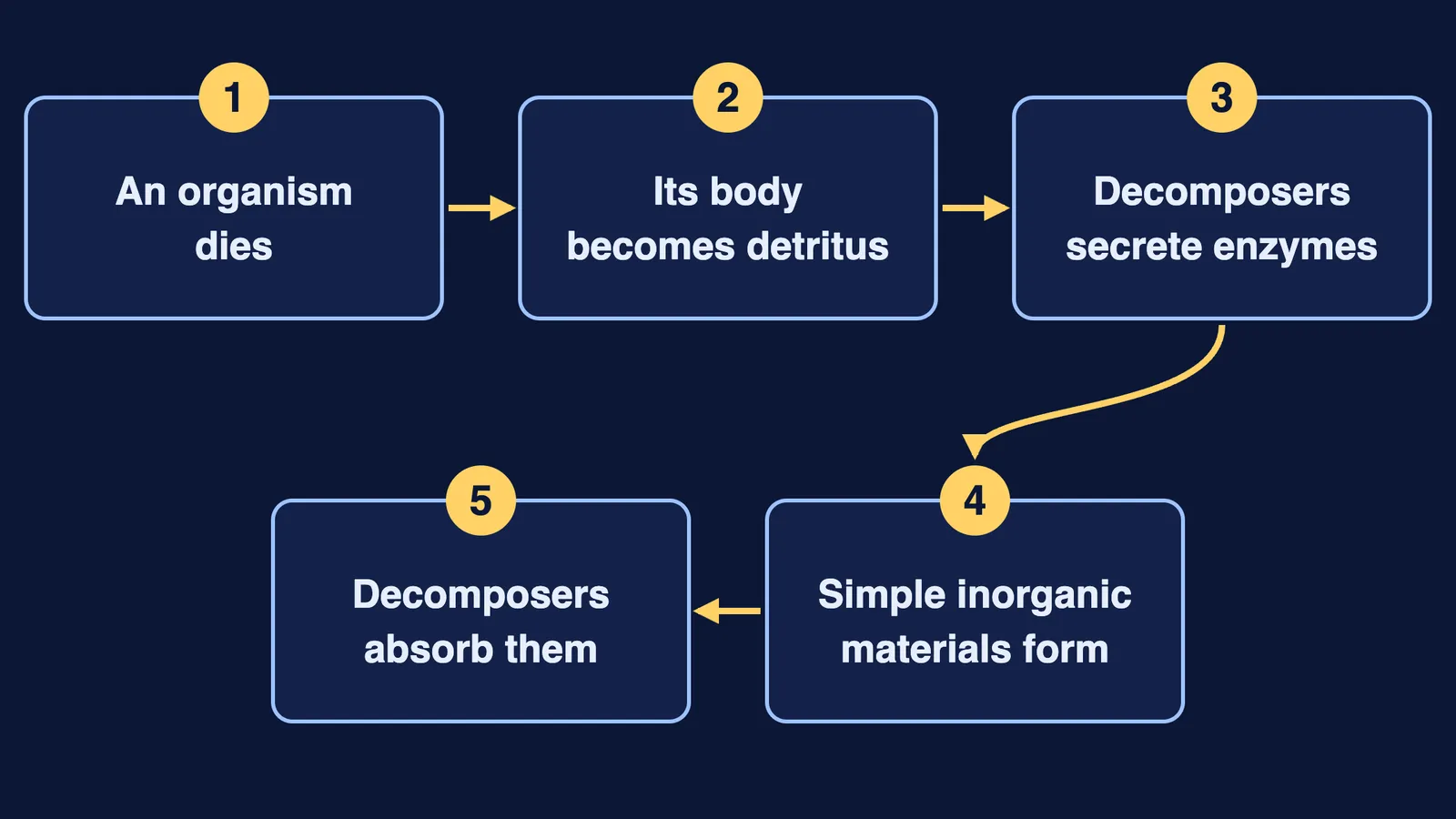
Detritus food chain (12.4): death → detritus → decomposers secrete digestive enzymes → simple inorganic materials → absorbed by decomposers.
How should you solve arrange-in-order questions?
Fix the first and last steps and cross out options that disagree. Among survivors, check only the first position where they differ.
Ecosystem arrange-in-order questions
Q1. Starting from energy capture, order the pond's functions: A. Dead matter is decomposed and mineralised B. Autotrophs make organic material using radiant energy C. Nutrients are released for autotrophs D. Heterotrophs consume autotrophs. (1) B, D, A, C (2) D, B, A, C (3) B, A, D, C (4) B, D, C, A
Answer: (1). Eating precedes decomposition; release closes the loop (12.1).
Q2. Order the productivity steps: A. Plants respire part of their production B. Photosynthesis makes organic matter (GPP) C. Consumers form new organic matter D. NPP remains E. Herbivores and decomposers consume NPP. (1) B, A, D, E, C (2) B, D, A, E, C (3) A, B, D, E, C (4) B, A, E, D, C
Answer: (1). NPP, GPP minus respiration, is what heterotrophs use (12.2).
Q3. Order the path of the sun's energy: A. Plants capture part of the PAR B. Solar radiation falls on the ecosystem C. Consumers get energy from producers, directly or indirectly D. Plants make food from simple inorganic materials. (1) B, A, D, C (2) B, D, A, C (3) A, B, D, C (4) B, A, C, D
Answer: (1). Plants fix the sun's energy to make food, and all consumers depend on producers (12.4).
Q4. Order the levels of a grazing food chain: A. Primary carnivore B. Producer C. Secondary carnivore D. Herbivore. (1) B, D, A, C (2) B, A, D, C (3) D, B, A, C (4) B, D, C, A
Answer: (1). Secondary carnivores depend on primary carnivores, which eat herbivores (12.4).
Q5. Order the detritus food chain: A. Decomposers secrete digestive enzymes B. An organism dies C. Decomposers absorb simple inorganic materials D. Dead matter is broken into simple inorganic materials E. Remains become detritus. (1) B, E, A, D, C (2) B, A, E, D, C (3) E, B, A, D, C (4) B, E, A, C, D
Answer: (1). Death begins this chain; absorption follows the enzyme breakdown (12.4).
Q6. Order what happens to organic matter in soil: A. Inorganic nutrients are released B. Humification forms a dark, amorphous substance C. Detritus lies in the soil D. Some microbes slowly degrade humus. (1) C, B, D, A (2) C, D, B, A (3) B, C, D, A (4) C, B, A, D
Answer: (1). Humus forms before microbes degrade it (12.3).
Before, after and out-of-place questions
Q7. In a grazing food chain, which level comes immediately before the secondary carnivore? (1) Producer (2) Herbivore (3) Primary carnivore (4) Decomposer
Answer: (3). Secondary carnivores feed on primary carnivores (12.4).
Q8. What comes immediately after humus has accumulated in the soil? (1) Humification (2) Some microbes degrade it and inorganic nutrients are released (3) Dead remains form detritus (4) Plants capture PAR
Answer: (2). Humus is further degraded by microbes in mineralisation (12.3).
Q9. A student lists grazing-chain levels as: secondary carnivore, producer, herbivore, primary carnivore. Which single step, moved, fixes the order? (1) Secondary carnivore (2) Producer (3) Herbivore (4) Primary carnivore
Answer: (1). It belongs last, above the primary carnivore (12.4).
Q10. Starting from energy capture, a list of pond functions reads: dead matter is decomposed and mineralised, autotrophs make organic material, heterotrophs eat autotrophs, nutrients are reused by autotrophs. Moving which one step restores the order? (1) Autotrophs make organic material (2) Dead matter is decomposed and mineralised (3) Heterotrophs eat autotrophs (4) Nutrients are reused by autotrophs
Answer: (2). Decomposition belongs after consumption (12.1).
Two-statement questions on order
Key: (1) I and II true (2) I and II false (3) I true, II false (4) I false, II true.
Q11. I: A primary carnivore feeds on herbivores, and a secondary carnivore depends on primary carnivores. II: Humification follows the mineralisation of humus.
Answer: (3). Humus forms first, then is mineralised (12.3, 12.4).
Q12. I: In a grazing food chain, herbivores come before producers. II: Heterotrophs consume autotrophs only after autotrophs have made organic material with the sun's energy.
Answer: (4). The chain starts with producers (12.4); the pond order puts making food first (12.1).
What should you do after this set?
Write sequences 1, 2 and 6 from memory; label each miss: start, end or neighbour swap. Then switch formats with the Ecosystem statement and match-the-list questions, the Ecosystem diagram-based questions on soil and pyramids and the Ecosystem exceptions and odd-one-out set.
Which ecosystem sequence keeps slipping? Fermi's AI tutor works out what you already know and builds a plan for the session.