On this page
Earth as a System: Energy, Matter, and Life is Chapter 13 of Exploration, the NCERT Class 9 science textbook, and Unit IV of the CBSE Class IX Science curriculum for 2026-27. Here are 34 of its key terms in five groups. For a study plan, read our Earth as a System Class 9 chapter guide.
What are the Earth's spheres?
From the opening pages of the NCERT chapter.
Earth system: the five spheres seen as one connected whole, where a change in one spreads to others. Example: less snow means a smaller lake and less grass.
Geosphere: the solid Earth: rocks, soil, landforms and the interior. Example: the Deccan plateau.
Hydrosphere: liquid water in oceans, rivers, lakes and underground. Example: the Ganga-Brahmaputra river system.
Cryosphere: frozen water, as ice and snow. Example: Himalayan glaciers. Don't confuse with: hydrosphere, which is liquid water.
Atmosphere: the air held around the Earth by gravity, mostly nitrogen (78%) and oxygen (21%).
Biosphere: all living things and the places they live. Example: mangroves and coral reefs.
How does sunlight warm the Earth?
From section 13.1 of the NCERT chapter.
Electromagnetic (EM) waves: how the Sun's energy travels; they need no medium and move at 3 × 10⁸ m/s in a vacuum. Don't confuse with: sound waves, which need a medium.
Electromagnetic spectrum: the range of EM radiation, from gamma rays and X-rays (high frequency) to microwaves and radio waves (low frequency). About 99% of the Sun's energy arrives as UV, visible light and infrared.
Ultraviolet (UV) radiation: high-energy radiation of 100 to 400 nm, mostly absorbed by the ozone layer. Example: sunscreen protects skin from it.
Infrared (IR) radiation: radiation that warms the ground, which then re-radiates heat as infrared.
Insolation: the Sun's radiation that reaches the Earth's surface, at most about 1 kW per square metre under a clear sky.
Solar constant: the solar power per square metre at the top of the atmosphere, facing the Sun: about 1.4 kW per square metre. Don't confuse with: insolation, measured at the ground, after the air takes its share.
Albedo: the fraction of sunlight a surface reflects. Example: snow reflects 0.80 to 0.90, which keeps polar regions cold.
Urban heat island effect: cities staying warmer than the countryside, especially in summer and at night, as concrete, brick and asphalt store heat and re-radiate it.
What does the atmosphere do?
From section 13.1.3 of the NCERT chapter. Going further: our Class 11 guide to solar radiation, heat balance and temperature.
Troposphere: the lowest layer, about 12 km high on average, where nearly all weather happens. It cools by about 6.5 °C per km of height.
Stratosphere: the layer from about 12 to 50 km. Its ozone absorbs UV, so it gets warmer with height and keeps weather below it.
Ozone layer: stratospheric ozone that shields life from UV. CFCs caused the ozone hole over Antarctica; the Montreal Protocol cut their use.
Greenhouse effect: carbon dioxide, methane and water vapour trapping heat given off by the ground, keeping the Earth warm enough for life. Don't confuse with: global warming, the extra warming from excess CO₂ added by humans. CO₂ rose from about 315 ppm in 1960 to about 420 ppm, a rise of about 35%.
Why do winds and ocean currents form?
From section 13.2 of the NCERT chapter. The cause is uneven heating: the equator gets stronger sunlight than the poles, and land, sea and slopes warm at different rates.
Valley breeze: a daytime wind up a hill. Sunny slopes heat faster than the valley floor, so valley air flows up. Example: hill towns such as Shimla and Dehradun feel this switch between the two breezes every day.
Mountain breeze: a night wind down a hill. Slopes cool faster, and cold, dense air slides into the valley.
Planetary winds: winds between pressure belts: low at the equator, high near 30°, low near 60°, high at the poles. The Earth's rotation bends them right in the Northern Hemisphere, left in the Southern.
Ocean currents: steady flows of huge masses of sea water, driven by winds and shaped by temperature, salinity, rotation and continents. Example: the North Atlantic Drift keeps many European ports ice-free in winter.
Gyres: giant circular loops of currents, clockwise in the Northern Hemisphere, anticlockwise in the Southern.
What are biogeochemical cycles?
From sections 13.3 and 13.4 of the NCERT chapter.
Biogeochemical cycle: matter such as carbon, nitrogen and oxygen moving again and again between living (biotic) and non-living (abiotic) parts of the Earth.
Water cycle: evaporation, condensation into clouds, precipitation, and flow back to the sea. Don't confuse: runoff flows over the ground; infiltration soaks in and refills groundwater.
Fast carbon cycle: over days to years, plants take in CO₂ by photosynthesis, and respiration and decomposition return it to the air.
Slow carbon cycle: over millions of years, buried organisms become coal, oil and gas; burning them releases that carbon almost at once.
Oxygen cycle: respiration and burning use oxygen; photosynthesis restores it.
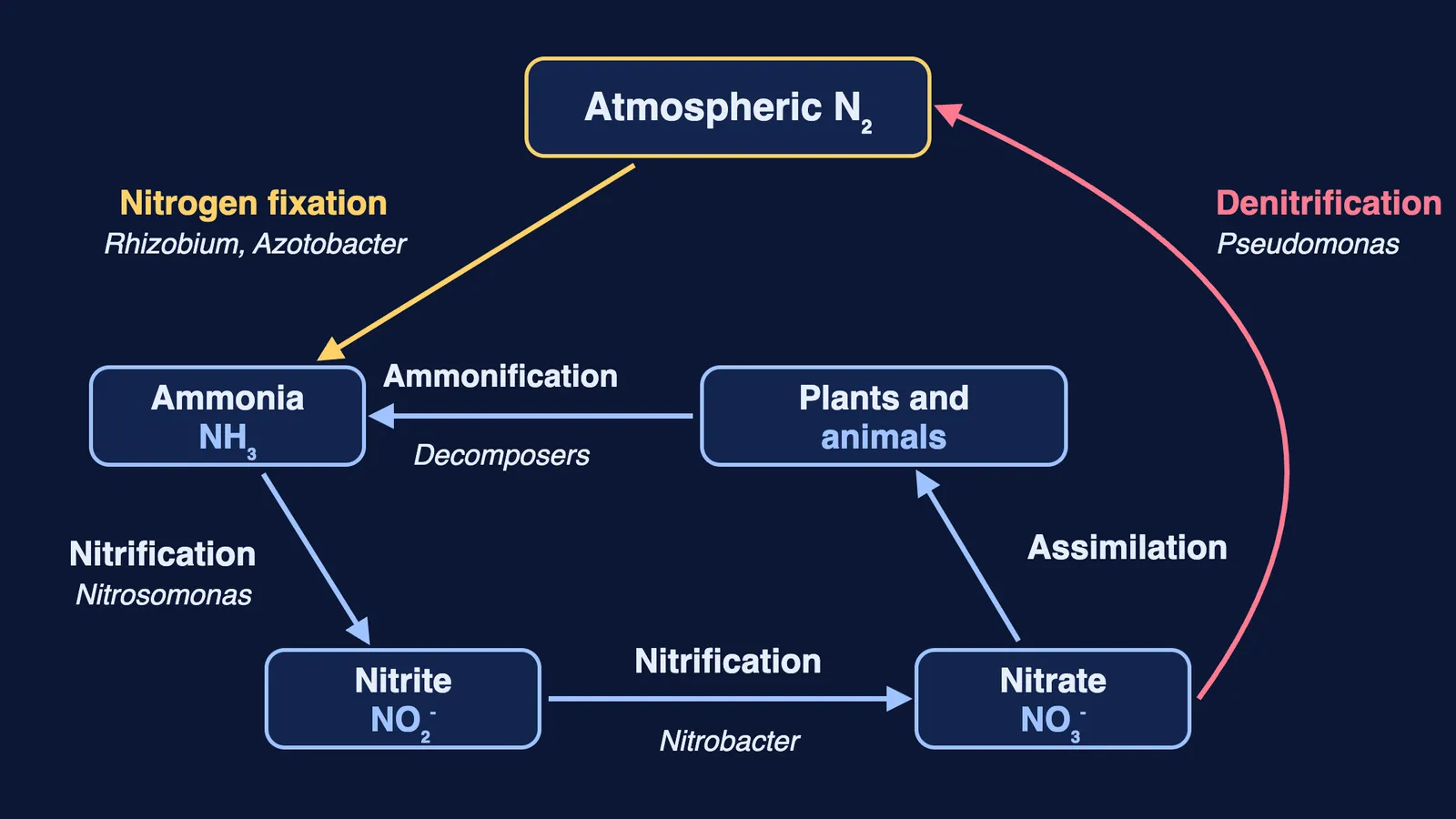
Nitrogen fixation: turning unreactive nitrogen gas into ammonia. Example: Rhizobium in legume root nodules, Azotobacter in soil.
Nitrification: ammonia to nitrite (Nitrosomonas), then nitrite to nitrate (Nitrobacter).
Assimilation: plants absorbing nitrogen compounds from the soil; animals get nitrogen by eating.
Ammonification: decomposers (bacteria, fungi) breaking down dead matter and wastes into ammonia in the soil.
Denitrification: bacteria such as Pseudomonas turning some nitrate back into nitrogen gas. Don't confuse with: nitrification, which makes nitrate.
Eutrophication: fertiliser nitrates in lakes and rivers causing algal blooms that use up oxygen and kill fish.
How to learn these terms
Draw the nitrogen cycle from memory, writing each of its five processes on its arrow with the bacterium beside it.
Learn the pairs together: solar constant and insolation, valley and mountain breeze, nitrification and denitrification.
For each sphere, write one change that spreads to another sphere.
Sketch the pressure belts from pole to pole, with the bent winds.
If a process still feels like a list of names, the Fermi Concept Library gives each concept its own lesson and its place in the map.