On this page
The Sun warms every place on Earth unevenly, yet the planet as a whole keeps a steady temperature. Chapter 8 of NCERT's Class 11 Fundamentals of Physical Geography explains how: energy in matches energy out. This guide covers the three ideas at the heart of the chapter: insolation, the heat budget and inversion of temperature.
Is solar radiation, heat balance and temperature still in the Class 11 syllabus?
Yes. In the NCERT contents page for the 2026-27 reprint, Solar Radiation, Heat Balance and Temperature is Chapter 8 in Unit IV, Climate. The CBSE Geography curriculum for 2026-27 keeps it in Class XI, covering insolation, heating and cooling of the atmosphere, terrestrial radiation, the heat budget, and temperature including inversion. Chapters 7 to 10 of the Climate unit share a combined weightage of 8 in that document.
What is insolation, and why does it vary?
Insolation is the incoming solar radiation, received by the Earth mostly in short wavelengths, according to the NCERT chapter. At the top of the atmosphere the Earth receives on average 1.94 calories per square centimetre per minute (NCERT).
The angle of the Sun's rays matters most. A slant beam spreads the same energy over more ground and passes through more air. Geometry shows it: a beam at 30 degrees above the horizon covers 1/sin 30 = 2 times the area of a vertical beam, so each square metre gets half the energy. That is why insolation at the surface ranges from about 320 W/m2 in the tropics to about 70 W/m2 at the poles (NCERT). The subtropical deserts, not the equator, receive the most, because they have the least cloud.
How does the atmosphere heat up and cool down?
The ground absorbs short-wave sunlight and then gives heat to the air in four ways described in the NCERT chapter:
Conduction: air touching warm ground is heated.
Convection: heated air rises, carrying heat upward within the troposphere.
Advection: heat moves sideways with the wind, as in the summer loo of north India.
Terrestrial radiation: the warm Earth radiates long waves that greenhouse gases absorb.
For a refresher, see our Class 7 guide to the layers of the atmosphere and their temperatures.
What is the heat budget of the Earth?
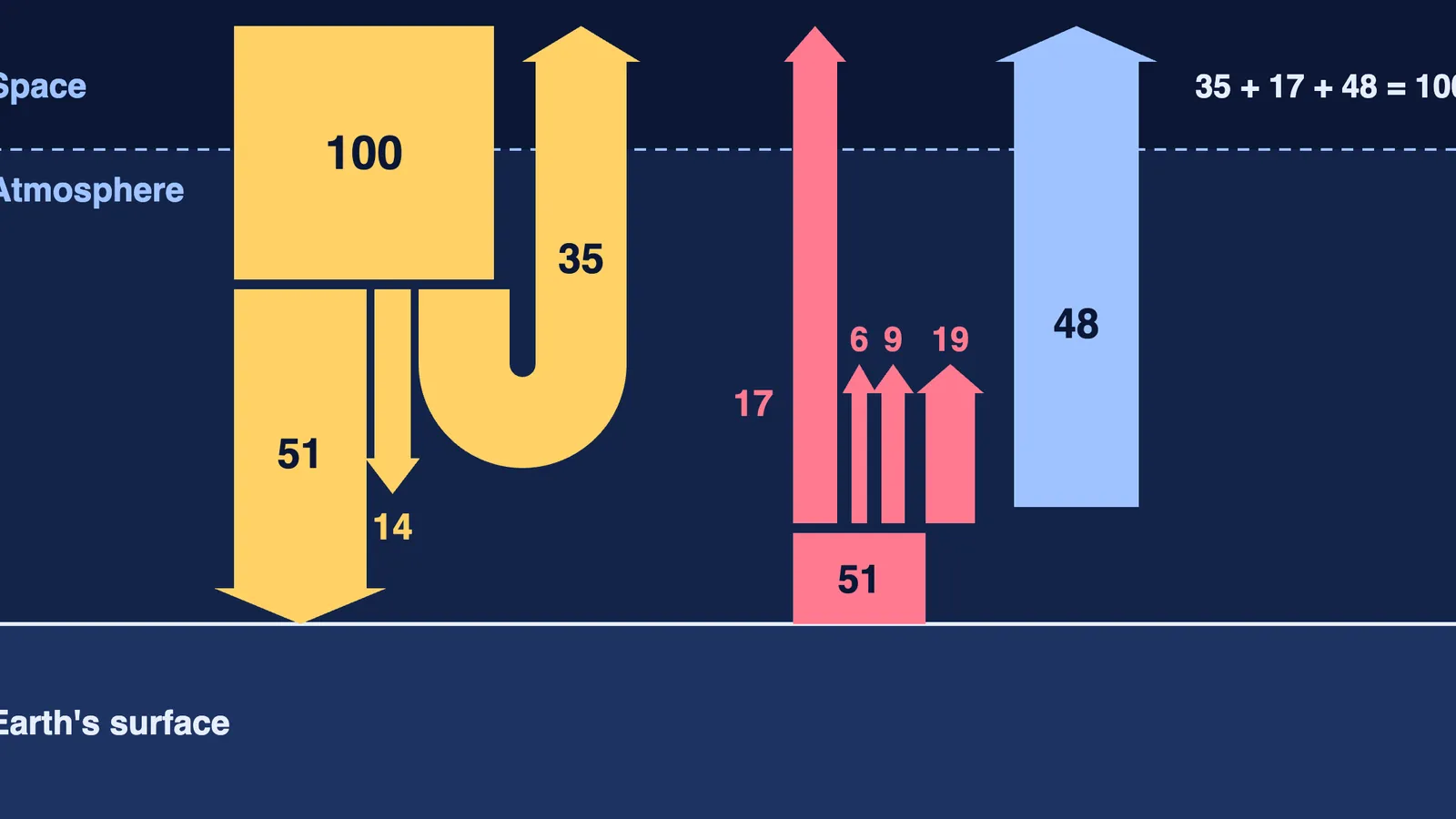
The heat budget is the balance between the insolation the Earth receives and the energy it sends back to space, which is why the Earth neither warms up nor cools down overall (NCERT). NCERT counts incoming sunlight as 100 units. A worked check you can redo in the exam:
Of 100 units, about 35 go straight back to space without being absorbed: 27 reflected from cloud tops, 2 from snow and ice, and 6 scattered by the air (Figure 8.2). This reflected share is the Earth's albedo.
The remaining 65 are absorbed: 14 by the atmosphere and 51 by the surface.
The surface gives up its 51 units: 17 radiated straight to space and 34 passed to the atmosphere (6 radiated and absorbed directly, 9 by convection and turbulence, 19 as latent heat of condensation).
The atmosphere now holds 14 + 34 = 48 units and radiates them to space.
Outgoing: 17 + 48 = 65, which balances the 65 absorbed. Add the 35 reflected and you get back to 100.
The balance is global: NCERT's Figure 8.3 shows a surplus of net radiation between 40 degrees north and south and a deficit near the poles, and the surplus is carried poleward (NCERT).
If energy flows are hard to picture, the Fermi Simulation Lab has interactive simulations for ideas that are easier to see than to read.
What controls temperature, and what is inversion of temperature?
Temperature at a place depends on latitude, altitude, distance from the sea, air masses and ocean currents, and local aspects (NCERT). Temperature normally falls with height at the normal lapse rate of 6.5°C per 1,000 m (NCERT). So a hill town 2,000 m above a plain should be about 2 x 6.5 = 13°C cooler, other things equal.
Inversion of temperature is when this reverses and air near the ground is colder than the air above. NCERT says a long winter night with clear skies and still air is ideal for it, that smoke and dust collect beneath it and morning fog is common, and that it is normal all year over polar areas. In hills, cold dense air drains downslope at night and pools in valleys: air drainage.
To see how air temperature is measured fairly, read why weather thermometers are kept in a shaded white box.
How should you revise this chapter?
Draw the heat budget from memory and check that both sides add to 100.
List the five controls of temperature.
Compute the change in temperature for a 1,500 m climb using 6.5°C per 1,000 m.
If a word such as albedo or latent heat still feels shaky, the Fermi Concept Library gives each concept its own lesson. For Unit II, see our guide to the interior of the Earth for Class 11.