On this page
The short answer: some sharks would suffocate if they stopped, but many would not. The myth survives because it mixes up two separate problems. One is sinking, because sharks have no air bladder. The other is breathing, because some sharks can only push water over their gills by swimming.
Why do people think sharks die if they stop swimming?
The NCERT Class 11 chapter on the animal kingdom says of cartilaginous fishes: "Due to the absence of air bladder, they have to swim constantly to avoid sinking" (NCERT Biology, Chapter 4). That sentence is about sinking, not about breathing.
Sharks make up for the missing bladder partly with an oily liver. Hawaii's Division of Aquatic Resources notes that shark livers "contain large amounts of oil that is less dense than seawater", yet "all sharks are slightly negatively buoyant, which means they sink" (Hawaii DLNR shark anatomy). A study of body composition across 32 shark species points out that liver lipids are far denser than the gas in a bony fish's swim bladder, so large livers are needed to provide neutral buoyancy (Gleiss, Potvin and Goldbogen, 2017). For the bony-fish side of the comparison, see our explainer on how a swim bladder adjusts buoyancy at depth.
So a shark that stops swimming drifts down. For a shark that lives on the seabed, that is simply where it wanted to go.
What is ram ventilation?
Ram ventilation is breathing by swimming forward with the mouth open so that water flows in and over the gills (Sharks4Kids). The same source lists white sharks, mako sharks and whale sharks as sharks that breathe this way. Discover Wildlife's explainer says makos and great whites rely on ram ventilation and would suffocate if they stopped swimming (BBC Wildlife).
Biologists call these species obligate ram ventilators. "Obligate" means they have no backup: for them, the myth is true.
Which sharks can breathe while resting?
Buccal pumping is breathing by using the mouth (buccal) muscles to draw water into the mouth and push it over the gills, which lets a shark breathe while lying still (Sharks4Kids). Sharks4Kids names nurse sharks, whitetip reef sharks and Port Jackson sharks as buccal pumpers, and lemon and tiger sharks as species that can switch between both methods.
Lara Ferry-Graham measured pressures inside the mouth and gill chambers of swellsharks to test the classic two-pump model of fish breathing, a suction pump followed by a pressure pump, and found pressure patterns that did not fit it neatly (Journal of Experimental Biology, 1999).
Spiracles are paired openings behind the eyes of rays and some sharks that take water into the mouth cavity before it moves on to the gills; wobbegongs and angel sharks have them (Sharks4Kids).
The idea that every shark must keep moving was a scientific belief, not only a playground one. National Geographic reports that Eugenie Clark found "sleeping sharks" in undersea caverns off Mexico's Yucatán Peninsula, a discovery that "upended scientists' belief that sharks had to keep moving to breathe" (National Geographic). Read more about her work in Eugenie Clark, the Shark Lady who proved sharks learn.
Does a shark's breathing method matter in real life?
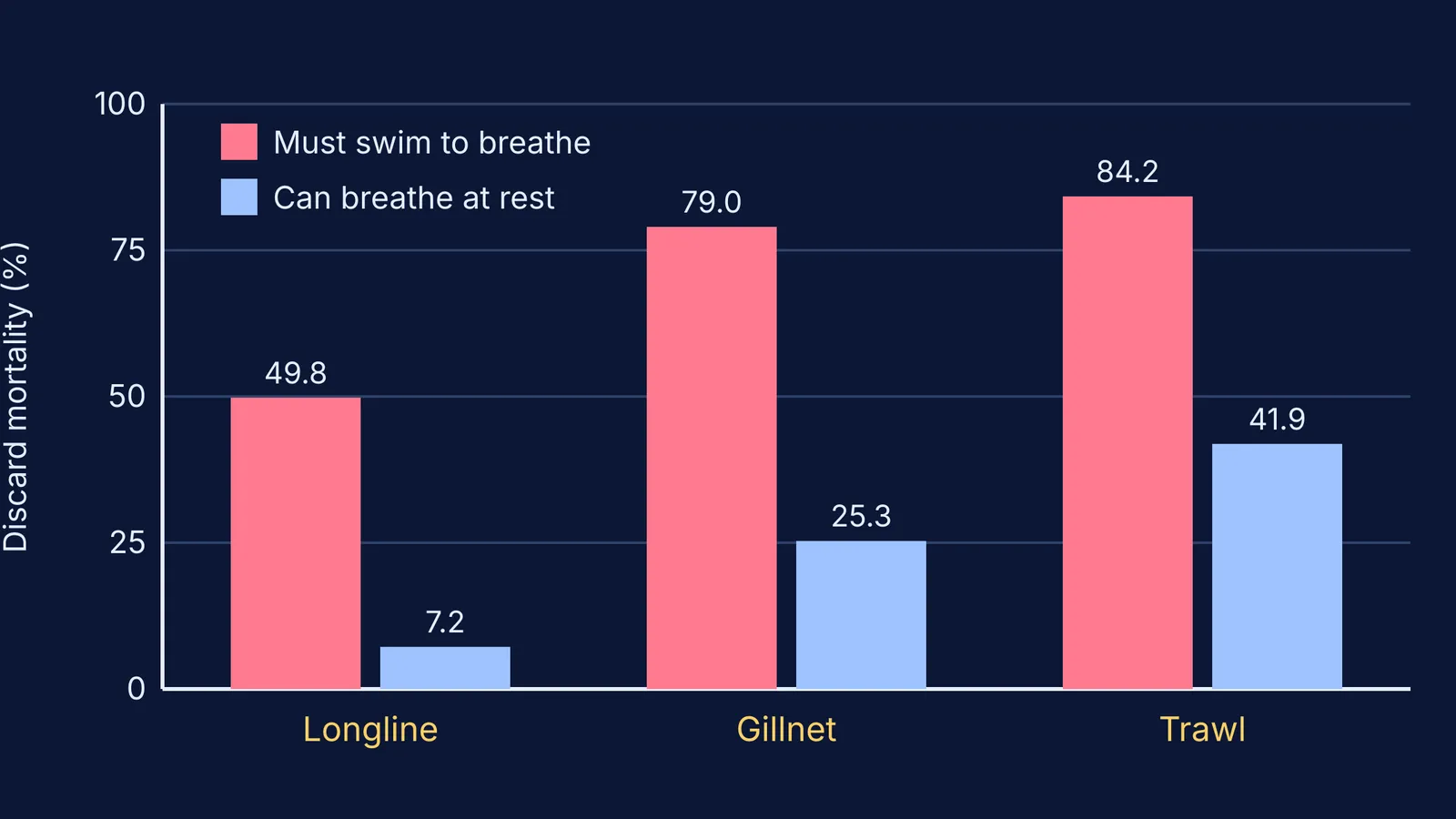
Yes. Dapp and colleagues compiled published data on immediate deaths for 83 shark and ray species, and on deaths after release for 40, caught and thrown back by fisheries (Fish and Fisheries, 2016). Their models put mean total deaths (immediate plus after release) for obligate ram ventilators at 49.8% on longlines, 79.0% in gillnets and 84.2% in trawls. For species that can breathe while still, the figures were 7.2%, 25.3% and 41.9%.
In gillnets, 79.0 divided by 25.3 is about 3.1, so a ram ventilator was estimated to be roughly three times as likely to die. On longlines, 49.8 divided by 7.2 is about 6.9. A shark tangled in a net cannot swim, and if swimming is its only way to breathe, it is likely to suffocate.
How do you answer this in an exam?
Use this three-step check for any shark question:
Air bladder? No shark has one, so a shark that stops swimming tends to sink. The oily liver only reduces this.
Buccal pumping or spiracles? If yes (nurse shark, wobbegong, angel shark), it can rest on the bottom and keep breathing.
Obligate ram ventilator? If yes (white, mako, whale shark), it must keep swimming to breathe.
A two-mark answer you can adapt: "Sharks lack an air bladder, so they are slightly denser than seawater and sink if they stop swimming. Breathing is a separate matter. Bottom-dwelling sharks such as the nurse shark pump water over their gills with mouth muscles, so they can rest. Only obligate ram ventilators such as the mako must swim to keep water flowing over their gills."
If buoyancy, gills and the rest of fish anatomy feel like loose facts, the Fermi Concept Library gives every biology concept its own lesson and shows where it sits in the map, so the links between them stay visible. For the other NCERT shark features, see cartilage, placoid scales and the missing air bladder.