

On this page
For decades, scientists thought sharks were little more than mindless eating machines driven by pure instinct. The popular image was of a primitive predator, unable to learn or remember beyond its immediate needs. Dr. Eugenie Clark, a pioneering ichthyologist affectionately known as the "Shark Lady," proved this view wrong and transformed the field of marine biology.
Through her rigorous work at the Cape Haze Marine Laboratory in Florida and her extensive diving expeditions to the Red Sea, Clark changed how we understand shark intelligence and defence mechanisms in the ocean. Her behavioural experiments showed that sharks could be trained to remember tasks over long periods. In her later field observations, she also identified the first effective natural shark repellent.
How did Eugenie Clark train sharks?
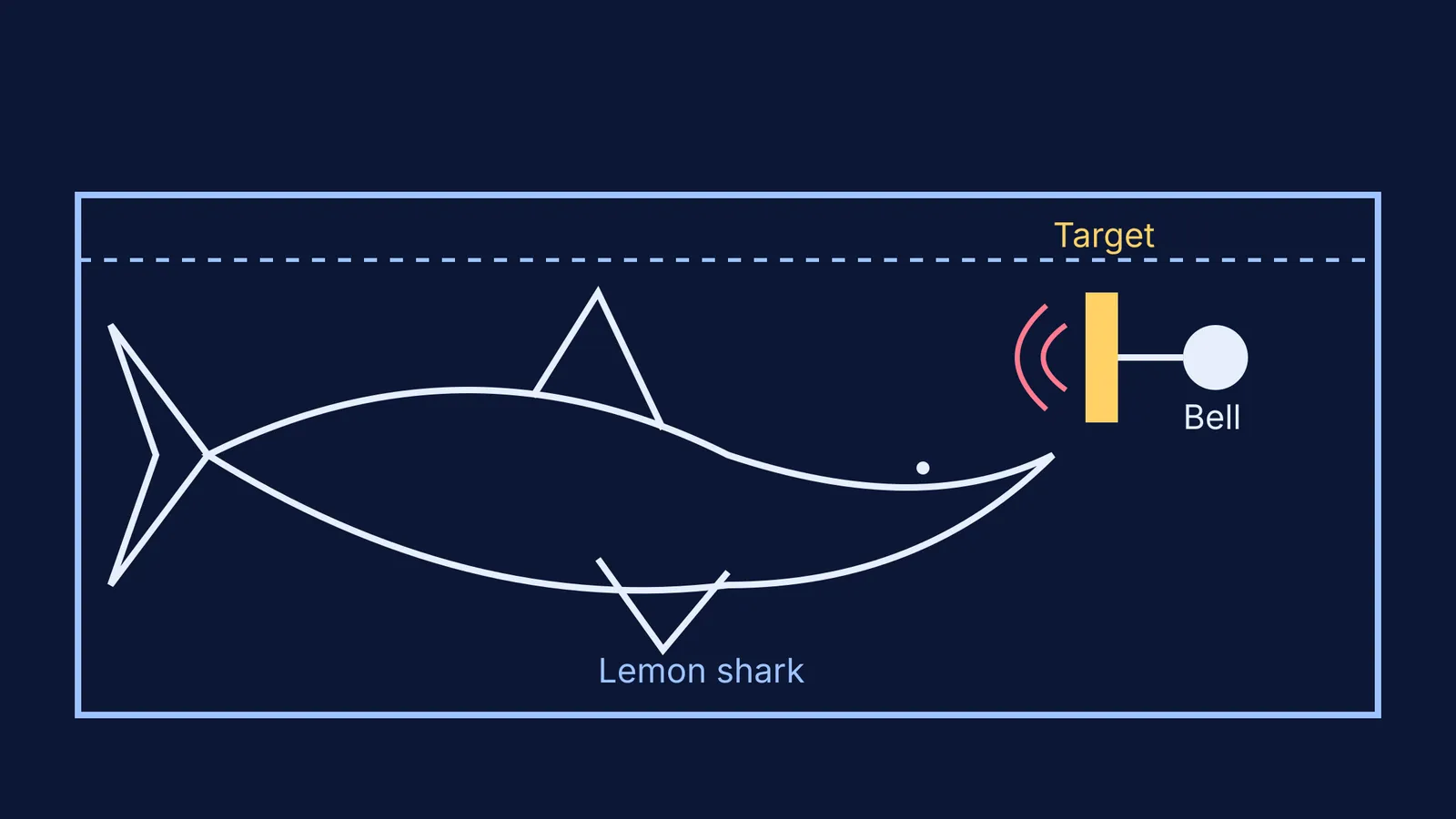
In 1959, Clark published a landmark study in *Science* detailing the instrumental conditioning of lemon sharks. She wanted to see if these predators could learn to associate a specific action with a reward—a process known as operant conditioning.
Working with two adult lemon sharks in a large pen, Clark placed a square target into the water. When a shark pressed the target, it triggered a submerged bell to ring, and the shark was rewarded with a piece of food. The sharks learned this association quickly. Clark later expanded the training, teaching them to press the target to obtain food placed remotely in another part of the pen.
More importantly, Clark tested their long-term memory. After a 10-week period of inactivity where the target and bell were completely removed, she reintroduced them to the pen. The lemon sharks retained their conditioned response and remembered to press the target for food. This proved that these predators possessed long-term memory and were capable of learning complex tasks, fundamentally challenging the idea that they were primitive, instinct-driven animals.
If you are studying operant conditioning, you can use the Fermi Concept Library to map out the differences between innate instincts and learned behaviours like this one.
What is the Moses sole shark repellent?
While diving in the Red Sea in the 1970s, Clark observed a strange interaction between sharks and a small local flatfish called the Moses sole (*Pardachirus marmoratus*). Sharks would swim toward the sole with their jaws open, but right before biting, they would suddenly recoil, often thrashing their heads as if in pain. The sole remained entirely unharmed.
Clark and her colleagues published their findings in Environmental Biology of Fishes in 1979, comparing the *Pardachirus marmoratus* of the Red Sea with the related *P. pavoninus* from Japan. They found that when threatened, the Moses sole secretes a milky, toxic fluid from glands along its fins. The active component, a biological surfactant called pardaxin, acts like a powerful detergent that irritates the sensitive membranes of the shark's mouth and gills.
This was the first time a natural, effective shark repellent had been documented in the wild. Before this, standard chemical repellents had proven largely ineffective. While pardaxin itself turned out to be too unstable to synthesize and bottle for long-term storage, Clark's discovery launched decades of research into chemical deterrents that mimic the flatfish's defence mechanism using synthetic surfactants.
What can students learn from Clark's mindset?
Eugenie Clark did not accept the prevailing assumptions about sharks. Where others saw danger and mindless instinct, she saw a subject worth investigating systematically. For students preparing for rigorous exams like JEE Advanced, this scientific mindset is highly practical:
Test your assumptions: If a concept seems impossibly difficult, do not assume you simply cannot do physics. Treat it as a hypothesis. Break the problem into smaller parts and test where your understanding actually stops.
Design your own experiments: When a study method fails, such as reading a textbook for hours without retaining the facts, change the variables. Try active recall or spaced repetition and measure your results over a few weeks.
Look closer at the exceptions: Just as Clark noticed the one fish a shark would not eat, pay attention to the one step in a maths problem where you consistently make an error. The exception holds the crucial lesson.
When you cannot pinpoint where a calculation went wrong, the Fermi Problem Library provides a step-by-step solver that explains the reasoning rather than printing an answer, helping you spot your own exceptions.


