On this page
Picture a frog sitting in a shallow puddle on a monsoon evening. It may actually be drinking, with its belly instead of its mouth.
Do frogs drink water through their skin?
Yes. A 2022 study in *Ecology and Evolution* puts it plainly: "Rather than drinking, anurans replace water losses by efficiently absorbing water through their skin" (Lemenager and colleagues, 2022). Anurans are the group that includes frogs and toads.
The same paper notes that frogs and toads have a very thin stratum corneum (the tough outer layer of skin) compared with other land vertebrates, and "must maintain hydrated skin to survive". Thin skin lets water in easily. It also lets water out.
What is the seat patch on a frog?
Water does not enter equally everywhere. Many frogs and toads have a seat patch: a highly vascularised area of skin on the lower belly that absorbs water quickly (Lemenager and colleagues, 2022).
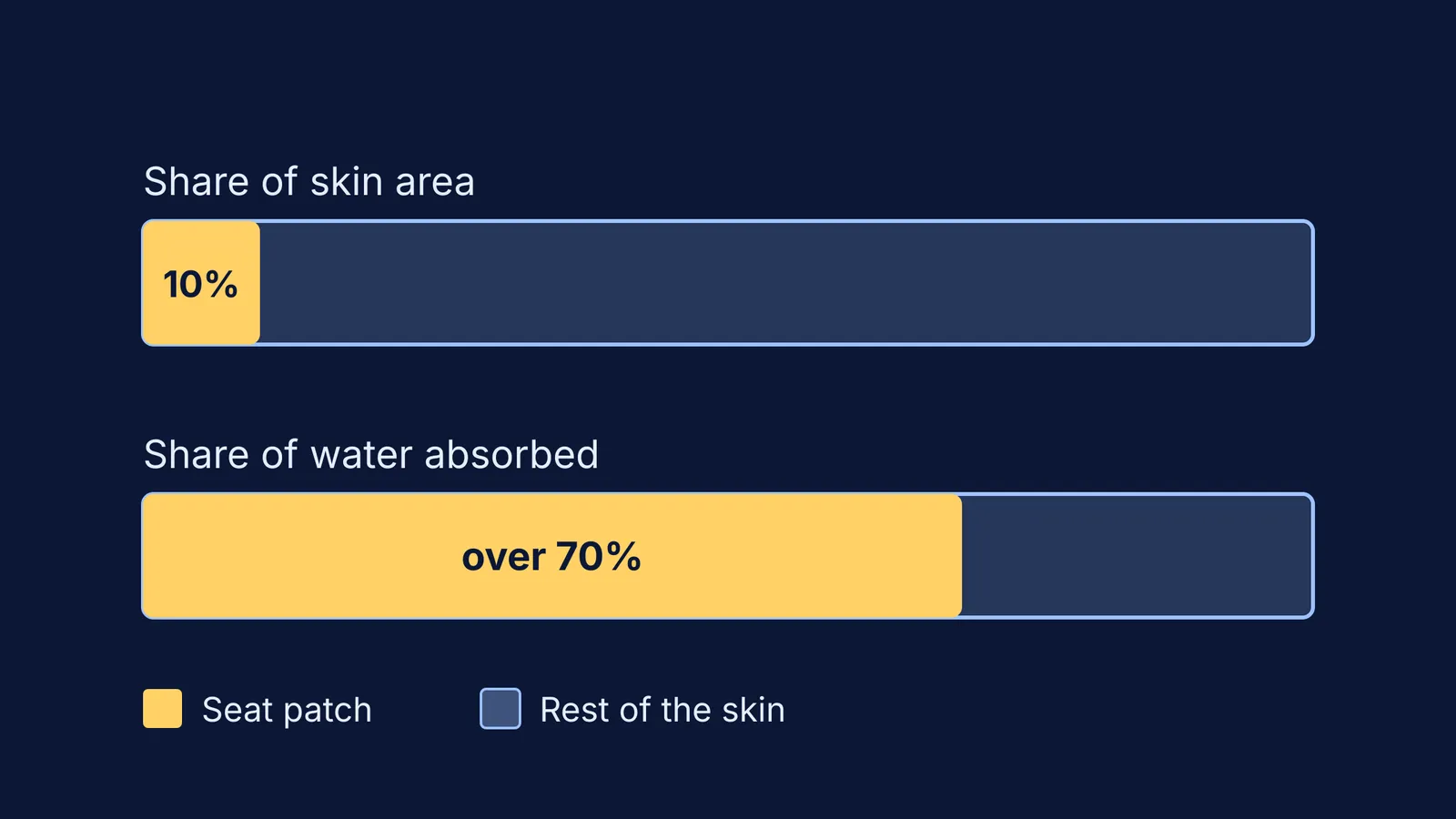
In dehydrated toads, the seat patch is about 10% of the total skin area but takes in over 70% of the water, according to a 2002 American Physiological Society release about toad research by A. L. Viborg (University of Copenhagen) and S. D. Hillyard (University of Nevada, Las Vegas), reported by ScienceDaily.
Thirsty frogs and toads also change how they sit. In what researchers call the water absorption response, they push their hind legs back and press the belly onto a wet surface (ScienceDaily).
The water moves by osmosis: it flows from the dilute water outside towards the more concentrated fluids inside the skin. Lemenager and colleagues found that the seat patch acts as its own compartment, with a water potential controlled separately from that of the blood. Frogs can also speed uptake up. The hormone arginine vasotocin makes skin cells insert aquaporins, protein channels for water, into their outer membrane, so water is absorbed faster (Glinski and colleagues, 2018).
If you mix up osmosis and diffusion, our explainer on the difference between osmosis and diffusion puts them side by side. Water crossing a membrane is easier to see than to read about, which is what the Fermi Simulation Lab is for.
How do frogs breathe through their skin?
Cutaneous respiration is gas exchange across the skin: oxygen diffuses in and carbon dioxide diffuses out through blood vessels just under the surface. A classic review by Martin Feder and Warren Burggren found that in many lower vertebrates "the skin is the major or even sole avenue for respiration", and that skin often matters more for getting rid of carbon dioxide than for taking in oxygen (Feder and Burggren, 1985). Skin breathing tends to count most in small animals, at cool temperatures and when the animal is inactive.
How big is the skin's share? In resting leopard frogs (*Rana pipiens*) at 25°C in still water, about 23% of total oxygen uptake went through the skin; when the water was stirred, the skin's share rose to 35% (Pinder and Burggren, 1986). Stirring brings fresh water to the skin, a bit like the skin taking a breath. When the frogs were active or short of oxygen, the balance shifted towards the lungs.
The lungs and the lining of the mouth do the rest, as our post on how a frog breathes through its skin, lungs and buccal cavity explains.
Why do frogs stay near water?
Skin that drinks and breathes has to be thin, well supplied with blood and wet. That same skin cannot hold water in the way a lizard's scales do. A frog that dries out loses water it cannot replace by drinking, and loses some of its breathing surface too.
So frogs keep to ponds, puddles, wet leaf litter and damp soil, where they can press the seat patch against moisture and keep the whole skin wet. Most also return to water to breed, part of the "dual life" in our guide to the features of amphibians.
How do you explain it in 60 seconds?
Use this chain in a viva or a short answer. Each step leads to the next.
Frog skin is thin, moist and full of blood vessels.
Water enters by osmosis, in many species mostly through the seat patch on the lower belly.
A hormone, vasotocin, adds aquaporin water channels to speed this up.
The same skin exchanges oxygen and carbon dioxide (cutaneous respiration).
Thin, wet skin also loses water fast, so frogs stay near water.
Then test yourself. Answer each question in one line before reading the hint.
Why would a frog lose water in very salty water? Hint: which side is now more concentrated?
Why did stirring the water raise the skin's share of oxygen uptake? Hint: what happens to the water touching the skin?
Why would a frog with dry skin struggle to breathe through it? Hint: what must gases cross?
If one step feels shaky, look it up in the Fermi Concept Library, where each concept has its own lesson and its place in the map, and rebuild the chain from there.
Next time you see a frog in a puddle, you will know what it is doing.