

On this page
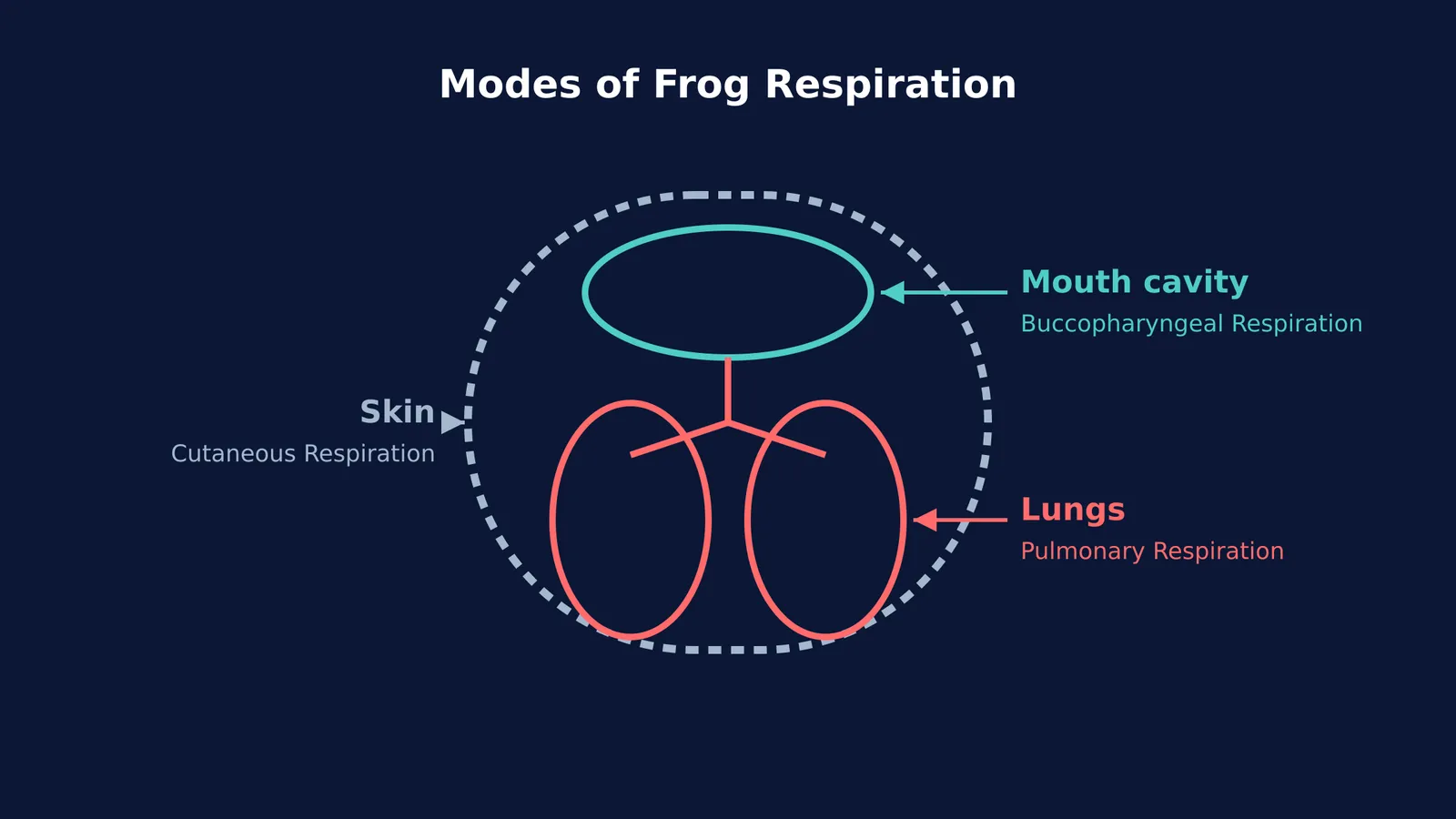
The frog (*Rana tigrina*) is an amphibian marvel, equipped to survive both on land and deep underwater. To manage these completely different environments, a frog uses three distinct modes of respiration: cutaneous (skin), buccopharyngeal (mouth), and pulmonary (lungs).
For students preparing for exams like NEET or studying CBSE Class 11 Biology, mastering how these modes switch is a frequent requirement. It is a prime example of structural organisation in animals, showing how physiology adapts to extreme environmental shifts.
What are the modes of respiration in a frog?
A frog does not breathe the way a human does. Instead, it relies on three different surfaces for gaseous exchange:
Cutaneous respiration: The frog exchanges oxygen and carbon dioxide directly through its thin, moist skin.
Buccopharyngeal respiration: The lining of the buccal cavity (the mouth) is highly vascularised and acts as a respiratory surface.
Pulmonary respiration: The frog uses a pair of pink, sac-like lungs located in its upper trunk (thorax).
Because a frog lacks a diaphragm and ribs, it cannot simply expand its chest to draw air into its lungs. Instead, it uses a mechanical process called buccal pumping (Wikipedia). First, the frog lowers the floor of its mouth, which draws air in through the open nostrils (external nares). Then, the nostrils close, and the frog raises the floor of its mouth, compressing the air and forcing it down the glottis into the lungs. This positive-pressure breathing is fundamentally different from the negative-pressure breathing seen in mammals.
If you have concept gaps regarding how gas exchange changes across different animal phyla, the Fermi Concept Library has every concept in physics, chemistry, biology, mathematics and computing, each with its own lesson and its place in the map.
How does a frog breathe in water and on land?
When a frog is submerged in water, its nostrils remain closed, and the lungs are completely inactive. It relies entirely on cutaneous respiration. Dissolved oxygen from the water diffuses directly across the skin and into the bloodstream, while carbon dioxide diffuses out. The skin must remain moist for this process to work, which is why frogs secrete mucus and stay near damp habitats. Certain aquatic species have evolved adaptations to maximise this: for example, the Titicaca water frog has wrinkly skin to drastically increase its surface area for gas exchange.
On land, the situation changes. The frog uses all three methods depending on its activity level. When resting in a damp terrestrial environment, it relies heavily on buccal and cutaneous respiration. When active, the demand for oxygen rises, triggering pulmonary respiration. The lungs take over the majority of the oxygen uptake workload, although the skin remains a crucial exit route for carbon dioxide.
Why do frogs use skin respiration during hibernation?
During the extremes of winter (hibernation) and summer (aestivation), frogs burrow into damp soil or settle at the bottom of ponds to enter a state of dormancy. In this state, they stop moving, and their metabolic rate drops dramatically.
During hibernation, a frog meets 100% of its oxygen needs through cutaneous respiration. According to a review in *Biological Reviews* (DOI: 10.1111/j.1469-185X.2008.00035.x), submerged overwintering frogs can absorb enough dissolved oxygen from cold water through their skin to sustain their depressed metabolism without ever using their lungs. Because cold water holds more dissolved oxygen and the dormant frog is barely burning energy, the skin is perfectly adequate as the sole respiratory organ.
To see how these biological concepts are tested in exams, you can work through related questions using the Fermi Problem Library, which has worked problems with a step-by-step solver that explains the reasoning rather than printing an answer.
The transition from tadpole to adult
The respiratory flexibility of a frog is not just about moving between land and water; it is also a story of metamorphosis. Before they become adult frogs, larval frogs (tadpoles) are fully aquatic. In this stage, they rely on internal gills to extract dissolved oxygen from the water, much like fish.
As the tadpole undergoes metamorphosis, a dramatic physiological shift occurs. The gills are gradually reabsorbed and lost, while the rudimentary lungs develop. The circulatory system also rewires itself to support the new pulmonary and cutaneous networks. Once this transition is complete, the adult frog emerges with its signature hybrid respiration system, ready to thrive in a dual-habitat life. This developmental journey is a core topic in biology because it connects broader life processes to evolutionary adaptation.
Quick review checklist for exam prep
When reviewing frog respiration for exams like NEET, make sure you can answer these core questions:
Environment: Can you identify the primary respiratory organ in water (skin) versus active on land (lungs)?
Mechanics: Do you know how buccal pumping forces air into the lungs without a diaphragm?
Dormancy: Do you understand why hibernation relies entirely on cutaneous respiration?
Development: Can you describe the shift from larval gills to adult lungs?
You can read more about how energy is managed at a cellular level in our guide to respiration as an amphibolic pathway and review the broader systems in structural organisation in animals.


