On this page
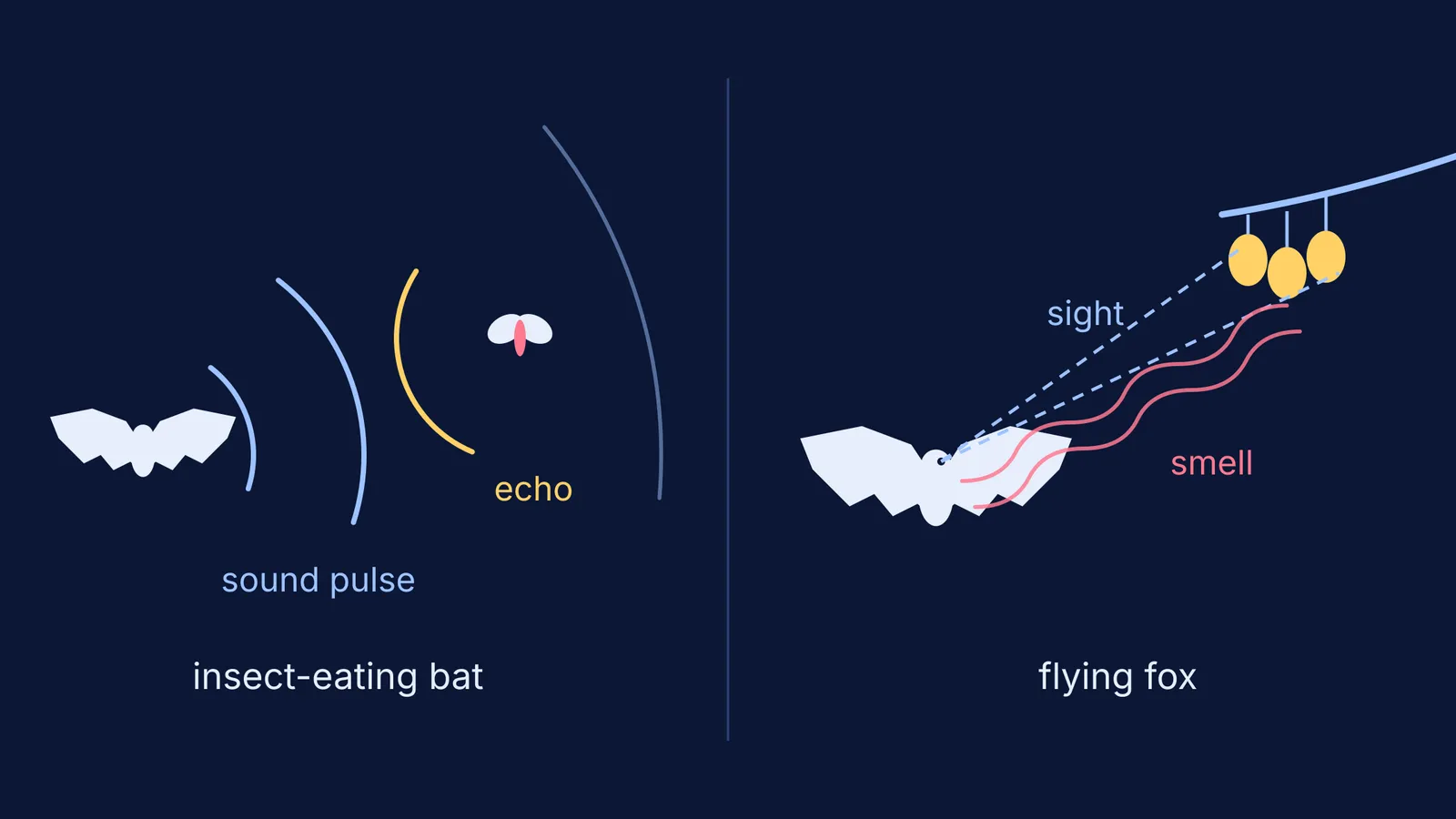
You learn it in school: bats see with sound. That is true for most bats, but not for the big fruit bats hanging from banyan or eucalyptus trees in many Indian towns. Those flying foxes find food mostly by looking and sniffing.
Do all bats use echolocation?
No. Bats are the second-largest order of mammals, with more than 1,300 species, according to Thiagavel and colleagues in Nature Communications (2018). Most of them make high-pitched calls in the larynx (the voice box) and listen for the echoes to find their way and their food in the dark. This is called laryngeal echolocation.
One whole family is the exception. The Pteropodidae, or Old World fruit bats, are about 200 vision-dependent species, none of which uses laryngeal echolocation, the same 2018 study reports. Flying foxes, the genus Pteropus, belong to this family.
How do flying foxes find fruit without echolocation?
They use their eyes and their nose. Pteropodidae "lacks laryngeal echolocation capacity" and "instead relies on eyesight and smell detection abilities to locate food", write Ritu Devi and Parmesh Kumar, citing earlier studies, in a 2024 survey of Indian flying foxes in Kurukshetra district, Haryana.
Their eyes are built for dim light, and they are not blind. A study of six fruit bat species by Brigitte Müller, Steven Goodman and Leo Peichl, published in Brain, Behavior and Evolution in 2007, found retinas dominated by rods, with cones making up about 0.5 percent of the photoreceptors, as reported by ScienceDaily. The Pteropus species had two cone types, which is the basis for two-colour vision.
The flying fox you are most likely to see is the Indian flying fox, Pteropus medius, recorded in India, Sri Lanka, Pakistan, Bangladesh, Nepal and nearby countries (Mammal Diversity Database). In Kurukshetra district, Devi and Kumar found that 6 of the 10 roosting sites they identified (60%) were close to water sources (Journal of Threatened Taxa, 2024).
Are there fruit bats that echolocate?
A few Old World fruit bats do, in a simpler way, which is why careful wording matters.
Rousettus fruit bats produce echolocation clicks with the tongue rather than the larynx (Smarsh and colleagues, Proceedings of the Royal Society B, 2021).
In 2014, Arjan Boonman, Sara Bumrungsri and Yossi Yovel found that wild-caught fruit bats of three species make clicks with their wings (Current Biology).
That wing-click sonar is rudimentary. The bats could tell a board from a cloth but kept crashing into thick cables, ScienceDaily reported.
Why did Old World fruit bats lose echolocation?
The 2018 Nature Communications study offers one explanation. The authors note that substantial evidence now supports a common ancestor of all bats that was nocturnal and could both fly and echolocate with its larynx. They found that this ancestor had eyes too small to catch flying insects at night by sight, but a hearing brain good enough for sonar. Among today's insect-hunting bats, species with less sophisticated sonar have relatively larger eyes.
If the common ancestor echolocated, the fruit bat family lost laryngeal echolocation along the way. The authors suggest fruit bats may still keep some of the building blocks for sonar. One way to picture the logic (our illustration, not the study's): a fig or a flowering tree stays put, can be seen in moonlight and gives off scent. A moth in the dark is small, fast and silent, so hearing its echo works better than looking for it.
How do you answer flying fox questions in exams?
Most mistakes come from one absolute word. Run any statement through three checks:
Which family is it? Pteropodidae, the Old World fruit bats including flying foxes, rely on sight and smell; other bats use laryngeal echolocation.
Does the statement say all, no or only? Look for the exception: Pteropodidae for all bats, Rousettus for no fruit bats.
Is it about how the sound is made? Larynx, tongue and wings are three different answers.
Worked example. Mark each statement true or false:
All bats use echolocation. False: Old World fruit bats do not use laryngeal echolocation.
Flying foxes locate fruit mainly by sight and smell. True.
Fruit bats are blind. False: they have rod-rich retinas and cones.
No fruit bat can echolocate. False: Rousettus uses tongue clicks.
A flying fox is a bird because it flies. False: it is a mammal, with fur, milk and a diaphragm.
Our animal kingdom NCERT examples with NEET questions shows how bats sit among the mammals, and why birds and reptiles breathe without a diaphragm explains one feature that sets mammals apart. For the vision side, why faint stars vanish when you look straight at them shows how rods handle dim light in your own eyes.
If rods, cones or the larynx feel hazy, the Fermi Concept Library covers every concept in physics, chemistry, biology, mathematics and computing, each with its own lesson and its place in the map. To practise questions like these, the Fermi Problem Library has worked problems with a step-by-step solver that explains the reasoning rather than printing an answer.