On this page
Dissolution is the last topic in Unit 1, Accounting for Partnership Firms, of the CBSE Accountancy 2026-27 curriculum. Unit 1 carries 36 marks. It keeps the meaning and types of dissolution and the realisation, capital and cash or bank accounts, but excludes piecemeal distribution, sale to a company and insolvency of partners.
What is dissolution of a partnership firm?
Under Section 39 of the Partnership Act 1932, dissolution of the firm means the dissolution of partnership between all the partners, as the NCERT chapter on dissolution (Accountancy Part 1, Reprint 2026-27) explains. Admission, retirement or death dissolves the partnership, but the firm can carry on. Dissolving the firm closes the business: assets are sold, liabilities paid and the books closed. For the reconstitution side, see our guide to admission of a partner in Class 12.
NCERT lists five ways a firm is dissolved:
By agreement of all partners.
Compulsorily, such as when the business becomes illegal.
On contingencies: a fixed term ends, the venture is completed, or a partner dies.
By notice, in a partnership at will.
By the court, for example for a partner's misconduct.
What goes into the realisation account?
The realisation account finds the profit or loss on selling assets and paying liabilities, shared in the profit sharing ratio (NCERT).
Debit side: all assets except cash, bank and fictitious assets, at book value (debtors at the gross figure); payments to creditors and other liabilities; realisation expenses the firm bears.
Credit side: outside liabilities and provisions such as provision for doubtful debts; cash received for assets sold; assets a partner takes over, at the agreed value.
Kept out: cash and bank, partners' capitals, partners' loans, and reserves and accumulated profits, which go straight to the capital accounts.
Question 16 of the CBSE 2026-27 sample paper asks which items stay out of the realisation account, and the marking scheme answers: general reserve and the debit bank balance.
The 2026-27 curriculum adds two defaults: if no realised value is given, take a tangible asset at book value and an intangible asset at nil.
In what order is cash paid out on dissolution?
Subject to any agreement between partners, Section 48 of the Partnership Act sets the order, as explained in the NCERT chapter:
Debts of the firm to outsiders.
Partners' loans and advances, as distinct from capital.
Each partner's capital.
Any surplus, in the profit sharing ratio.
Losses come first out of profits, then capital, then from partners individually in their profit sharing ratio.
Worked example: Kavya and Rohan close their firm
Kavya and Rohan share profits 2:1 and dissolve their firm. The balance sheet on that date:
Liabilities: creditors ₹60,000; bills payable ₹15,000; Rohan's loan ₹20,000; general reserve ₹18,000; capitals Kavya ₹90,000 and Rohan ₹60,000. Total ₹2,63,000.
Assets: bank ₹22,000; debtors ₹40,000 less provision ₹2,000; stock ₹35,000; furniture ₹25,000; machinery ₹1,05,000; investments ₹38,000. Total ₹2,63,000.
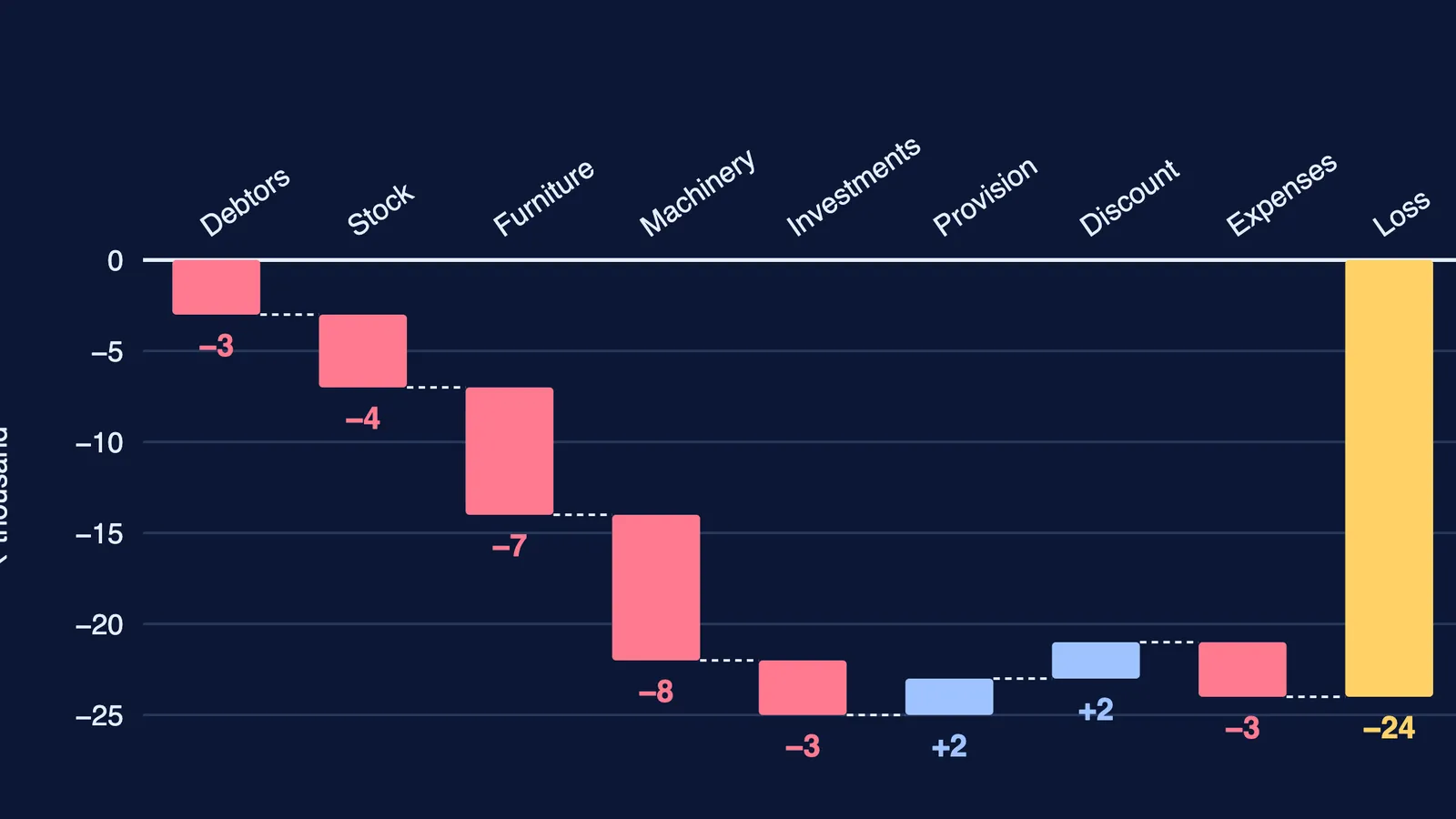
Debtors realise ₹37,000, stock ₹31,000, furniture ₹18,000 and machinery ₹97,000. Kavya takes the investments at ₹35,000. Creditors accept ₹58,000, bills payable are paid in full, and the firm pays realisation expenses of ₹3,000.
Step 1: Realisation account. Debit: assets ₹2,43,000 plus payments ₹76,000 = ₹3,19,000. Credit: provision ₹2,000 + creditors ₹60,000 + bills payable ₹15,000 + cash from assets ₹1,83,000 + Kavya for investments ₹35,000 = ₹2,95,000. Loss on realisation: ₹24,000.
Step 2: Share the loss and the reserve 2:1. Loss: Kavya ₹16,000, Rohan ₹8,000. Reserve: Kavya ₹12,000, Rohan ₹6,000.
Step 3: Repay Rohan's loan. Pay ₹20,000 before any capital; the loan never enters the realisation account.
Step 4: Close the capital accounts. Kavya: ₹90,000 + ₹12,000 − ₹16,000 − ₹35,000 = ₹51,000. Rohan: ₹60,000 + ₹6,000 − ₹8,000 = ₹58,000.
Step 5: Check the bank. ₹22,000 + ₹1,83,000 − ₹76,000 − ₹20,000 = ₹1,09,000, which equals ₹51,000 + ₹58,000. The bank account closes at nil.
Which mistakes cost marks in dissolution questions?
Putting general reserve or a partner's loan into the realisation account.
Transferring debtors net of provision. Debtors go in at the gross figure; the provision goes to the credit side.
Transferring creditors at the settled amount. In Question 14 of the sample paper, creditors of ₹40,000 and ₹15,000 are transferred at ₹55,000 even though one accepts ₹30,000, per the marking scheme.
Confusing who bears realisation expenses with who pays them (Question 17B).
Forgetting to debit a partner's capital for an asset they take over.
How should you revise dissolution this year?
Learn the three lists: debit side, credit side, kept out.
Solve sample paper Questions 14, 16 and 17 timed, then check the scheme.
Redo the Kavya and Rohan example from memory, changing one realised value each time.
Practise other Unit 1 numericals with our goodwill valuation guide.
If you are unsure where to start, Fermi's AI tutor can work out what you already know and build a plan for the session, so you sit down to a clear next step.