On this page
These terms come from Chapter 9 of the NCERT Class 12 Mathematics Part II textbook (Reprint 2026-27). The CBSE Mathematics curriculum for 2026-27 sets the scope: definition, order and degree, general and particular solutions, separation of variables, homogeneous equations of first order and first degree, and two linear forms. Most terms come with a short example and, where useful, a "Don't confuse with" pair.
Forming a differential equation whose general solution is given (by eliminating arbitrary constants) is left out: the rationalised chapter has no section on it and the 2026-27 syllabus does not list it.
What is a differential equation, and what are its order and degree?
Differential equation: an equation containing the derivative (or derivatives) of a dependent variable with respect to an independent variable. Example: dy/dx = 3x² is one; x² − 3x + 2 = 0 is not.
Dependent and independent variable: y is the unknown function you solve for; x is the variable the derivatives are taken with respect to.
Ordinary differential equation: derivatives with respect to only one independent variable. The chapter studies only these.
Derivative notation: y′ = dy/dx, y″ = d²y/dx², y‴ = d³y/dx³, and yₙ for the nth derivative.
Order: the highest order of any derivative that appears. Example: y″ + 3y′ + y = 0 has order 2.
Degree: defined only when the equation is a polynomial in its derivatives; it is then the largest power (a positive integer) to which the highest-order derivative is raised. Example: (y″)³ + (y′)⁴ + y = 0 has order 2 and degree 3, not 4. Don't confuse with: the highest power anywhere in the equation.
Degree not defined: a derivative sits inside sin, log, e^ or a similar function. Example: y′ + sin(y′) = 0 has order 1 and no degree.
Positive integers: order and degree (when defined) are always positive integers.
What is the difference between a general and a particular solution?
Solution: a function y = φ(x) that makes both sides equal when it and its derivatives are substituted. Example: y = e^(2x) solves y′ − 2y = 0, since 2e^(2x) − 2e^(2x) = 0.
Arbitrary constant: a free constant such as C, a or b that can take any real value.
General solution (primitive): a solution whose number of arbitrary constants equals the order. Example: y = a cos 2x + b sin 2x solves y″ + 4y = 0, with two constants for order 2.
Particular solution: what you get by giving every arbitrary constant a fixed value, so none remain. Example: a = 1, b = 0 gives y = cos 2x. Don't confuse with: the general solution; a particular solution has zero arbitrary constants whatever the order.
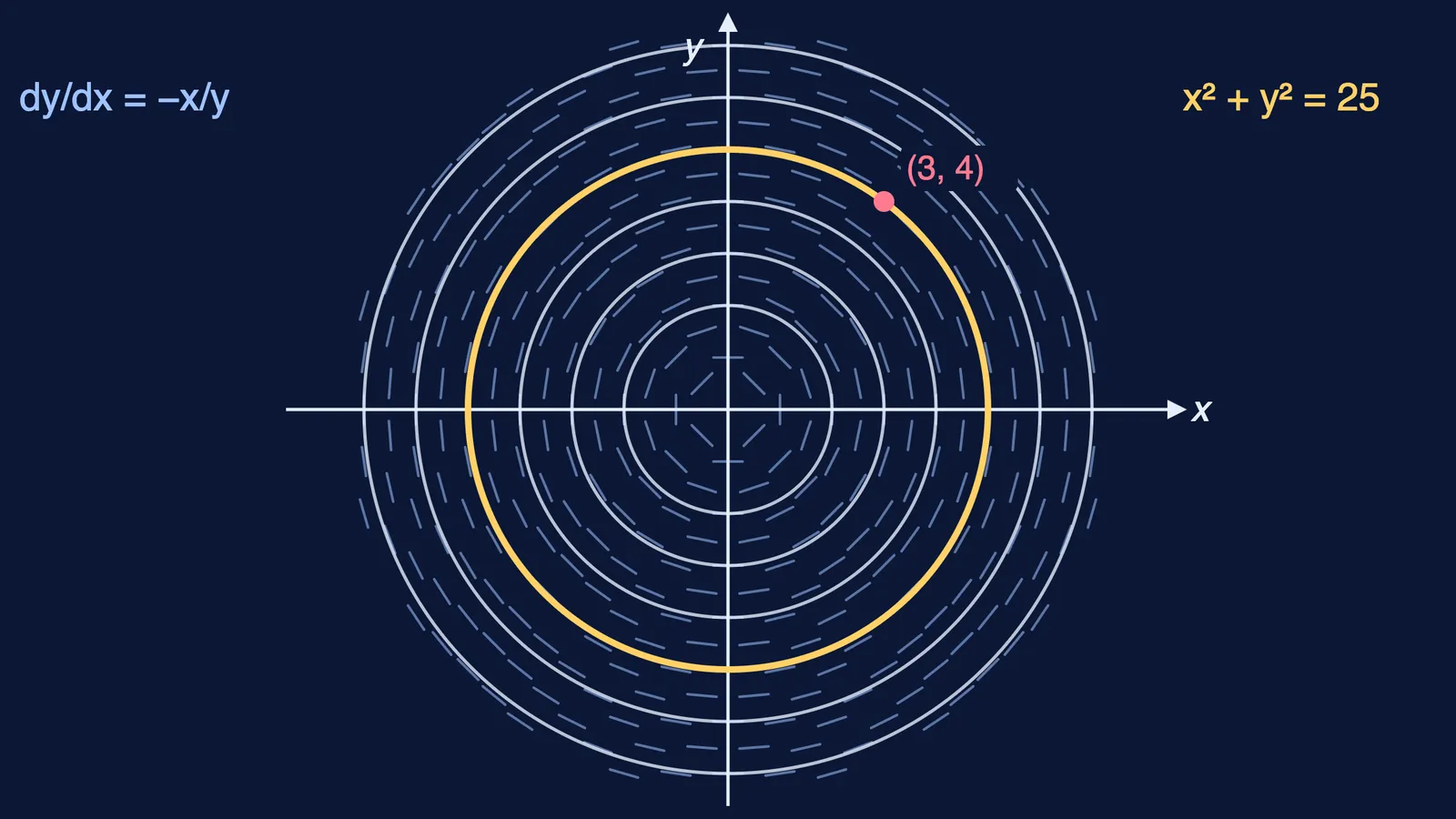
Solution curve (integral curve): the graph of a solution. Example: dy/dx = 2x gives the family y = x² + C; the curve through (1, 3) needs C = 2.
Family of solution curves: the general solution's curves, one per value of the constant.
Which first order equations can you solve by separating variables?
First order, first degree equation: one that can be written dy/dx = F(x, y).
Variable separable equation: F(x, y) factorises as g(x)·h(y). Example: dy/dx = xy. Don't confuse with: dy/dx = x + y, which does not factorise (it is linear).
Separation of variables: y terms go with dy, x terms with dx, then integrate both sides and add one constant. Example: for y ≠ 0, dy/y = x dx gives log|y| = x²/2 + C. The step needs h(y) ≠ 0.
What makes a differential equation homogeneous?
Homogeneous function of degree n: F(λx, λy) = λⁿF(x, y) for every nonzero λ. Example: x² + 3xy has degree 2; x² + y is not homogeneous.
Homogeneous differential equation: dy/dx = F(x, y) with F homogeneous of degree zero, so it depends on y/x only. Example: dy/dx = (x + y)/x = 1 + y/x. Don't confuse with: the degree of a differential equation; here "degree" belongs to the function F.
Substitution y = vx: replaces dy/dx by v + x dv/dx and makes the equation separable. Example: v + x dv/dx = 1 + v gives dv = dx/x, so y = x log|x| + Cx.
Substitution x = vy: used when the equation is given as dx/dy = h(x/y).
How do you solve a linear differential equation?
First order linear equation: dy/dx + Py = Q, where P and Q are constants or functions of x only. Example: dy/dx + y/x = x² for x > 0.
Integrating factor (I.F.): e^(∫P dx), the multiplier that turns the left side into the derivative of y × I.F. Example: P = 1/x gives I.F. = x for x > 0.
Solution formula: y × I.F. = ∫(Q × I.F.) dx + C. Example: xy = ∫x³ dx = x⁴/4 + C, so y = x³/4 + C/x.
Linear in x form: dx/dy + P₁x = Q₁, with P₁ and Q₁ constants or functions of y only; I.F. = e^(∫P₁ dy) and x × I.F. = ∫(Q₁ × I.F.) dy + C. Example: dx/dy + x = y gives x = y − 1 + Ce^(−y).
How to learn these terms
Learn order and degree as a pair, and find order first: degree is read off the highest-order derivative only.
Count constants as a self-check: an order-n general solution needs n constants, a particular one needs none.
Sketch a few curves of y = x² + C and mark one point, so "general" and "particular" become a picture.
Keep one tiny example per method: dy/dx = xy, dy/dx = 1 + y/x and dy/dx + y/x = x².
Brush up integration; most slips here are in the integrals, which our Integrals Class 12 board exam guide covers.
If a term still feels shaky, the Fermi Concept Library gives every concept in mathematics its own lesson and its place in the map. For question types and a study plan, read the Differential equations Class 12 board exam guide; if you also take JEE, see how to spot the type of differential equation for JEE.