On this page
Eight new JEE Advanced-style questions, easy to hard: single-correct, one or more options correct, numerical-value and one list-match, each with a solution and the trap.
Every question stays inside the d-Block, f-Block and Coordination Compounds units of the official JEE (Advanced) 2026 syllabus. Facts and data come from NCERT Class 12 Chemistry, Unit 4, The d- and f-Block Elements, and Unit 5, Coordination Compounds (Reprint 2026-27). For the chapter plan, read how to prepare d- and f-block and coordination compounds for JEE Advanced.
How should you use this practice set?
Allow 30 minutes; write each metal's oxidation state and dⁿ count before reading options.
Judge each option of a multi-correct question alone. Our guide to JEE Advanced question types explains the formats.
Easy: isomers, oxoanions and the f-block
Q1 (easy, single-correct). X and Y are octahedral cobalt(III) compounds, both of composition CoCl(SO₄)(en)₂(H₂O). A solution of X gives a white precipitate with BaCl₂ but none with AgNO₃; Y gives a white precipitate with AgNO₃ but none with BaCl₂. Which is correct?
(A) X = [Co(en)₂(H₂O)Cl]SO₄ and Y = [Co(en)₂(H₂O)(SO₄)]Cl; they are ionization isomers (B) X = [Co(en)₂(H₂O)(SO₄)]Cl and Y = [Co(en)₂(H₂O)Cl]SO₄; they are ionization isomers (C) X = [Co(en)₂(H₂O)Cl]SO₄ and Y = [Co(en)₂Cl(SO₄)]·H₂O; they are solvate isomers (D) X = [Co(en)₂(H₂O)Cl]SO₄ and Y = [Co(en)₂(H₂O)(SO₄)]Cl; they are linkage isomers
Answer: (A). Only free ions precipitate: sulfate in X, chloride in Y. Swapping the inner and outer anion is ionization isomerism. Trap: (C)'s neutral Y has no free chloride, so it would give no AgCl at all.
Q2 (easy, one or more options correct). Which statements are correct?
(A) CrO₄²⁻ and MnO₄⁻ are both tetrahedral. (B) Cr₂O₇²⁻ consists of two tetrahedra sharing an edge. (C) Green MnO₄²⁻ is paramagnetic, while purple MnO₄⁻ is diamagnetic. (D) The colour of MnO₄⁻ comes from d–d transitions of Mn(VII).
Answer: (A), (C). NCERT Unit 4 calls both ions tetrahedral and dichromate two tetrahedra sharing one corner. Manganate is Mn(VI), 3d¹, one unpaired electron; permanganate is 3d⁰. Trap: (D) borrows the usual colour rule, but a d⁰ ion has no d electron to excite.
Q3 (easy, one or more options correct). Which statements are correct?
(A) The actinoid contraction is greater from element to element than the lanthanoid contraction, because 5f electrons shield poorly. (B) Lanthanoid hydroxides, Ln(OH)₃, are basic. (C) La³⁺ and Lu³⁺ are paramagnetic. (D) 5f orbitals are more buried than 4f orbitals, so 5f electrons take less part in bonding.
Answer: (A), (B). Both are NCERT statements. La³⁺ is 4f⁰ and Lu³⁺ is 4f¹⁴, with no unpaired electrons. Trap: (D) reverses NCERT, which says 5f orbitals are less buried and take part in bonding far more.
Medium: crystal fields, potentials and carbonyls
Q4 (medium, one or more options correct). Ignoring pairing energy in CFSE, which statements are correct?
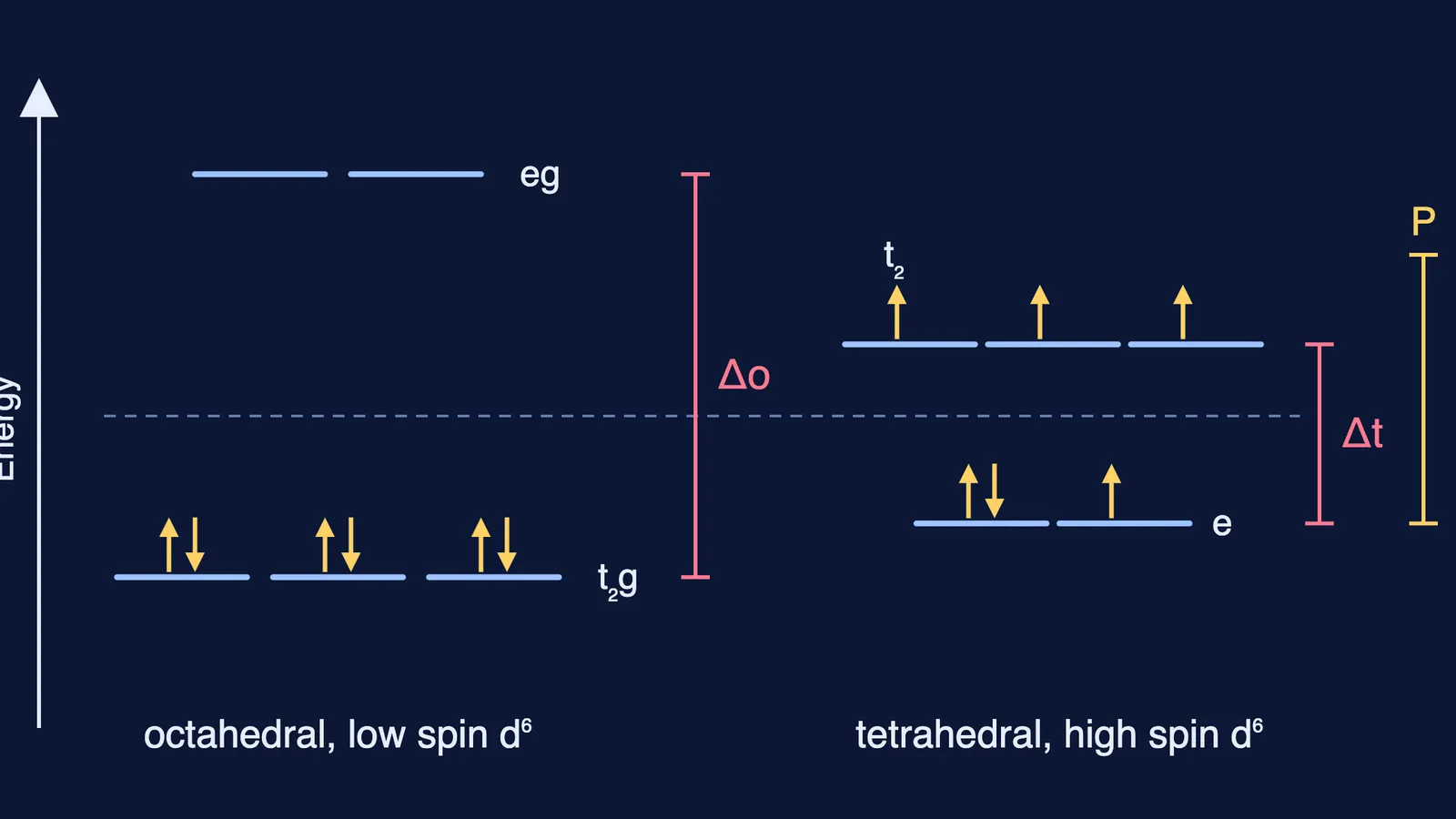
(A) [Co(C₂O₄)₃]³⁻ is diamagnetic. (B) A high-spin octahedral d⁶ ion has CFSE = −0.4Δo. (C) A high-spin tetrahedral d⁴ ion has CFSE = −0.6Δt. (D) If Δo = 1.5P for an octahedral d⁶ complex, the tetrahedral complex of the same metal, ligands and distances is low spin.
Answer: (A), (B). NCERT calls [Co(C₂O₄)₃]³⁻ diamagnetic. For (B), t₂g⁴eg² gives 4(−0.4) + 2(+0.6) = −0.4Δo. For (C), e²t₂² gives 2(−0.6) + 2(+0.4) = −0.4Δt. For (D), Δt = (4/9)(1.5P) = 0.67P, below P, so high spin. Trap: (C) counts only the e electrons.
Q5 (medium, numerical-value). From NCERT's Table 4.2, E°(Cr²⁺/Cr) = −0.90 V and E°(Cr³⁺/Cr²⁺) = −0.41 V. If E°(Cr³⁺/Cr) = −x V, what is x, to two decimal places?
Answer: 0.74. Free energies add, potentials do not: ΔG° = −nFE°, so 3E° = 1(−0.41) + 2(−0.90) = −2.21 V, giving E° = −0.74 V. Trap: adding the potentials gives 1.31; averaging them gives 0.66.
Q6 (medium, one or more options correct). For the isoelectronic carbonyls [V(CO)₆]⁻, Cr(CO)₆ and [Mn(CO)₆]⁺, which statements are correct?
(A) All three are octahedral, with a d⁶ metal. (B) Back-donation into CO's π* orbital is greatest in [Mn(CO)₆]⁺, whose metal has the highest oxidation state. (C) The C–O bond is longest in [V(CO)₆]⁻. (D) Metal-to-CO π donation raises the C–O bond order above that in free CO.
Answer: (A), (C). V(−1), Cr(0) and Mn(+1) are all d⁶; NCERT shows Cr(CO)₆ as octahedral. In NCERT's synergic bonding, metal d electrons enter CO's antibonding π* orbital, which lowers the C–O bond order, so (D) is backwards. The most electron-rich metal, V(−1), back-donates most and lengthens C–O most. Trap: (B) assumes a more positive metal donates more; it holds its d electrons tightest and back-donates least.
Hard: magnetism match and a redox titration
Q7 (hard, list-match). Match each complex in List-I with its spin-only magnetic moment in List-II.
List-I: (P) [Mn(CN)₆]³⁻ (Q) [MnCl₆]³⁻ (R) [Cr(NH₃)₆]³⁺ (S) [Fe(CN)₆]⁴⁻
List-II (BM): (1) 0 (2) 2.83 (3) 3.87 (4) 4.90 (5) 5.92
(A) P→2, Q→4, R→3, S→1 (B) P→4, Q→2, R→3, S→1 (C) P→1, Q→4, R→3, S→1 (D) P→2, Q→4, R→3, S→4
Answer: (A). Mn³⁺ is d⁴; NCERT reports two unpaired electrons in [Mn(CN)₆]³⁻ (t₂g⁴, √8 = 2.83 BM) and four in [MnCl₆]³⁻ (√24 = 4.90). Cr³⁺ is d³: 3.87. Fe²⁺ with CN⁻ is t₂g⁶: 0. Trap: (C) assumes low spin means no unpaired electrons; four electrons in three t₂g orbitals leave two unpaired.
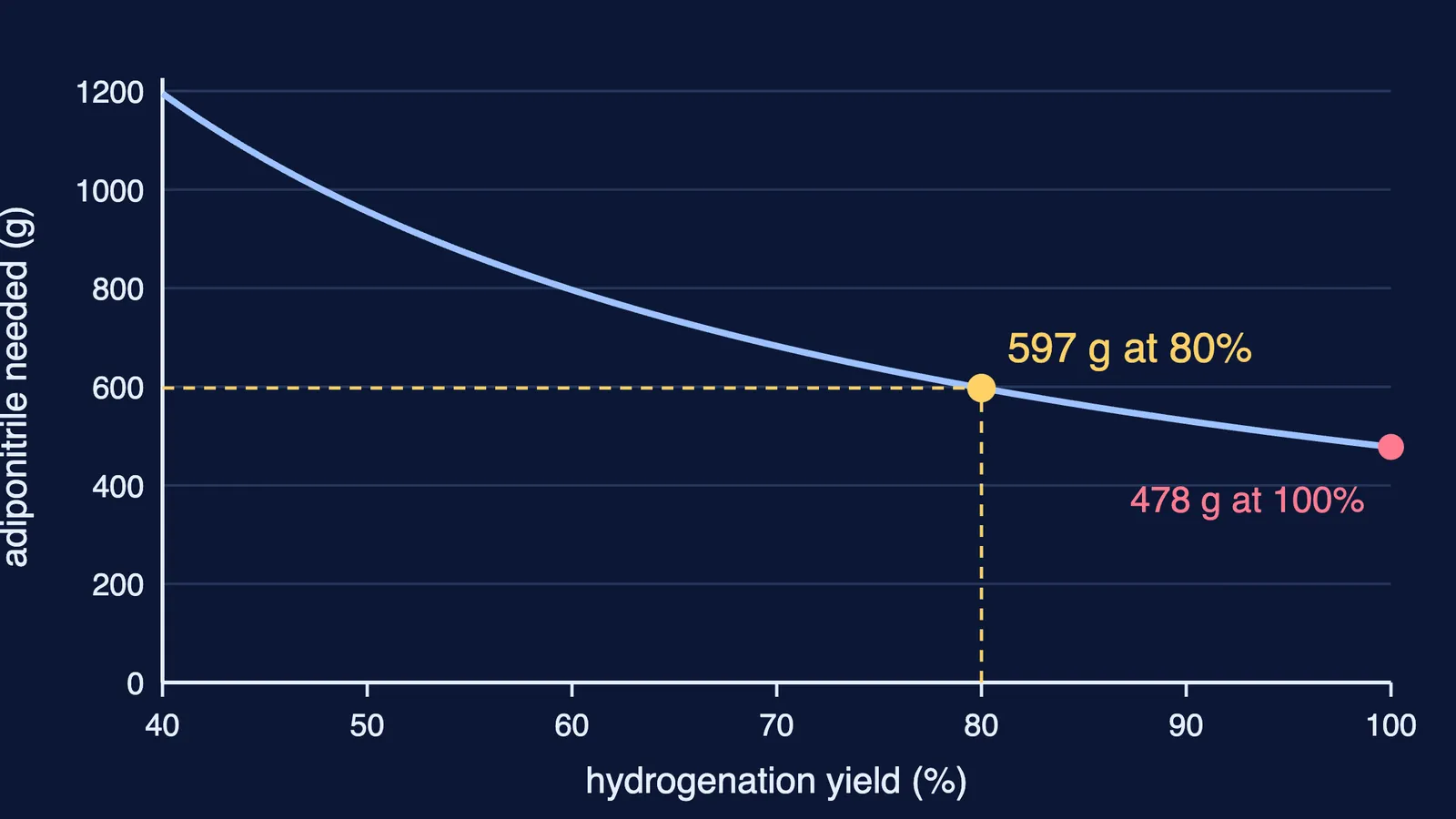
Q8 (hard, numerical-value). 0.982 g of potassium trioxalatoferrate(III) trihydrate is dissolved in dilute H₂SO₄ and titrated at 333 K with 0.0400 M KMnO₄. Taking K = 39, Fe = 56, C = 12, O = 16 and H = 1, what volume of KMnO₄, in mL, is needed?
Answer: 60. The formula is K₃[Fe(C₂O₄)₃]·3H₂O, M = 491 g/mol, so 2.00 mmol, holding 6.00 mmol of oxalate. NCERT's equation, 5C₂O₄²⁻ + 2MnO₄⁻ + 16H⁺ → 2Mn²⁺ + 8H₂O + 10CO₂, needs 2.40 mmol MnO₄⁻, or 60.0 mL. Fe(III) takes no permanganate. Trap: 70 also titrates the iron as Fe²⁺; 20 counts one oxalate per formula.
What should you do after this set?
Charge slips (Q1, Q8): balance the bracket first; see our explainer on finding oxidation state and coordination number.
Spin slips (Q4, Q7): fill t₂g and eg on paper before counting.
Recall slips (Q2, Q3, Q6): reread NCERT on oxoanions, actinoids and carbonyls.
Potential slips (Q5): add ΔG°, never E°.
If a method cost you the mark, the Fermi Problem Library has worked problems with a step-by-step solver that explains the reasoning rather than printing an answer.