On this page
For JEE Advanced, this unit rewards reasoning over recall. The official JEE (Advanced) 2026 syllabus says it is the same as the 2025 syllabus. The 2027 syllabus is not yet published; the JEE (Advanced) website says the 2027 exam will be held on 23 May 2027, organised by IIT Delhi.
What does the JEE Advanced syllabus list for d-block, f-block and coordination compounds?
The 2026 syllabus lists, in its own words:
d-Block Elements: oxidation states and their stability; standard electrode potentials; interstitial compounds; alloys; catalytic properties; applications; preparation, structure, and reactions of oxoanions of chromium and manganese.
f-Block Elements: lanthanoid and actinoid contractions; oxidation states; general characteristics.
Coordination Compounds: Werner's theory; nomenclature, cis-trans and ionization isomerism, hybridization and geometries (linear, tetrahedral, square planar and octahedral) of mononuclear coordination compounds; bonding [VBT and CFT (octahedral and tetrahedral fields)]; magnetic properties (spin-only) and colour of 3d-series coordination compounds; ligands and spectrochemical series; stability; importance and applications; metal carbonyls.
What is beyond JEE Main in this unit?
NTA's current JEE (Main) syllabus covers transition-metal trends, K2Cr2O7 and KMnO4, and only "basic ideas of Crystal field theory". The Advanced list adds standard electrode potentials, the structures of chromium and manganese oxoanions, actinoid contraction, CFT in tetrahedral as well as octahedral fields, the spectrochemical series, stability and metal carbonyls. It names only cis-trans and ionization isomerism. For the shared base, start with our d- and f-block guide for JEE Main and our coordination compounds guide for JEE Main.
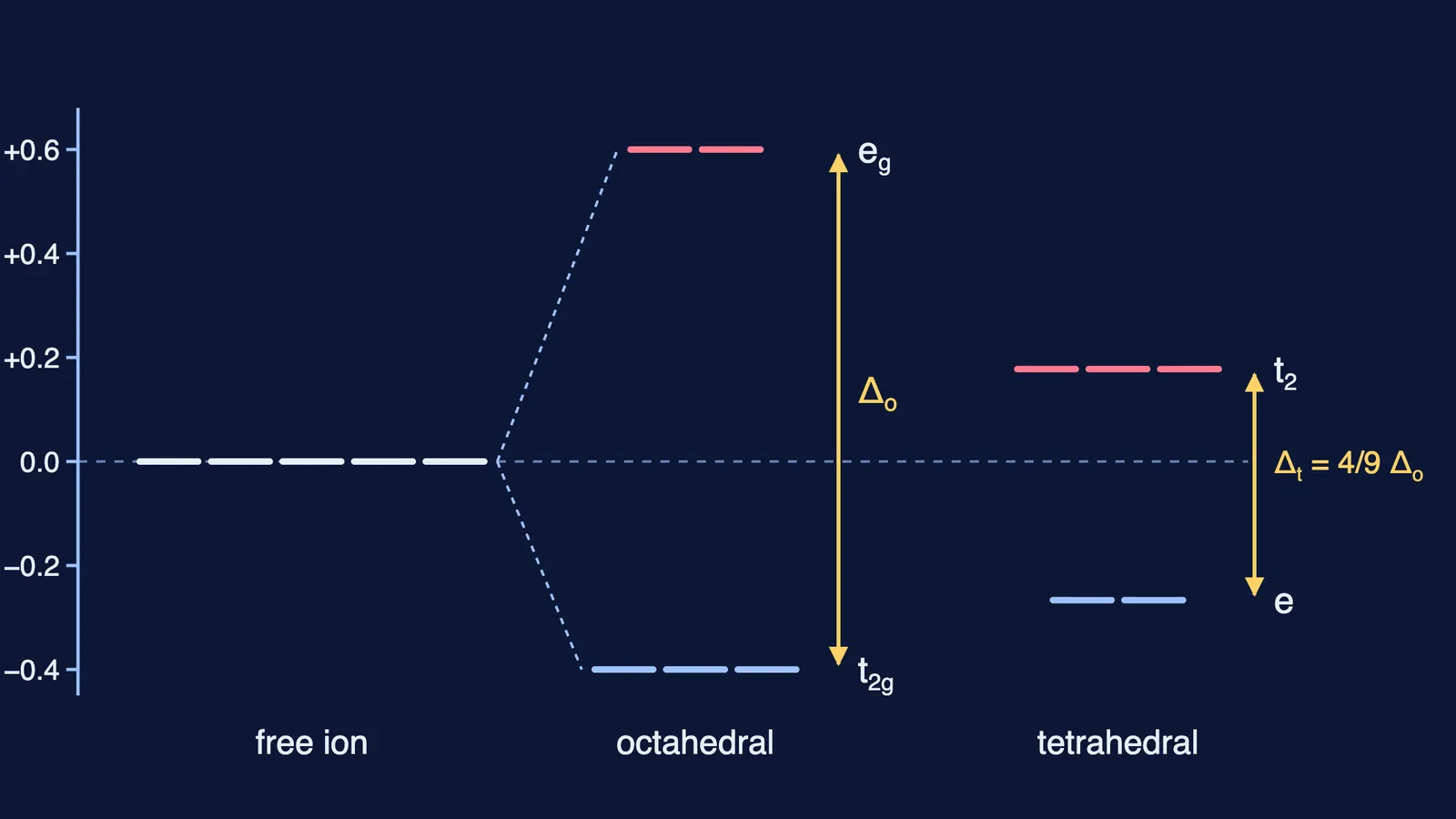
Three facts carry most of the reasoning. In an octahedral field, the two eg orbitals rise by (3/5)Δo and the three t2g orbitals fall by (2/5)Δo, according to NCERT's Coordination Compounds chapter. For the same metal, ligands and distances, the same chapter gives Δt = (4/9)Δo, which is why tetrahedral complexes are rarely low spin. The spin-only moment is μ = √(n(n+2)) BM for n unpaired electrons, from NCERT's d- and f-block chapter, which also gives the lanthanoid-contraction example of Zr at 160 pm and Hf at 159 pm.
Worked examples: what does an Advanced-level question look like?
Example 1 (spin state from two energies). An octahedral d6 complex has Δo = 250 kJ/mol and mean pairing energy P = 210 kJ/mol. Find its spin state and spin-only moment. What changes with a weaker ligand giving Δo = 170 kJ/mol, and in a tetrahedral complex of the first ligand set?
High spin is t2g4 eg2: energy −4(0.4Δo) + 2(0.6Δo) + P = −0.4Δo + P (one pair).
Low spin is t2g6: −2.4Δo + 3P (three pairs).
Low minus high = −2.0Δo + 2P = −500 + 420 = −80 kJ/mol, so low spin: no unpaired electrons, μ = 0.
With Δo = 170: −340 + 420 = +80 kJ/mol, so high spin: 4 unpaired, μ = √24 = 4.90 BM.
Tetrahedral: Δt = (4/9)(250) = 111 kJ/mol, well below P, so high spin.
The trap: counting all pairs or only extra pairs gives the same difference, so low spin wins exactly when Δo > P.
Example 2 (ionization and cis-trans together). A Pt(IV) compound has composition PtCl2Br2·4NH3, with all four NH3 bound to platinum. How many isomers are possible, and what mass of precipitate does 1.00 mmol of each ionization isomer give with excess AgNO3?
Six-coordinate Pt(IV) holds 4 NH3 and two halides; two are counter-ions.
Ionization isomers: [Pt(NH3)4Cl2]Br2, [Pt(NH3)4Br2]Cl2 and [Pt(NH3)4ClBr]ClBr.
Each octahedral cation has a cis and a trans form, so 6 isomers in all.
Precipitates (AgCl 143.32, AgBr 187.77 g/mol): [Pt(NH3)4Cl2]Br2 gives 375.5 mg AgBr, [Pt(NH3)4Br2]Cl2 gives 286.6 mg AgCl, and [Pt(NH3)4ClBr]ClBr gives 143.3 + 187.8 = 331.1 mg of mixed halides.
Not sure why the eg pair points at the ligands? The Fermi Concept Library covers every concept in physics, chemistry, biology, mathematics and computing, each with its own lesson and its place in the map.
How do you practise for multiple-correct and numerical questions?
The JEE Advanced question types have changed from year to year and are announced in the paper itself. In a multiple-correct set, judge each statement alone. For numerical answers, check units, then a limiting case.
A two-week plan:
Days 1 to 4: oxidation states, electrode potentials and the chromium and manganese oxoanions.
Days 5 and 6: lanthanoid and actinoid contractions.
Days 7 to 11: nomenclature, isomer counting, VBT, CFT and carbonyls.
Days 12 to 14: mixed timed questions, with an error log.
Try these:
An octahedral d7 ion has spin-only moments for the high-spin and low-spin cases. Find both and their difference.
Iron in 0.500 g of an alloy is dissolved as Fe2+ and needs 12.5 mL of 0.0200 M K2Cr2O7. Find the percentage of iron (Fe = 55.85 g/mol), and the volume of 0.0200 M KMnO4 the same solution would need.
Answers: 1. 3.87 BM and 1.73 BM; difference 2.14 BM. 2. 16.8% iron (1.50 mmol Fe2+, six per dichromate); 15.0 mL KMnO4 (five Fe2+ per permanganate).