On this page
Eight new JEE Advanced-style questions, none reworded from NCERT, exemplar or past papers, each with its trap.
What does JEE Advanced cover in current electricity?
The JEE (Advanced) 2026 syllabus lists Ohm's law, resistances and cells in series and parallel, Kirchhoff's laws, the heating effect of current, galvanometer conversions and RC circuits with d.c. sources. Every question stays inside it. For theory, see how to prepare current electricity for JEE Advanced.
How should you use this set?
Cover the solutions; allow 25 minutes.
In multi-correct questions, judge every option.
Log each trap that caught you; redo those in three days.
Formats are explained in JEE Advanced question types.
Easy: meters and wires
Q1 (easy, single-correct). Two identical galvanometers (99 Ω, full scale 1 mA) become a 0–100 mA ammeter and a 0–10 V voltmeter. To measure a 100 Ω resistor, the voltmeter is placed directly across it and the ammeter in series with that pair. What does V/I give?
(A) 98.0 Ω (B) 99.0 Ω (C) 100 Ω (D) 101.0 Ω
Answer: (B). The voltmeter's resistance is 10/0.001 = 10,000 Ω. The ammeter reads current through both, so V/I = 100 ∥ 10,000 ≈ 99.0 Ω.
Trap: (D) is the other connection; (A) subtracts the ammeter too.
Q2 (easy, one or more options correct). Same-metal wires P and Q are in parallel across an ideal battery; Q has twice P's length and diameter. Which are correct?
(A) Q carries twice P's current. (B) Q dissipates half P's power. (C) The field inside Q is half that in P. (D) Q's current density is twice P's.
Answer: (A), (C). R ∝ L/d², so R_Q = R_P/2: double current, double power. The field V/L halves; current density, 2I over 4A, halves.
Trap: (D) assumes current density follows current.
Medium: ladders, capacitors and heat
Q3 (medium, numerical value). An infinite ladder repeats one section: a 1 Ω series resistor, then a 6 Ω rung. An ideal 12 V battery is across the input, ahead of the first 1 Ω. Find the voltage, in volts, across the third rung (two decimals).
Answer: 3.56. R = 1 + 6R/(6 + R) gives R = 3 Ω. Each node sees 6 ∥ 3 = 2 Ω, so each stage keeps 2/3 of the voltage: 8, 16/3, then 32/9 ≈ 3.56 V.
Trap: 8.00 is the first rung.
Q4 (medium, one or more options correct). An ideal 18 V battery feeds two parallel branches: 3 Ω (top) and 6 Ω (bottom) meeting at M₁; 6 Ω (top) and 3 Ω (bottom) meeting at M₂. A 2 μF capacitor joins M₁ and M₂; the positive terminal is at the top. At steady state the battery is removed, terminals left open. Which are correct?
(A) The steady charge is 12 μC. (B) The plate at M₁ is positive. (C) It then discharges with τ = 8 μs. (D) 36 μJ of heat then appears in the resistors.
Answer: (A), (B), (D). V(M₁) = 12 V and V(M₂) = 6 V, so Q = 12 μC with M₁ positive. After removal, two 9 Ω paths join M₁ and M₂: 4.5 Ω, τ = 9 μs. All of ½CV² = 36 μJ becomes heat.
Trap: (C) treats the removed battery as a wire (4 Ω).
Q5 (medium, numerical value). An uncharged 4 μF capacitor is fully charged through a resistor by an ideal 5 V battery, which is then swapped for an ideal 10 V battery until charging ends. Find the total heat in the resistor, in microjoules.
Answer: 100. Charging from V₀ to E through any resistance wastes ½C(E − V₀)². Two 5 V steps give 2 × ½ × 4 μF × 25 = 100 μJ.
Trap: 200 is the one-step ½CE².
Hard: can you handle time constants and symmetry?
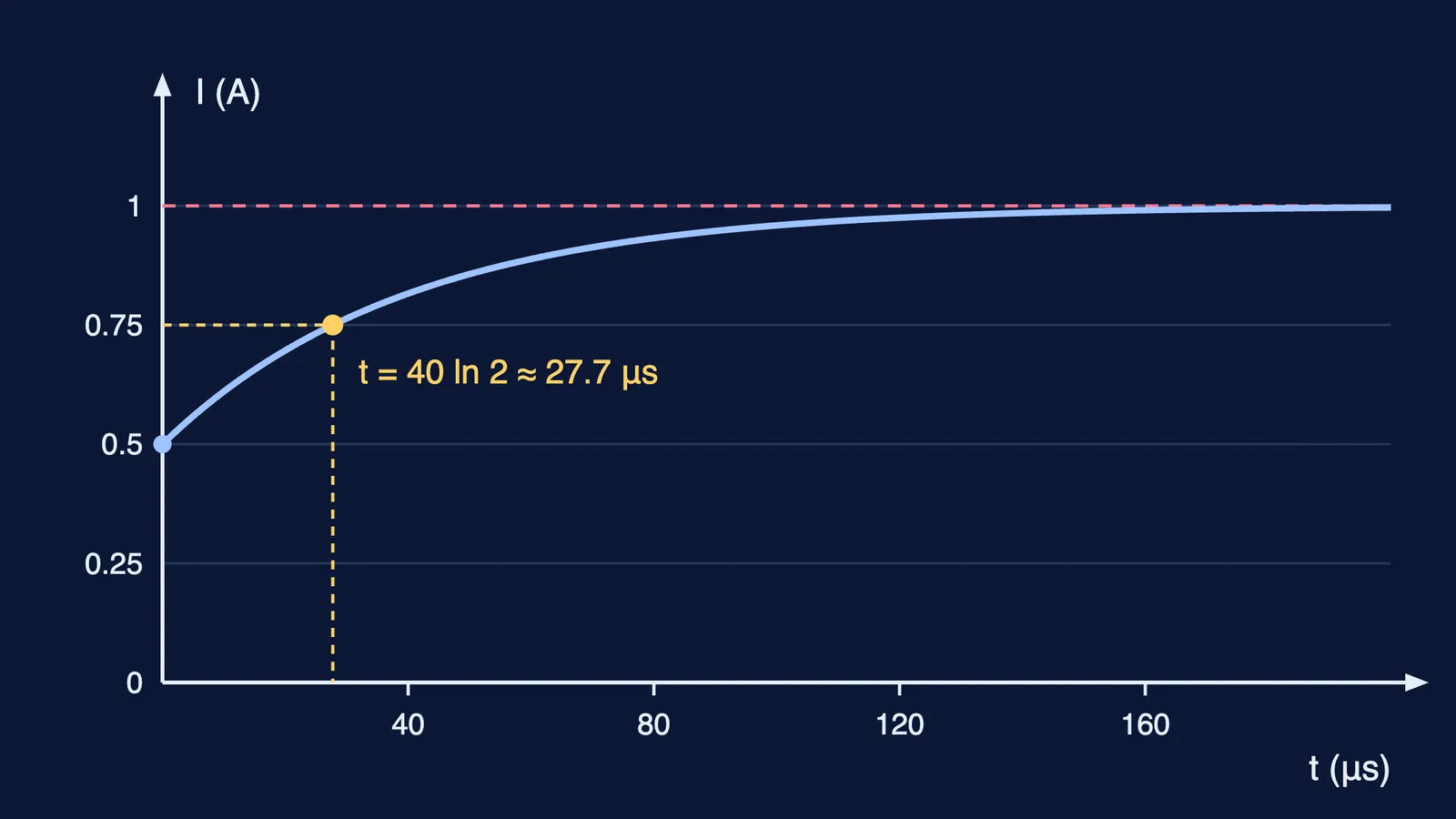
Q6 (hard, single-correct). An ideal 9 V battery, a switch and a 6 Ω resistor in series lead from the positive terminal to node X. From X back to the negative terminal run two branches: 3 Ω, and an uncharged 10 μF capacitor in series with 2 Ω. The switch closes at t = 0. When does the 3 Ω current reach 0.75 A?
(A) 13.9 μs (B) 27.7 μs (C) 40.0 μs (D) 55.5 μs
Answer: (B). At t = 0 the capacitor acts as a wire, so the 3 Ω takes 0.5 A; finally 1 A. The capacitor sees 6 ∥ 3 + 2 = 4 Ω, so τ = 40 μs and I = 1 − 0.5e^(−t/τ). Hence t = τ ln 2 ≈ 27.7 μs.
Trap: (A) drops the capacitor's own 2 Ω; (C) forgets ln 2.
Q7 (hard, list-match). Square ABCD has 2 Ω sides and 4 Ω diagonals AC and BD, not joined where they cross. Match (SI units).
List-I: (P) resistance A to C; (Q) resistance A to B; (R) current in BD, 6 V across A and C; (S) current in CD, 6 V across A and B.
List-II: (1) 0 (2) 3/7 (3) 7/6 (4) 4/3 (5) 3/2
(A) P–4, Q–3, R–1, S–2 (B) P–4, Q–5, R–1, S–2 (C) P–3, Q–4, R–1, S–2 (D) P–4, Q–3, R–2, S–1
Answer: (A). Across AC, B and D are equipotential, so BD is idle and R_AC = 4 ∥ 4 ∥ 4 = 4/3 Ω. Across AB, symmetry gives V_C + V_D = 6 V and the junction rule at C gives V_C = 18/7 V. CD carries 3/7 A from D to C; the battery gives 36/7 A, so R_AB = 7/6 Ω.
Trap: (B) ignores the diagonals: 2 ∥ 6 = 3/2 Ω.
Q8 (hard, numerical value). A 500 Ω galvanometer (full scale 20 μA) is made into a 0–20 V voltmeter and connected at t = 0 across an isolated 10 μF capacitor charged to 20 V. After how many seconds does it read 5.0 V (two decimals)?
Answer: 13.86. The voltmeter is 20 V/20 μA = 1 MΩ, so τ = 10 s. From 20e^(−t/10) = 5, t = 10 ln 4 ≈ 13.86 s.
Trap: 6.93 s is the 10 V reading. Compare when a capacitor's stored energy halves.
What should you do after this set?
Seven or more right: try timed mixed sets. Fewer: redo your trap list.
If one step keeps going wrong, the Fermi Problem Library has worked problems with a step-by-step solver that explains the reasoning rather than printing an answer.