On this page
A common capacitor question asks how long it takes the stored energy to become half. Many students write t = RC ln2, because that is the half-life they remember. That number is the half-life of the charge, not the energy, and in a multiple-choice question the wrong answer is often among the options. The fix takes two lines of algebra.
What happens to charge when a capacitor discharges?
When a charged capacitor discharges through a resistor R, the charge left on it is q(t) = Q₀e^(−t/RC), where Q₀ is the starting charge (OpenStax University Physics Volume 2, section 10.5).
The time constant τ = RC is measured in seconds, and after one time constant the charge has dropped to about 0.368 of its starting value (OpenStax, RC circuits).
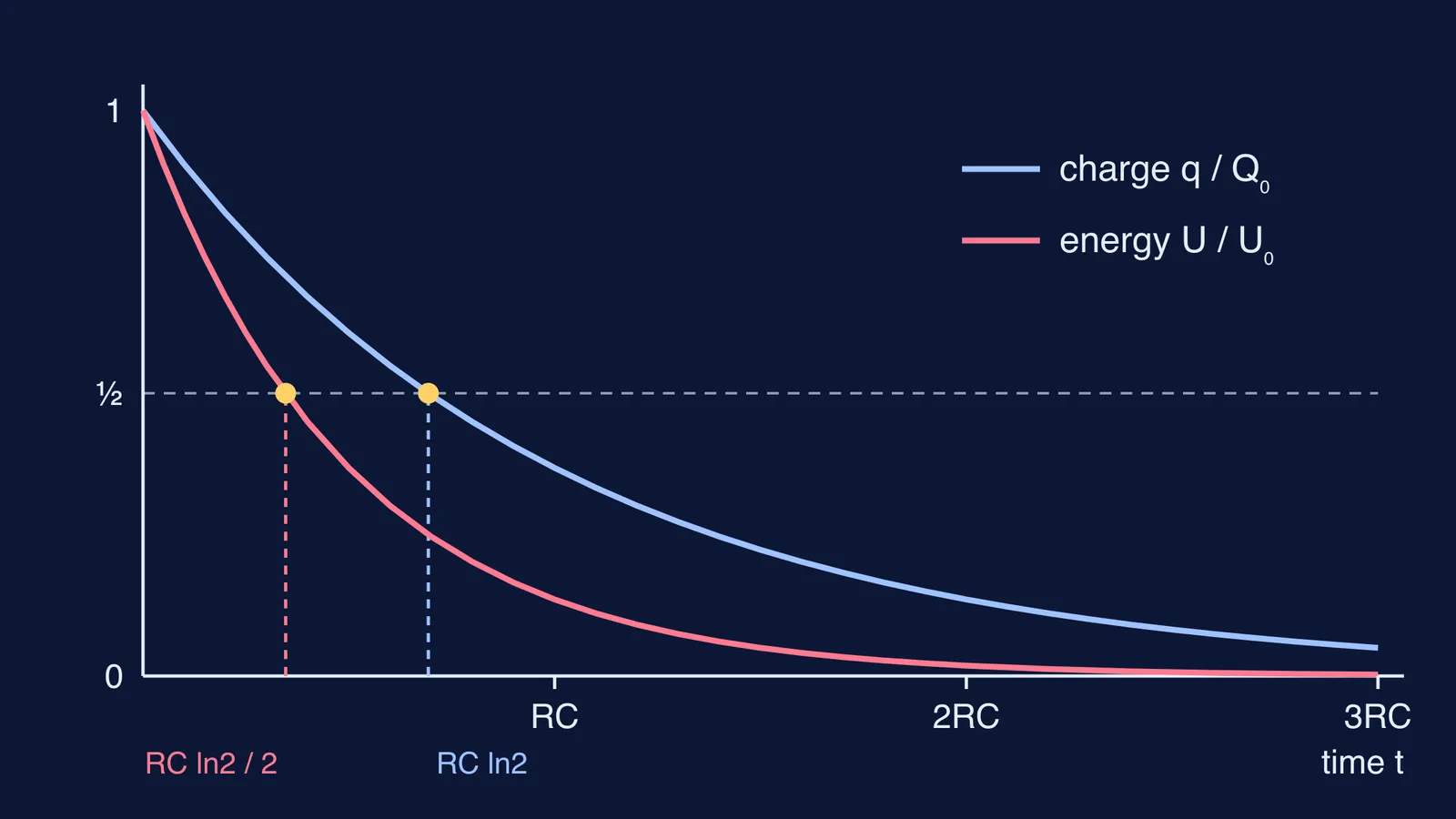
Setting q = Q₀/2 gives e^(−t/RC) = 1/2, so the charge half-life is t = RC ln2 ≈ 0.693RC. Voltage (V = q/C) and current both follow the same exponential, so they halve at that same moment too.
Why does the energy halve faster than the charge?
The energy stored in a capacitor is U = Q²/2C = CV²/2 = QV/2 (OpenStax University Physics Volume 2, section 8.3). The key point is the square.
Substitute the discharge equation:
U(t) = q²/2C = (Q₀²/2C) e^(−2t/RC) = U₀e^(−2t/RC).
Set U = U₀/2: e^(−2t/RC) = 1/2.
Take logs: 2t/RC = ln2, so t = (RC ln2)/2 ≈ 0.347RC.
Energy decays with an effective time constant of RC/2, so it falls twice as fast as the charge. When the charge has dropped to half, the energy is (1/2)² = 1/4 of its starting value, not 1/2. For the energy to be half, the charge only has to fall to 1/√2 ≈ 0.707 of Q₀.
Worked numerical: how long until the energy is half?
A 100 μF capacitor is charged to 12 V and then discharged through a 20 kΩ resistor. Find when the charge becomes half and when the stored energy becomes half. We use only the two textbook formulas above (OpenStax, energy stored).
Time constant: RC = (20 × 10³ Ω)(100 × 10⁻⁶ F) = 2.0 s.
Starting energy: U₀ = ½CV² = ½ × 100 × 10⁻⁶ × 12² = 7.2 mJ.
Charge half-life: t = RC ln2 = 2.0 × 0.693 = 1.39 s. The voltage is now 6 V, so U = ½ × 100 × 10⁻⁶ × 36 = 1.8 mJ. That is one quarter of 7.2 mJ, not half.
Energy half-time: t = (RC ln2)/2 = 0.69 s. The voltage is 12/√2 ≈ 8.49 V, so U = ½ × 100 × 10⁻⁶ × 72 = 3.6 mJ. That is exactly half.
So the energy halves at 0.69 s and the charge at 1.39 s, a factor of exactly two. The missing 3.6 mJ became heat in the 20 kΩ resistor.
If the same capacitor had two resistors in its path, find the equivalent resistance first; our walkthrough on the time constant of an RC circuit with two resistors shows how. A capacitor that leaks through its own dielectric follows the same exponential, as in our post on the leaky capacitor time constant RC = Kε₀ρ.
Which quantity halves at which time?
Charge, voltage and current all decay as e^(−t/RC) (OpenStax, RC circuits), and energy goes as their square. Copy this list into your notebook:
Charge q, voltage V, current I: halve at RC ln2 ≈ 0.69RC.
Stored energy U, power I²R in the resistor: halve at (RC ln2)/2 ≈ 0.35RC.
Energy down to one quarter: RC ln2, the same moment the charge halves.
Energy down to any fraction f: t = (RC/2) ln(1/f).
The same idea works for any exponential decay: if a quantity decays with constant λ, its square decays with 2λ. To practise reading decay constants off a graph, see how to find the decay constant from an ln N vs t graph.
How do you check your answer in 30 seconds?
These checks use U = CV²/2 (OpenStax, energy stored) and the fact that RC is in seconds (OpenStax, RC circuits).
Ask: does the quantity depend on q or on q²? Squared means divide the half-life by two.
Plug your time back in: at the energy half-time, V should be V₀/√2, about 71% of the start.
Check units: ohms times farads gives seconds.
Sanity check: energy must halve before the charge does, never after.
For more practice, the Fermi Problem Library has worked problems with a step-by-step solver that explains the reasoning rather than printing an answer, so you can see where the square enters. To revise exponential decay itself, the Fermi Concept Library gives each physics and mathematics concept its own lesson.
Try the numerical again with C = 50 μF and the same resistor: you should get 0.35 s for the energy and 0.69 s for the charge.