On this page
Charge a capacitor filled with glass or mica, disconnect the battery, and the charge slowly drains away through the dielectric itself, because real insulators carry a tiny current. The neat part: the time this takes does not depend on the plates' size, spacing or shape. Here is the proof and a numerical you can check with a calculator.
What is a leaky capacitor?
A leaky capacitor is one whose dielectric has a very large but finite resistivity ρ, so the same two plates behave like a capacitor C and a resistor R connected in parallel.
Resistance follows R = ρL/A, and glass has a resistivity between 10⁹ and 10¹⁴ Ω m at 20 °C, according to Table 9.1 of OpenStax University Physics Volume 2. Huge, but not infinite.
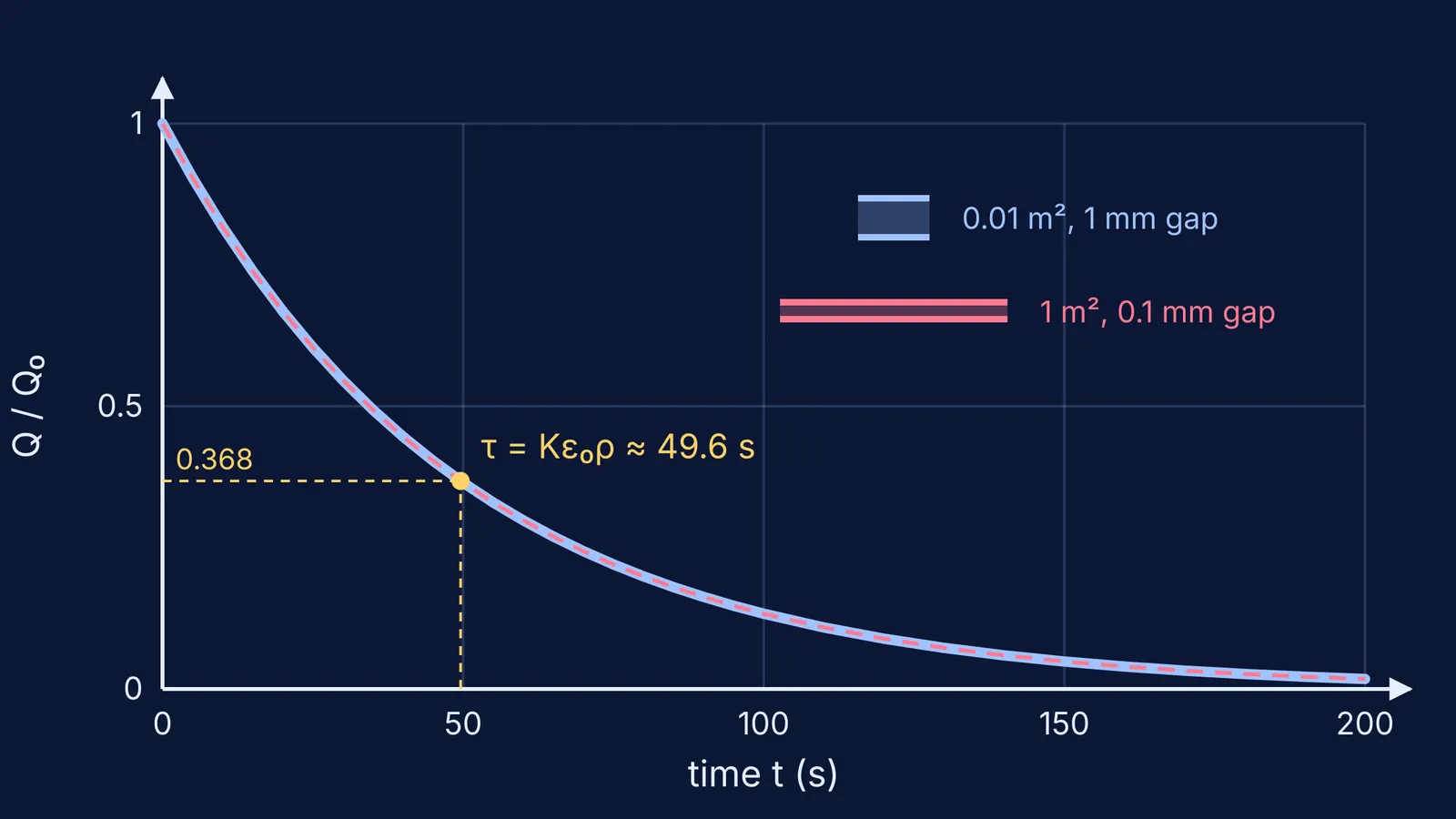
Once the battery is removed, the capacitor discharges through that built-in resistor. Its charge follows q(t) = Q e^(−t/τ) with time constant τ = RC, exactly as in an ordinary RC discharge (OpenStax, section 10.5). After one time constant, about 36.8% of the charge is left.
Why does RC equal Kε₀ρ for parallel plates?
Take plates of area A and gap d, with the gap completely filled by a material of dielectric constant K and resistivity ρ.
Capacitance: a dielectric multiplies the vacuum capacitance by K (OpenStax, section 8.4), so C = Kε₀A/d.
Resistance: leakage current flows across the gap, so the length is d and the cross-section is A, giving R = ρd/A.
Product: RC = (ρd/A)(Kε₀A/d) = Kε₀ρ.
The area and the gap cancel. The vacuum permittivity is ε₀ = 8.854 × 10⁻¹² F/m, the CODATA 2022 value published by NIST. A quick unit check: (F/m) × (Ω m) = F Ω = seconds. If you want a refresher on what K measures, read our explainer on what the dielectric constant means.
Does RC = Kε₀ρ work for any plate shape?
Yes, as long as one uniform material fills the whole space between the two conductors. Here is a proof that never mentions shape.
Give the inner conductor charge +Q and draw a closed surface S just around it, inside the dielectric. Gauss's law in the dielectric gives ∮E·dA = Q/(Kε₀).
Ohm's law in local form is J = σE, with σ = 1/ρ (OpenStax, section 9.3). The current leaving through S is I = ∮J·dA = (1/ρ)∮E·dA = Q/(Kε₀ρ).
That current drains the conductor: dQ/dt = −Q/(Kε₀ρ). So Q = Q₀e^(−t/Kε₀ρ) and τ = Kε₀ρ.
With R = V/I and C = Q/V, RC = Q/I = Kε₀ρ.
Check it on a spherical capacitor with radii a and b: C = 4πKε₀ab/(b − a) and R = ρ(b − a)/(4πab), so the product is again Kε₀ρ. Our post on spherical and cylindrical capacitors derives C for those shapes.
How long does a leaky glass capacitor take to discharge?
For the material, take K = 5.6, the value OpenStax lists for Pyrex glass in Table 8.1, and ρ = 1.0 × 10¹² Ω m, inside the 10⁹ to 10¹⁴ Ω m range for glass in OpenStax Table 9.1. Real glass varies a lot, so treat this as a representative value.
Capacitor 1 has 0.01 m² plates and a 1 mm gap:
C = 5.6 × 8.854 × 10⁻¹² × 0.01/0.001 = 4.96 × 10⁻¹⁰ F (about 496 pF)
R = 10¹² × 0.001/0.01 = 1.0 × 10¹¹ Ω
RC = 49.6 s
Capacitor 2 has 1 m² plates and a 0.1 mm gap, so A/d is 1000 times larger:
C = 4.96 × 10⁻⁷ F, 1000 times larger
R = 1.0 × 10⁸ Ω, 1000 times smaller
RC = 49.6 s, unchanged
The shortcut gives the same answer in one line: Kε₀ρ = 5.6 × 8.854 × 10⁻¹² × 10¹² ≈ 49.6 s. From there:
Half the charge is gone at t = τ ln 2 ≈ 34 s.
Only 10% is left at t = τ ln 10 ≈ 114 s.
Stored energy goes as Q², so it decays with time constant τ/2 ≈ 24.8 s.
A bigger capacitor stores more charge, but it also gives that charge a wider, shorter path to leak through. The two effects cancel exactly.
What mistakes cost marks on leaky capacitor problems?
Using the plate's side length in R. Current runs across the gap, so L = d.
Dropping K. The permittivity of the filling is Kε₀, not ε₀.
Applying the shortcut to a partly filled or two-layer gap. Then no single material fills the space, so model each layer as its own R and C in parallel, then put the layers in series.
Mixing up ρ and σ = 1/ρ, or using Ω cm where the formula needs Ω m.
If a step in your own working stalls, the Fermi Problem Library has worked problems with a step-by-step solver that explains the reasoning rather than printing an answer. To revise Gauss's law or resistivity first, each has its own lesson in the Fermi Concept Library.
Next, see how the same exponential appears when you charge a capacitor through a resistor.