On this page
Chapter 8 of NCERT's Exploring Society: India and Beyond, Part II (book code hees2, First Edition June 2026) covers five centuries of music, painting, language, learning, food and clothing. This guide gives you one way to hold its many names together, a worked example and practice questions.
CBSE publishes no separate 2026-27 curriculum for Classes 6 to 8; these classes follow the NCERT book, and this chapter is assessed by the school. We give no marks or exam pattern here.
What is Cultural Currents: 13th to 17th Centuries about?
The chapter asks how Indian culture kept growing between the 13th and 17th centuries, a time the book describes as politically unstable. Its answer rests on three patterns it names early on:
Continuity: communities kept up their traditional practices.
Patronage: rulers of many backgrounds supported art, languages, literature and philosophy.
Participation: people from every section of society took part.
The book also says Indian culture "adopted or adapted" outside influences. Adopting means taking something in as it is; adapting means reshaping it to local taste.
Which topics does the chapter cover?
The chapter moves through these themes:
Belief systems: the bhakti tradition (Kabir, Ravidas, Guru Nanak, Mirabai, Chaitanya Mahaprabhu, Tukaram, Purandaradasa and others) and Sufism (Khwaja Moinuddin Chishti, Nizamuddin Auliya).
Music: two streams, Hindustani (North) and Carnatic (South); dhrupad under Raja Mansingh Tomar of Gwalior; Tansen at Akbar's court; Amir Khusrau and the qawwali.
Painting and gardens: Rajput and Mughal miniatures borrowing from each other; the four-part Persian charbagh garden.
Women in society: changes that differed by region, and royal women such as Razia Sultan and Nur Jahan who took part in public life.
Education and knowledge: gurukulas, mathas, temple schools, madrasas and apprenticeships; the Kerala School's work on infinite series; Sanskrit-Persian translation, including Dara Shikoh's 52 Upanishads.
Literature, architecture and daily life: regional languages, Urdu and Dakhini, temple rebuilding at Srirangam, and food and clothing.
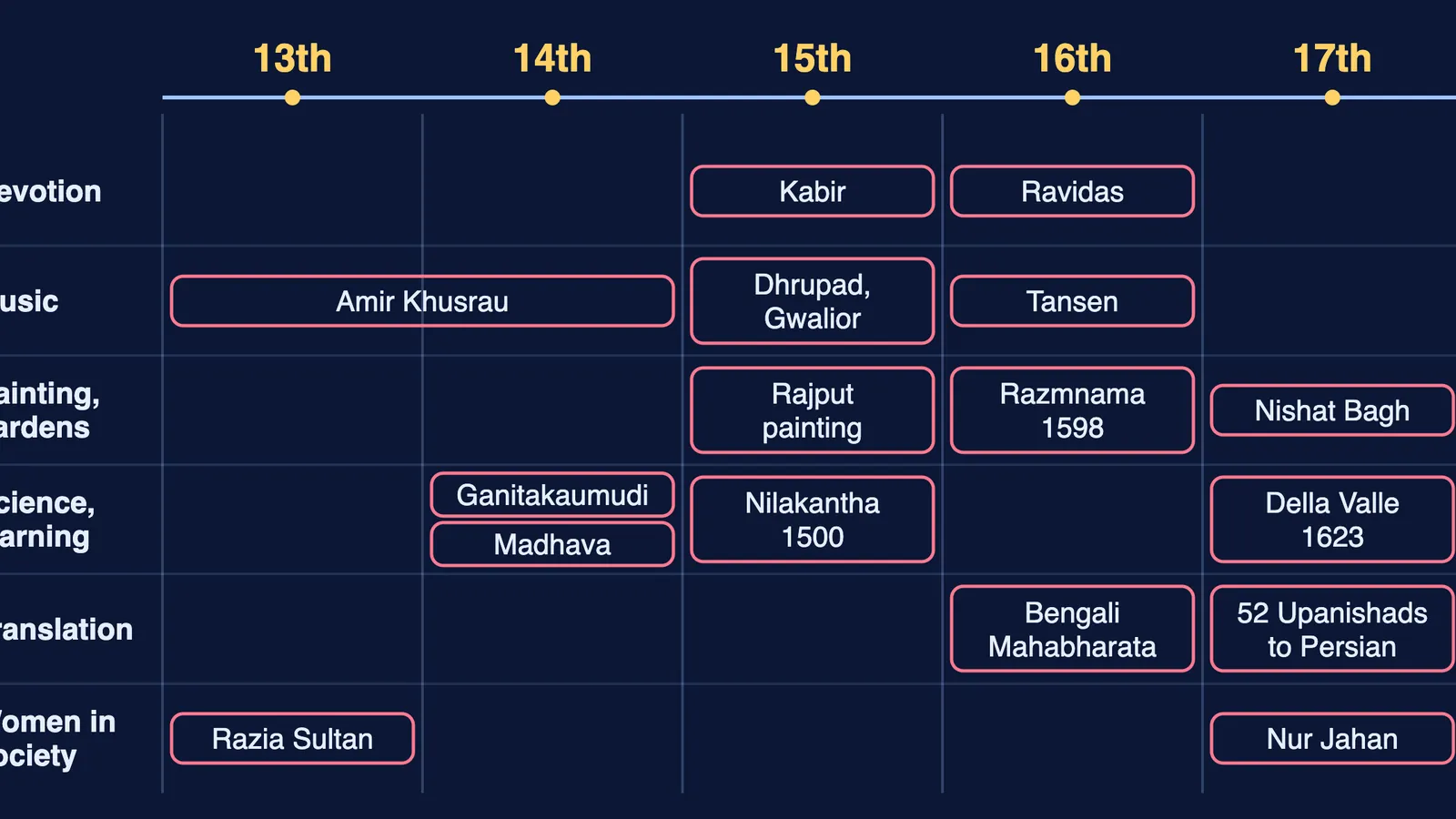
The timeline at the top places some of these names by century.
How do you use the adopt-or-adapt test? A worked example
When a question asks how cultures mingled, run any example through three questions: where did it come from, what changed, and what stayed? Here it is on four cases from the chapter.
Samosa. Came from: sambuseh, a Persian dish brought to the Delhi Sultanate courts by West Asian chefs. Changed: a filling of meat and nuts became potatoes and peas. Verdict: adapted.
Jalebi. Came from: the Persian zalabiyeh. Changed: uneven floral coils became round ones, and honey with rose water gave way to plain sugar syrup. Verdict: adapted.
Tansen's music. Stayed: compositions praising Krishna and Shiva. Added: the influence of a Sufi saint of his time, as the book reports it. Verdict: enriched while keeping its core.
Banarasi silk. Came from: weavers who moved from Gujarat to Banaras with Akbar's encouragement; zari and brocade introduced by the Mughals. Stayed: the old apprenticeship system that still trains weavers. Verdict: new materials, old way of teaching.
Each case also shows a pattern: the weavers show continuity, the Mughal court shows patronage, and spices reaching ordinary kitchens show participation. Linking an example to a pattern turns a list of facts into an answer.
How does Chapter 8 connect to the rest of the book?
The Letter to the Student explains that Chapter 8 belongs to the theme Our Cultural Heritage and Knowledge Traditions and sits at the end because NCERT plans to move it into Part I later.
It builds on Chapter 2 of Part I, 'Reshaping of India's Political Map', which covers the political events of these centuries.
It points back to Chapter 3 of this book, 'A Journey Through Indian Architecture', for building styles.
It refers to the Grade 7 chapter 'Turning Tides: 11th and 12th Centuries' for the destruction of Nalanda and Vikramashila.
If you studied from the older books, our guides to Bhakti and Sufi traditions for Class 7 and the making of regional cultures in Class 7 cover overlapping ground.
Practice questions
Marks are our suggestion; your school sets its own pattern.
Name the two streams of Indian classical music and the region linked to each. (2 marks)
What is a charbagh garden? Name one garden from the chapter that follows Mughal design. (2 marks)
Explain, with one example, the difference between adopting and adapting a cultural influence. (3 marks)
A family of weavers in Banaras trains its children at home. Using the chapter, explain how this kind of training links to the pattern of continuity. (3 marks)
Choose any two of continuity, patronage and participation. Show each one with an example from music, language or food. (5 marks)
Not sure which theme to revise first? Fermi's AI tutor works out what you already know and builds a plan for the session.