On this page
A two-wheel bowling machine has no arm and no wrist, yet it can send down a 140 km/h ball with backspin, or a slow ball that turns. It works on an idea from JEE mechanics: a cylinder squeezed between two moving planks, rolling without slipping. Two short formulas then give the wheel speeds for any delivery.
How does a two-wheel bowling machine throw a cricket ball?
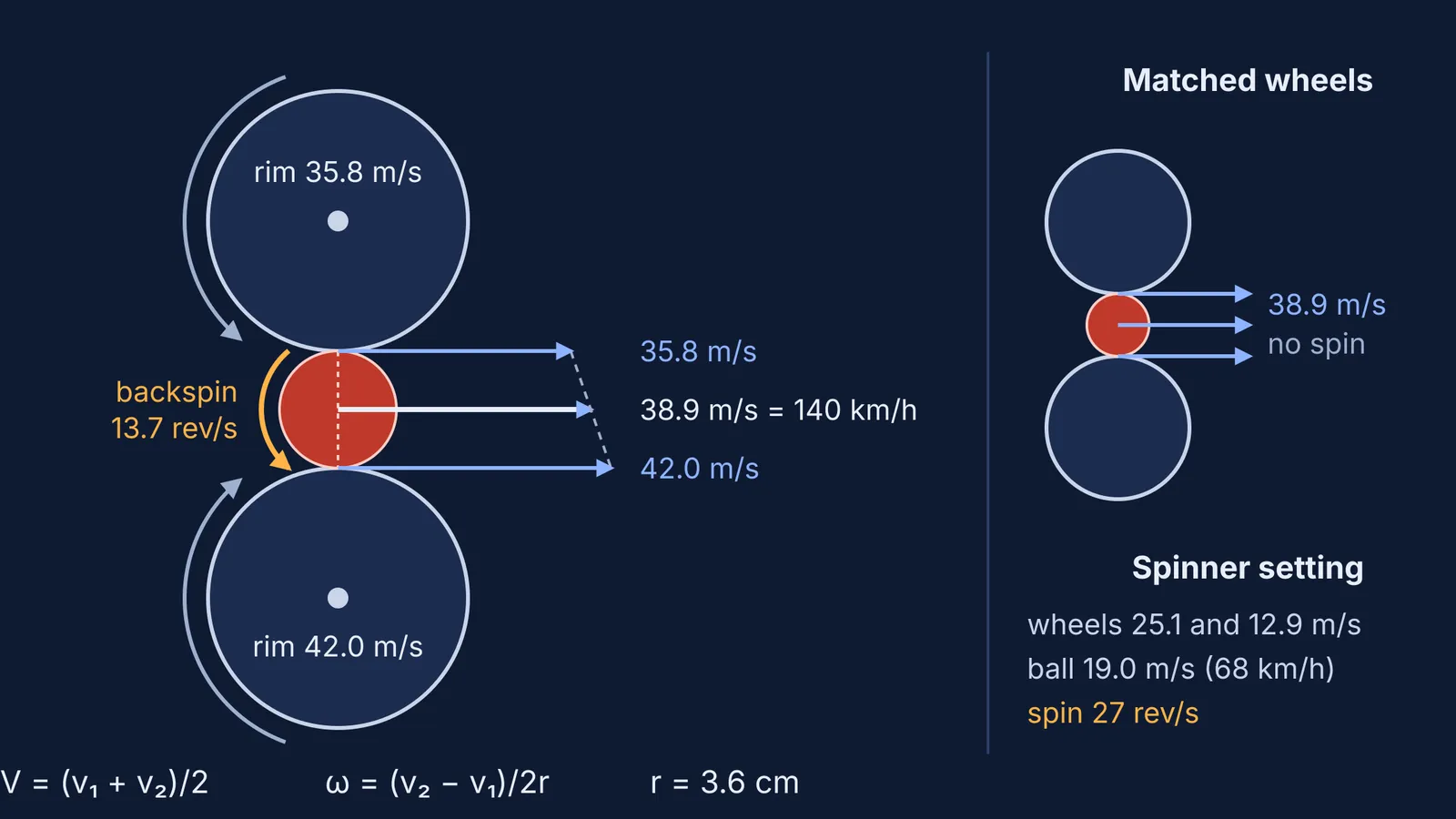
In the two-wheel design, two rubber-tyred wheels sit one above the other, each with its own motor, and the gap between them is a little smaller than the ball. The wheels turn in opposite senses, so where they touch the ball both rims move towards the batter.
A ball fed into the gap is gripped by both rims and pushed out. Equal rim speeds give a ball with no spin. If one rim is faster, the ball leaves spinning.
Why does the ball leave at the average of the two wheel speeds?
Treat the ball as a rigid sphere of radius r that does not slip on either rim. Each contact point then moves with the rim it touches:
the top of the ball moves forward at v₁, the rim speed of the upper wheel;
the bottom of the ball moves forward at v₂, the rim speed of the lower wheel.
For a rigid body, the velocity of any point is the velocity of the centre, V, plus ω × r. The top and bottom are a distance r above and below the centre, so:
top: v₁ = V − ωr
bottom: v₂ = V + ωr
Here ω is positive for backspin, when the bottom moves forward faster than the top. Add and subtract the two equations:
V = (v₁ + v₂)/2
ω = (v₂ − v₁)/2r
The velocity across the vertical diameter changes linearly from v₁ to v₂, with the centre halfway. This is the plank problem with the planks replaced by wheel rims. Note that the formula uses the radius, not the diameter. A men's cricket ball has a circumference of 22.4 to 22.9 cm under the ICC playing conditions for the ball, which gives r ≈ 3.6 cm.
How do you set the wheels for a 140 km/h ball with backspin?
Here is a fully worked example. For the wheel itself, take a radius of 0.20 m. This is an illustrative round value; manufacturers rarely publish wheel sizes.
Convert the target speed. 140 km/h ÷ 3.6 = 38.9 m/s.
Matched wheels first. For no spin, both rims run at 38.9 m/s. The wheel's angular speed is v/R = 38.9 ÷ 0.20 = 194 rad/s. Multiply by 60/2π to get 1,857 rpm.
Now split the speeds. Set the upper rim to 35.8 m/s and the lower rim to 42.0 m/s. The centre speed is (35.8 + 42.0)/2 = 38.9 m/s, so the ball still leaves at 140 km/h.
Find the spin. ω = (42.0 − 35.8)/(2 × 0.036) = 6.2 ÷ 0.072 = 86 rad/s. Divide by 2π: 13.7 rev/s, or about 822 rpm.
Find the direction. The bottom of the ball moves faster than the top, so the ball turns backwards relative to its flight: backspin, the spin a seam bowler puts on the ball. Swap the two speeds and you get the same 140 km/h with topspin.
Check units. ω = Δv/2r has units (m/s)/m = 1/s, which is rad/s. Good.
Why a seam bowler wants backspin on a seam-up ball, and what it does in the air, is explained in why a cricket ball has a raised seam. The machine simply reproduces it.
Can a bowling machine copy a spin bowler?
It can get close on speed and spin rate. In a lab study, Beach, Ferdinands and Sinclair (2012) measured club and state spin bowlers releasing the ball at 16.9 to 20.1 m/s with spin rates from about 16 to 29 rev/s. Their higher-level bowlers all reached about 27 rev/s or more.
Take 19.0 m/s (68 km/h) and 27 rev/s as the target:
ω = 2π × 27 = 170 rad/s.
The rim speed difference is 2rω = 2 × 0.036 × 170 = 12.2 m/s.
The rims must average 19.0 m/s, so they run at 19.0 + 6.1 = 25.1 m/s and 19.0 − 6.1 = 12.9 m/s.
One wheel runs almost twice as fast as the other. A real spinner's spin axis is also tilted, giving a mix of sidespin and topspin, so machines tilt or rotate the wheel head to turn the axis. How that spin then drifts in the air and grips off the pitch is the subject of how spin bowlers make the ball turn.
Why are bowling machine wheels so heavy?
Each delivery takes energy from the wheels. A 0.16 kg ball at 38.9 m/s carries ½mv² = ½ × 0.16 × 38.9² = 121 J of translational energy. Its spin energy is small: treating the ball as a uniform sphere (an approximation, since a real ball has a cork core and leather case), ½Iω² with I = (2/5)mr² comes to about 0.3 J at 86 rad/s.
Now take two solid disc wheels of 5 kg each (an illustrative value) with R = 0.20 m:
I = ½MR² = ½ × 5 × 0.20² = 0.10 kg m².
At 194 rad/s, each stores ½Iω² = ½ × 0.10 × 194² ≈ 1,890 J.
Together they hold about 3,780 J, so one ball takes 121 ÷ 3,780 = 3.2% of it.
Kinetic energy goes as ω², so the wheel speed drops by only about 1.6%, and the motors restore it before the next ball.
A light wheel would lose much more speed per ball, so consecutive deliveries would differ. Heavy wheels act as flywheels and make the machine repeatable: a batter can face the same delivery again and again, inside the reaction window worked out in how much time a batter gets against a 150 km/h ball.
What does the simple model leave out?
The formulas above give the ideal result. Real machines differ in a few ways:
The ball squashes and can slip on the rubber, so the exit speed is usually somewhat below the mean rim speed. Machines are calibrated with a speed gun.
Single-wheel and air-cannon machines work differently.
A real ball is not a uniform sphere, so the spin energy is only an estimate.
Machines are run by a coach, and nobody should stand in front of one while it is being loaded.
If you want to practise the plank-and-cylinder problems this machine is built on, the Fermi Problem Library has a step-by-step solver that explains the reasoning at each step.
Quick checklist
No slip at each rim: top moves at v₁, bottom at v₂.
Exit speed V = (v₁ + v₂)/2; spin ω = (v₂ − v₁)/2r with r ≈ 3.6 cm.
Faster lower wheel gives backspin; faster upper wheel gives topspin.
140 km/h with 13.7 rev/s backspin: rims at 42.0 and 35.8 m/s.
68 km/h with 27 rev/s: rims at 25.1 and 12.9 m/s.
Heavy wheels store about 30 times the ball's energy, so speed barely changes between balls.
Real balls slip and squash, so treat the result as the ideal limit.